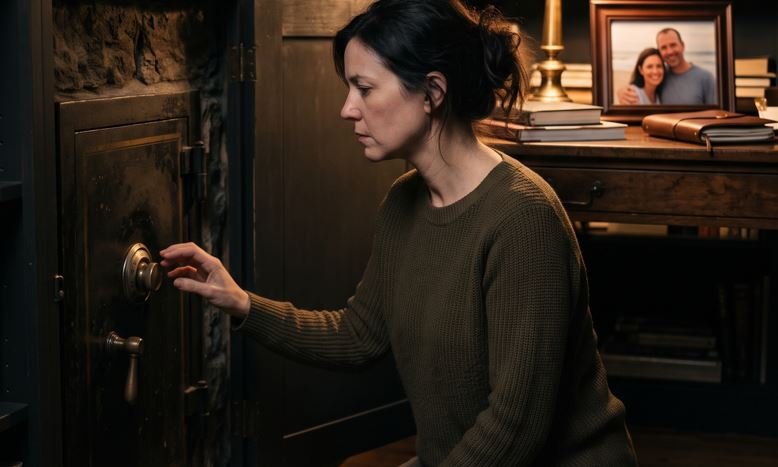
Margaret Ellison had known about the safe for as long as she’d known Daniel — a heavy, old-fashioned wall unit hidden behind a swinging bookshelf in his home office, installed years before they’d even met, back when the house still belonged to his late father. What she hadn’t known, until the week they got married, was the one rule that came attached to it.
“Promise me something,” Daniel had said, the night before their wedding, sitting on the edge of their soon-to-be-shared bed with an unusual seriousness in his voice. “Whatever’s in that safe — you don’t open it until I’m gone. Not out of curiosity, not if we fight, not for any reason. After I die, it’s yours. Until then, I need you to trust me on this one thing.”
Margaret had laughed, at the time, assuming it was some sentimental holdover from his father — old family documents, maybe, or something private about the business he didn’t want cluttering their new life together. She’d promised easily, the way you promise something you don’t expect to ever actually have to keep. Twenty-six years of marriage had passed since that night, and in all that time, she’d never once asked about the safe again, and Daniel had never once brought it up, the subject settling into the comfortable background static of a long marriage — one of a hundred small agreements a couple makes and simply stops examining.
Daniel died in March, quietly, in his sleep, three months after a heart condition he’d downplayed to everyone, including Margaret, finally caught up with him. The funeral was small and warm, exactly as he’d have wanted it, and for the three weeks that followed, Margaret moved through her house in the particular fog of early widowhood — unable to sleep in their bedroom some nights, unable to throw away his reading glasses still sitting on the nightstand, unable, for a long while, to even walk into his office at all.
It was her sister, gently, who finally asked the question Margaret had been avoiding. “Do you know what’s in that safe he always kept locked?”
Margaret realized, standing in the doorway of Daniel’s office three weeks after the funeral, that she genuinely didn’t. Twenty-six years, and she had no idea what she was about to find.
The bookshelf swung open easily, the way it always had when Daniel occasionally retrieved documents for taxes or insurance, though Margaret had never once seen what lay past the shelf behind it. The safe’s dial was cool under her fingers. She remembered the combination without having to think about it — his birthday, then their anniversary, numbers he’d once told her to memorize “just in case,” though she’d never asked in case of what.
“Okay, Daniel,” she whispered to the empty room, her hand trembling slightly on the dial. “Let’s see what you didn’t want me to see.”
The door clicked open.
Inside, stacked neatly, was not the pile of legal paperwork she’d half-expected, but a bundle of envelopes tied together with string — dozens of them, each labeled with a date in Daniel’s familiar handwriting, the earliest dated nearly seventeen years back, the most recent just six months before he’d passed.
Margaret’s hands shook as she untied the string and lifted the most recent envelope from the top. The handwriting on the front wasn’t addressed to her. It was addressed to an address she didn’t recognize at all — a street in a town two hours away that she’d never once heard Daniel mention in twenty-six years of marriage.
“Wait,” she said aloud, her voice breaking. “This isn’t our house.”
For a long moment she sat frozen on the office floor, envelope in hand, torn between the urge to open it immediately and a sudden, sharp fear of what she might find — an affair, a second family, some entire hidden life Daniel had somehow maintained for seventeen years without her ever suspecting a thing.
She opened it anyway.
Inside was a single handwritten letter, dated the previous September, addressed not to a lover or a secret family, but to someone named Theo.
Theo, it read. Eighteen years old today. I still don’t know if I’ve made the right choice keeping this distance, but I made a promise a long time ago to your mother, and I’ve kept it, even when it cost me more than anyone will ever know. I hope, wherever you end up, that the money has helped. I hope you never have to know the reasons behind any of this. Happy birthday. — D.
Margaret sat with the letter in her lap for a long time before reaching for the next envelope, then the next, working backward through seventeen years of nearly identical letters — birthday after birthday, addressed to the same name, Theo, each one referencing a “promise” made to someone called “your mother,” each one accompanied by a torn deposit slip from an account Margaret had never known existed.
It took her three more days, and a visit to Daniel’s longtime attorney, to piece together the full picture — a story Daniel had apparently intended to explain fully only after his death, through a secondary, sealed letter addressed directly to Margaret that had been sitting at the bottom of the safe the entire time, beneath all the others.
Margaret, it read. If you’re reading this, I’m gone, and I need you to understand something I should have told you the day we met, but couldn’t find the courage to. Before you and I ever met, I had a brief relationship with a woman named Carol, back when I was twenty-four. She got pregnant, and chose to raise the child on her own, with support from me but without me in the picture — her decision, not mine, made because she was about to marry someone else and didn’t want the complication of a second father in her son’s life. I agreed to send support quietly every year, and to stay out of his life entirely unless he ever came looking, which he never did. Carol passed away eleven years ago. I kept sending the money to a trust for Theo anyway, and kept writing him letters he’s never read, because it felt like the only honest thing I could still do for a son I never got to know. I didn’t tell you, at first, because I was ashamed, and later, because it felt like there was never a right moment that wouldn’t upend everything between us. I’m sorry for the secrecy. I’m not sorry for the money, or the letters, or the years of showing up quietly for a boy who never knew my name. I hope you can understand, even if you can’t forgive the silence.
Margaret read the letter four times before she could fully absorb it. There was grief in it — a fresh, disorienting kind, mourning not just her husband but the shape of a marriage she’d believed she understood completely. But underneath the shock, she found something she hadn’t expected: relief. Whatever this was, it wasn’t the affair she’d braced herself for reading those first unfamiliar letters. It was, in its strange, quiet way, a kind of integrity Daniel had carried alone for seventeen years rather than burden her with, right or wrong as that choice had been.
Margaret tracked down Theo three weeks later, a young man of eighteen living two hours away, working part-time and finishing his first year of community college, entirely unaware that the quiet trust deposits he’d grown up receiving had a name and a face behind them until Margaret arrived at his door with a box of seventeen years of unopened letters.
He read them all in one sitting, in Margaret’s presence, at her kitchen table, tears running steadily down his face by the third envelope. “He never wanted to meet me?” he asked quietly, when he finished.
“I think he was afraid to,” Margaret said honestly. “I think he thought showing up would only complicate something that felt safer to him from a distance. I don’t think it was about not wanting you. I think it was about not trusting himself to do right by wanting you.”
It wasn’t a clean resolution. Grief rarely allows for one. But Theo kept the letters, and started, tentatively, visiting Margaret every few months, the two of them slowly building something neither had expected — not quite family, not quite strangers, but something in between, held together by seventeen years of birthday letters that had finally, after all that silence, found the person they were written for.
THE END