Emma had never been more terrified of a flight. Not because of turbulence, but because Flight 407 from Dallas to Seattle was taking her to her mother’s funeral. Ten years. Ten years of silence, stubborn pride, and unanswered calls. Now it was too late.
She boarded the plane with puffy eyes and a swollen heart. Her seat was 14A, next to an older man in a rumpled tweed jacket—Henry, according to his boarding pass. He looked kind, with gentle eyes and silver-streaked hair. He smiled at her as she collapsed into the seat.
“Rough day?” he asked softly.
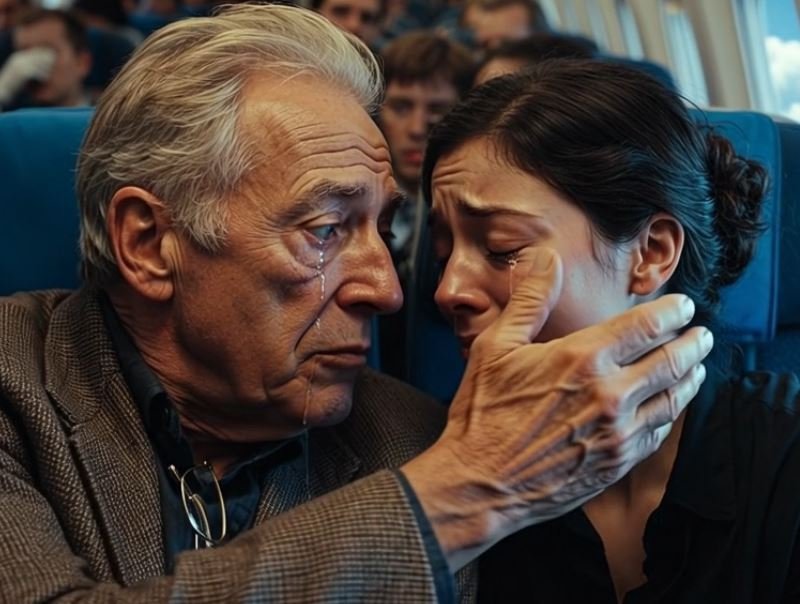
Emma tried to speak but burst into tears instead. Henry didn’t flinch. He quietly offered her his handkerchief—an old-fashioned white one, neatly folded. He didn’t push her to talk. He just sat there, a quiet anchor in the storm.
Halfway through the flight, the captain announced smooth sailing ahead. Emma finally broke her silence.
“I’m flying to my mother’s funeral,” she whispered. “I haven’t spoken to her in ten years. I was so angry. I thought we had time. But we never have time.”
Henry listened intently. His jaw tightened. “I understand,” he said, his voice thick. “I lost my sister fifty years ago. She ran away from home at eighteen. I’ve been looking for her ever since. I never found her. I don’t even know if she’s alive.”
Emma felt a strange pull. She reached into her wallet and pulled out a faded photograph—the only picture she had of her mother from when she was young. “This is my mom,” she said, handing it to him. “She was eighteen in this photo. Just before she left home.”
Henry took the photograph. His hands began to shake. His face drained of color. He stared at the image for a long, breathless moment. Then he looked up at Emma, tears streaming down his weathered cheeks.
“Where did you get this?” he whispered.
“It was in her old locket,” Emma replied, confused.
Henry’s voice cracked. “That’s my sister. That’s Sarah. That’s… that’s your mother?”
The world stopped.
Emma’s mouth fell open. The flight attendant passing by froze. The passenger across the aisle leaned over, trying to see what was happening. Emma grabbed Henry’s arm, her fingers digging into his jacket.
“You’re my uncle?” she choked out. “She never told me she had a brother! She said she was an only child!”
Henry was sobbing now. “She ran away because our father was cruel. She swore she’d never come back. She changed her name. She erased us. But I never stopped searching. I have a file—thick as a phone book—with every lead, every dead end. I was on this flight to visit a woman in Seattle who I thought might be her. But she was on this flight the whole time—in my own niece.”
The cabin was silent except for their sobs. Other passengers wiped their eyes. A young mother comforted her child. A businessman offered tissues. The flight attendant knelt beside them, holding Emma’s hand.
Emma pulled out a letter from her bag—the final letter her mother had written, never sent. “She wrote this before she died,” Emma cried. “She said she regretted everything. She said she wished she had found the courage to tell me the truth about her family.”
Henry took the letter with trembling hands. He read the first line aloud: “My dearest daughter, if you’re reading this, I hope you know I loved you more than the stars. And I hope… I hope somewhere out there, my brother Henry found the peace I never gave him.”
Henry clutched the letter to his chest. “She remembered me. After all these years, she remembered.”
As the plane began its descent into Seattle, Henry took Emma’s hand. “I may have lost my sister,” he whispered, “but I found my family. We have a lifetime to catch up. And I’m not letting you go, sweetheart. Not ever.”
Emma hugged him so tightly that the entire plane applauded. A stranger’s act of kindness turned into a reunion fifty years in the making.
Today, Henry lives three blocks from Emma and her daughter. He never misses a family dinner. And the folded photograph is framed in both their homes—a reminder that some journeys are never too late, and some strangers are just family you haven’t met yet.