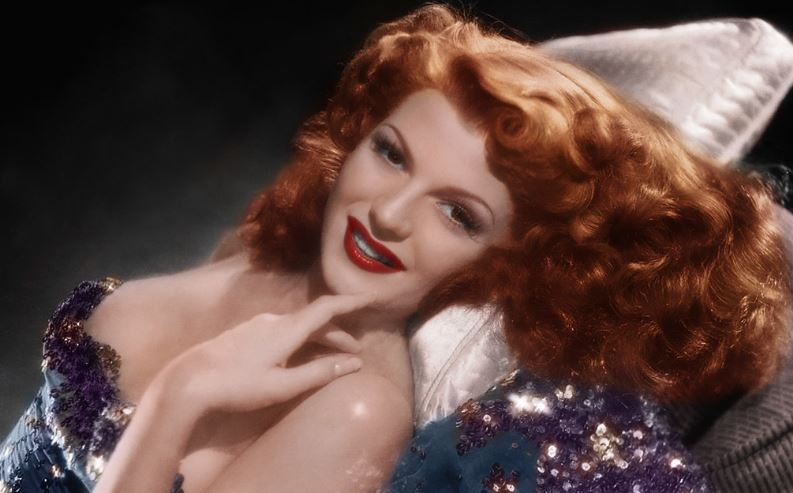
She was called “The Love Goddess” – and every man in America agreed.
Rita Hayworth, born Margarita Carmen Cansino on October 17, 1918 in Brooklyn, New York, was not just a movie star. She was THE star of the 1940s.
From Margarita to Love Goddess
Her story started in struggle. Daughter of Spanish dancer Eduardo Cansino, she started dancing in Mexico with her father as a child to support her family. She was shy, quiet, and painfully insecure.

She made her major film debut in Only Angels Have Wings (1939) with Cary Grant. But Columbia Pictures boss Harry Cohn saw something else. He changed her name from Margarita Cansino, dyed her black hair red, and raised her hairline with electrolysis to create “Rita Hayworth.”
The transformation was brutal, but it worked.
The Pin-Up That Stopped a War
In 1941, she starred with Fred Astaire in You’ll Never Get Rich and You Were Never Lovelier (1942), and with Gene Kelly in Cover Girl (1944). Although her singing voice was dubbed, she was one of Hollywood’s best dancers ever – powerful and precise.
Then came the photo.
A 1944 LIFE magazine photo of Rita kneeling on a bed in a nightgown became THE pin-up of World War II. It was pasted inside the lockers of hundreds of thousands of American GIs. The press officially crowned her “The Love Goddess.” She also graced the cover of TIME.
Gilda (1946) – The Role That Made Her Immortal
Directed by Charles Vidor and co-starring Glenn Ford, Gilda was a black-and-white film noir that had trouble with censors because it was so sensual.
One scene – where she slowly peels off a long black glove while singing “Put the Blame on Mame” – made her the ultimate femme fatale and became the biggest hit in Columbia Pictures history.
She once said: “Every man I’ve known has fallen in love with Gilda and woken up with me.”
Her other classics include The Lady from Shanghai (1948) directed by her then-husband Orson Welles, and Pal Joey (1957).

She made 61 films over 37 years.
The Heartbreaking End
Her private life was as dramatic as her films – 5 marriages including to genius Orson Welles, singer Dick Haymes, and Prince Aly Khan, making her a real princess.
But tragedy came early. Beginning in 1960 at just 42, she started forgetting lines. It was early-onset Alzheimer’s disease, though it wasn’t diagnosed until 1980. For 20 years she suffered, cared for by her daughter Princess Yasmin Aga Khan, until her death on May 14, 1987, at age 68.
Her daughter’s work after her death made Alzheimer’s research famous worldwide.
Final Thought: Rita Hayworth gave the world love during a war, but she spent her life looking for it herself.