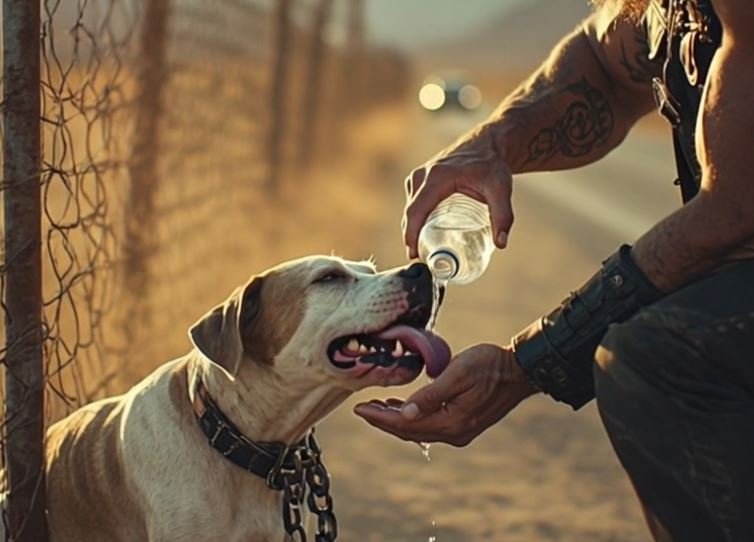
My name is Mason “Bear” Callahan, and I have ridden through the American Southwest more times than I can count. I have seen the desert in every season. I have watched the sun turn the sand red at dawn and purple at dusk. I have broken down in ghost towns, run out of water in the Mojave, and sat beside the road while vultures circled overhead. But I have never seen anything as cruel as what I found on Route 66, forty miles east of Kingman, Arizona.
It was June. The temperature was 108 degrees. The Iron Mercy Riders were on a cross-country charity run, delivering medical supplies to rural clinics in Arizona and New Mexico. Six bikes. Six people who had learned long ago that the desert does not forgive mistakes. We carried extra water, extra fuel, and a satellite phone because cell service was a fantasy out there.
We were riding single file, the heat rising from the asphalt in shimmering waves, when Luis hit his horn twice. The signal for stop. Now.
I looked ahead. The road stretched straight and empty, bordered by fence line that ran parallel to the highway for miles. The fence was old, rusted, the kind of boundary that had been there since before the interstate was built. And against one of the posts, maybe fifty yards off the road, there was a shape.
White. Motionless. Small.
“Trash?” Eddie said.
“Too big for trash,” Luis said.
I pulled off the road. The gravel was loose, and my boots sank into the dust as I walked toward the fence. The heat was crushing, a physical weight that made every step feel like walking through water. I could feel the sun on my neck, my arms, my back. I could taste the dust.
Then I saw her.
A pit bull mix. White and tan, her fur bleached almost colorless by the sun. She was lying on her side, pressed against the fence post, her body limp, her eyes closed. Around her neck was a chain. Not a collar. A chain. Heavy, rusted, wrapped around the post and padlocked. The chain was short enough that she could not lie flat. She could not reach the shade. She could not reach the empty, cracked water bowl that sat three feet away, just beyond the chain’s reach.
Her tongue was out, swollen and dry. Her ribs showed through her fur. Her paws were cracked and bleeding from the hot ground.
I ran.
I ran across the desert gravel, my boots kicking up dust, my heart hammering against my ribs. I fell to my knees beside her and I touched her neck. The skin was hot. Too hot. But beneath it, I felt a pulse. Weak. Slow. But there.
“She’s alive!” I shouted.
The other bikers were already moving. Eddie was pulling water bottles from his saddlebag. Darlene was grabbing her medical kit. Luis was on the satellite phone, trying to reach emergency services. Caleb and Wrench were running back to the bikes for more water, for shade tarps, for anything.
I looked at the chain. It was rusted solid, the padlock corroded by years of desert heat. I pulled at it. It didn’t move. I yanked harder. The post creaked, but the chain held.
“Give me the bolt cutters!” I yelled.
Wrench ran back with the heavy cutters we carried for fence repairs on charity runs. I positioned the blades around the chain, just above the padlock, and I squeezed with everything I had. The metal groaned. The rust fought back. I squeezed again, my arms shaking, my teeth grinding, and finally the chain snapped with a sound like a gunshot.
I threw the chain aside. It landed in the dust, heavy and useless, and I reached for the dog. She was light. So light. Maybe thirty pounds, when she should have been fifty. I lifted her and carried her to the shade of the bikes, where Eddie had already spread a tarp and was pouring water into a collapsible bowl.
I laid her down and I held the bowl to her mouth. She didn’t react at first. Her eyes were still closed, her breathing shallow and fast. I dipped my fingers in the water and touched her tongue. Once. Twice. Then I poured a small stream over her muzzle.
Her nose twitched.
Then her tongue moved. Slowly. Painfully. She licked the water from my fingers. Then she opened her eyes. They were brown. Dark brown. And they looked at me with confusion, with exhaustion, and with something that broke my heart.
Hope. Even after everything, there was still hope in her eyes.
“Drink, baby,” I whispered. “Drink.”
She lapped at the water. Weakly at first, then stronger. Eddie poured more. Darlene checked her vitals, her temperature, her hydration levels. She was severely dehydrated, heat-exhausted, and malnourished. But she was drinking. She was breathing. She was alive.
“Who did this?” Caleb asked, looking at the empty bowl, the chain, the isolation.
“Someone who knew nobody would find her,” I said.
The desert is a cruel place to abandon a dog. There are no neighbors to hear barking. No passersby to notice suffering. No rain to fill bowls. Just heat, dust, and silence. Whoever had chained her there had chosen the perfect place for her to die unnoticed.
But they didn’t count on six bikers with a satellite phone and a refusal to look away.
We called the Mohave County Sheriff’s Office. They dispatched a deputy and an animal control officer from Kingman, which was forty miles away. While we waited, we did everything we could. We poured water over her body to cool her. We gave her small sips of electrolyte solution. We shaded her with the tarp and our own bodies, sitting in the desert sun so she could rest in the cool space we made.
She drank three bottles of water. Then she looked at me, and she licked my hand. Her tongue was rough and dry, but the gesture was clear. Gratitude. Trust. The same thing River had done in the ditch. The same thing Ember had done in the barn. The same thing Haven had done in the snow.
I named her Sage. Because she had survived the desert. Because she was wise enough to still trust.
The deputy arrived two hours later. His name was Deputy Carlos Mendez, a thirty-year veteran with a face weathered by the same sun that had nearly killed Sage. He took one look at the chain, the empty bowl, the fence post, and he said, “I’ve seen this before. People think the desert will hide what they don’t want to face.”
He took our statements. He photographed the scene. He ran the fence line and found a property marker that led to an abandoned ranch three miles away. The owner, a man named Frank Hollis, had left the property six months before. He had left Sage behind.
Hollis was found two days later in Las Vegas, living in a motel. He claimed he had “forgotten” about the dog. The chain, the padlock, the empty bowl, the forty miles of desert — all forgotten. He was charged with animal cruelty. The case is still moving through the courts. I don’t know if it will end in justice. But I know it ended in survival for Sage.
We took her to a veterinary clinic in Kingman. Dr. Elena Vargas, a small woman with dark hair and hands that moved like a surgeon’s, treated Sage for three days. She administered IV fluids, treated the sunburn on Sage’s back, wrapped her cracked paws, and fed her small meals that grew larger as her stomach remembered how to hold food.
I stayed in Kingman. I slept in a motel room with Sage on a blanket beside the bed. I woke every two hours to give her water. I walked her in the cool of the morning, her paws wrapped in protective booties, her body leaning against my leg because she was still too weak to walk alone.
On the fourth day, she wagged her tail.
On the fifth, she barked at a bird.
On the sixth, she followed me to the motel parking lot and looked at my motorcycle with curiosity instead of fear.
On the seventh, Dr. Vargas cleared her for travel. I wrapped her in a blanket, secured her in my sidecar, and we rode home to Harrison, Arkansas. Six hundred miles. She slept most of the way, her head on my arm, her body rising and falling with the rhythm of the road.
Sage is four years old now. Her fur is white and thick, her body healthy and strong. She loves water — the irony of a desert dog — and she drinks from every bowl, every puddle, every raindrop with a reverence that breaks my heart. She sleeps in the shade of my porch, and when the sun is high, she moves to the coolest spot in the house. She never forgets the heat. But she no longer fears it.
She rides with me sometimes. Not in the sidecar — she prefers to be close. She sits behind me on the bike, her paws on my hips, her face in the wind. She loves the road. The open space. The freedom. The things that almost killed her have become the things that set her free.
The chain from the desert fence post sits in my garage. I keep it as a reminder. Not of cruelty. Of the moment I cut it. Of the sound it made when it broke. Of the weight of a dog in my arms when she realized she was no longer tied to anything.
The Iron Mercy Riders still ride through the desert. We still deliver supplies to rural clinics. But now we carry extra water. Extra bolt cutters. And a dog named Sage who reminds us that the emptiest places sometimes hold the most desperate souls.
Some people see the desert and they see nothing. They see heat and dust and death.
But we see the dog behind the fence post. We see the chain. We see the empty bowl. And we stop.
Because the desert may be vast.
But mercy is larger.