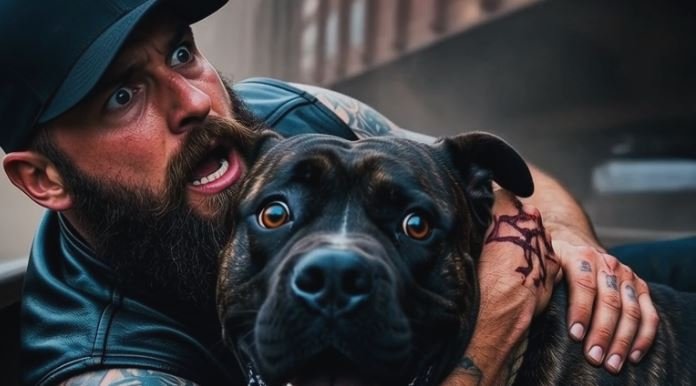
My name is Mason “Bear” Callahan, and I have been called many things in my sixty-one years. Biker. Veteran. Fool. But on the night of September 14th, kneeling on railroad tracks in rural Missouri with a freight train bearing down on me and a dog’s neck in my hands, I became something else entirely. I became the only thing standing between her and the end of the world.
The Iron Mercy Riders were returning from a late supply run to a shelter in Poplar Bluff. Six bikes. Six tired people. The moon was high and the air was cool, and we were riding parallel to the Union Pacific tracks that cut through the Ozark foothills. The tracks ran straight for miles, a silver ribbon in the moonlight, and we were making good time.
Luis was riding drag. He saw her first.
“Bear,” his voice came through the comm, sharp and strange. “On the tracks. Left side.”
I looked. Two hundred yards ahead, there was a shape on the rail. Dark. Low. At first, I thought it was a garbage bag, or a deer that had been hit and dragged. But then it moved. It lifted its head.
It was a dog.
A brindle pit bull mix, maybe forty pounds, lying across the rail with a thick rope tied around her neck. The rope was anchored to a steel spike driven between the ties. She was struggling, pawing at the rope, her body twisted around the rail, but the knot was too tight and the spike was too deep.
And behind her, coming around the bend, was a light.
Freight train. Headlight blazing. Horn silent, but the vibration was already in the rails. I could feel it through my boots before I heard it.
“How far?” Eddie said.
“Quarter mile,” Luis said. “Maybe less.”
I was off my bike before I made the decision. I jumped the ditch, hit the fence, and I ran. The gravel was loose, deep, designed to slow trespassers. I ran through it like it wasn’t there. My boots found the wooden ties. My eyes found the dog. She saw me coming. Her eyes were wide, white showing, her mouth open in a silent scream of terror.
The train was two hundred yards now. I could hear it. The rumble. The steel on steel. The whistle finally came, long and mournful, but it wasn’t a warning. It was the sound of something that couldn’t stop.
I dropped to my knees beside her. My hands found the rope. It was thick. Braided nylon, maybe an inch in diameter, looped around her neck and tied in a knot that had been pulled tight by her own struggling. I yanked at it. It didn’t give. I pulled harder. The spike held. The train was a hundred and fifty yards.
“Bear!” Eddie shouted. He was at the fence. The others were running. “The cutters!”
I always carry bolt cutters on my belt. Not for this. For fences, for locks, for the hundred obstacles charity riders face. I pulled them free. The metal was cold. The dog was shaking, her body pressed against the rail, the vibration now a physical force that made her teeth chatter.
The train was a hundred yards. I could see the engineer’s window. I could see the light illuminating us both, casting our shadow long and black across the gravel.
I positioned the cutters. The rope was against her neck. I had to be careful. One slip, and I would cut her. One hesitation, and the train would cut us both.
I squeezed.
The rope snapped with a sound like a gunshot. The tension released. I grabbed her by the scruff and I rolled. Left. Off the tracks. Into the gravel. I pulled her against my chest and I curled around her, my back to the train, my body a shield.
The train passed.
It was eighteen inches from my boots. The wind hit us like a wall, throwing gravel and dust and the smell of diesel and hot steel. The sound was deafening, a roar that filled the world and made my ribs vibrate. I held her tighter. She was rigid, frozen, her heart hammering against my arm so hard I could feel it in my own chest.
Then it was gone. The red taillights disappeared into the dark. The rails hummed with fading vibration. The silence that followed was absolute.
I looked down at her.
She was looking up at me. Her eyes were amber. Wide. Terrified. But alive. She was alive. She licked my hand. Once. Her tongue was rough and dry and warm.
“You’re okay,” I whispered. “You’re okay, baby. The train is gone.”
I sat up. My knees were bleeding from the gravel. My hands were shaking so hard I couldn’t hold the bolt cutters. Eddie reached me first, his hand on my shoulder, squeezing. Luis was there, then Caleb, then Wrench, then Darlene. They formed a circle around us, saying nothing, just breathing.
I stood up with the dog in my arms. She was limp, exhausted, her body trembling. I carried her to the bikes. Darlene checked her neck where the rope had been. The skin was abraded, raw, but not cut. No broken bones. No internal injuries. Just terror. Just the memory of a train that had missed her by the time it took me to squeeze a bolt cutter.
We took her to Ozark Valley Veterinary Clinic. Dr. Karen Whitcomb met us at the door, took one look at my bloody knees, my shaking hands, and the dog in my arms, and said, “Not again, Bear.”
“Again,” I said.
She examined the dog. Dehydration. Rope burns. Extreme stress. But otherwise unharmed. A miracle, she called it. I called it something else. I called it twelve seconds. The twelve seconds between seeing her and the train passing. The twelve seconds that had felt like a lifetime.
I named her Diesel. Because she survived the thing that should have killed her, and because she was stronger than the engine that almost took her.
Diesel came home with me that night. She slept on my chest, her body rising and falling with my breath, her paws twitching as she dreamed of rails and whistles. I didn’t sleep. I watched her. I listened to her breathe. I counted every breath like it was a gift.
The first week, she wouldn’t go near the garage. The concrete floor reminded her of the tracks. The sound of a distant train whistle made her flatten to the ground, her ears pinned, her body shaking. So I carried her. Everywhere. To the kitchen. To the porch. To the bed. I carried her until she learned that the ground was safe.
The second week, she walked on her own. Tentatively. Carefully. But she walked.
The third week, she barked at a squirrel. It was the first time I heard her voice. It was small, raspy, but it was hers.
Now, six months later, Diesel is forty-five pounds of muscle and joy. She runs in the yard. She chases squirrels. She sleeps on the couch with her head on my lap and her paws in the air. But she still flinches at train whistles.
When she does, I kneel beside her. I put my hand on her head. I whisper the same words I whispered on the tracks.
“The train is gone, baby. You’re safe.”
And she looks at me with those amber eyes, and she believes me. Because I was there. Because I knelt on the rail. Because I chose her over the train.
Some people see a biker and they see leather and noise and danger.
They don’t see the man who knelt on railroad tracks at midnight, holding bolt cutters and a stranger’s dog, while a freight train thundered past eighteen inches away.
But Diesel sees it.
And that’s enough.