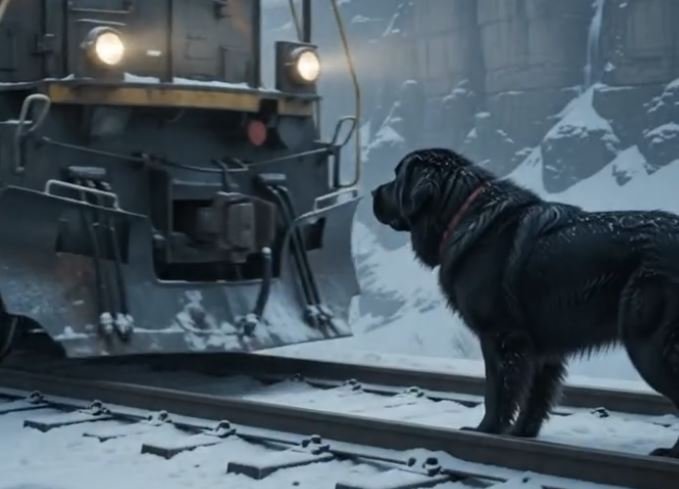
The freezing fog over Frost Pass had turned into an Arctic blizzard by midnight. Chief Track Inspector Marcus Vance was conducting a foot patrol along a deserted rail line when a sudden ice shelf collapse knocked him into a fifteen-foot steep drainage culvert beside the tracks. The impact dislocated his hip, pinning his legs beneath a heavy slab of frozen shale. As temperatures plunged to minus twenty-five degrees, the metallic hum of the steel rails began to vibrate—a heavy, unannounced automated freight train was approaching at sixty miles per hour on a downhill grade.
Trapped in the pit beneath the track bed, Marcus couldn’t stand or signal the train engineer. His thermal flashlight had broken on impact, and the roaring blizzard absorbed his cries for help. The automated freight had no visual conductor; it relied strictly on track-side infrared sensors, which were completely blinded by the thick ice buildup inside the culvert.
Running along the upper snowbank was Bruno—a 150-pound landseer Newfoundland. Bruno wasn’t a military or police dog; he was Marcus’s mountain companion, possessing the breed’s dense double coat and natural instinct for heavy snow navigation. Sensing the ground vibration of the oncoming train miles before it reached the pass, Bruno bounded through the chest-deep snow toward the track bed.
Finding Marcus trapped below, Bruno realized he couldn’t lift the frozen shale slab alone. Seeing the bright headlight of the freight train piercing the whiteout five hundred yards away, Bruno made a split-second decision.
He didn’t bark at the sky. Bruno leaped onto the center of the active rail line, directly in front of the approaching locomotive’s infrared track scanner. Positioned on the steel tracks, Bruno threw his massive 150-pound dark silhouette against the white snow. He began kicking up huge plumes of powdery snow with his back legs, creating an artificial, dense white wall directly over the track sensors.
The locomotive’s automated emergency collision-avoidance system detected the sudden, massive density obstacle on the rails. The pneumatic air brakes locked instantly with a deafening screech of steel against steel, sending blinding sparks shooting fifty feet into the night sky.
The heavy freight train ground to a complete halt just thirty feet from where Bruno stood. The emergency brake deployment automatically alerted the regional rail dispatch center, who pinpointed the train’s exact GPS location and dispatched an emergency crew.
When the rail rescue team arrived twenty minutes later, they found the train stopped on the bridge and heard Bruno barking down into the dark culvert.
The lead engineer looked at the massive dog standing safely beside the stopped train and murmured in complete shock: “The automated sensor registered a massive structural obstruction on the tracks… it was just a dog throwing snow into the scanner line.”
Marcus, being pulled up from the frozen pit by paramedics, pulled Bruno close: “He didn’t just block the sensor… he forced a 5,000-ton train to stop in its tracks for me.”