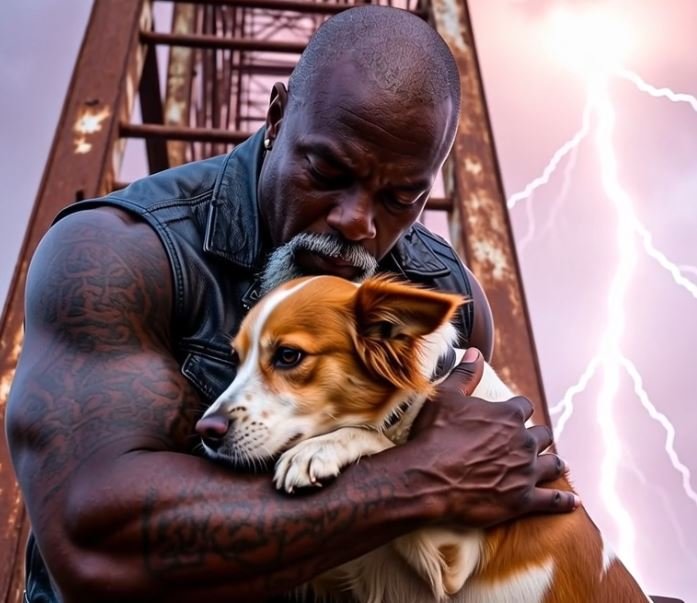
My name is Eddie “Preacher” Boone, and I am fifty-nine years old. I am six-foot-four, bald, with a silver goatee and tattoos that run from my wrists to my shoulders. I have ridden through hurricanes and blizzards and dust storms that turned the sky red. I have faced down men twice my size in bars and won. But I have never climbed anything higher than a stepladder until the evening of September 3rd, when a dog on an abandoned Ferris wheel made me forget that I was afraid of heights.
The Iron Mercy Riders were on a photography run. We had been riding through rural Ohio, looking for abandoned places, rusted machinery, the bones of America’s forgotten industries. We had found a collapsed barn, a rusted combine harvester, a schoolhouse with desks still inside. Then we saw the amusement park.
It had been called Dreamland. Opened in 1962, closed in 1984, left to rot in a field outside a town that had forgotten it existed. The rides were still there. The roller coaster, its track twisted and overgrown with vines. The bumper cars, their metal shells rusted to lace. And the Ferris wheel.
It was massive. Eighty feet tall, its paint gone, its metal orange with rust, its cars hanging empty like forgotten promises. The storm was gathering behind it, dark clouds rolling in from the west, lightning flickering in the distance. It was beautiful and terrible, the kind of place that makes you feel small.
Luis saw her first.
“Preacher,” he said. “On the wheel.”
I looked. Near the top, on one of the metal platforms between the spokes, there was a white shape. At first, I thought it was a seagull, or a piece of trash caught in the wind. Then it moved. It lifted its head.
It barked.
It was a dog. A spaniel mix. White and brown, small, maybe fifteen pounds. She was huddled on the platform, her body pressed against the railing, her eyes looking down at us with terror. She was trapped. Eighty feet up, on a rusted platform, with no way down and a storm coming.
“How did she get up there?” Caleb asked.
“Climbed,” I said. “Or someone put her there.”
“How do we get her down?”
I looked at the Ferris wheel. The ladder was rusted, bolted to the support structure, its rungs orange and thin. The platform was eighty feet up. The wind was already gusting, pushing against the wheel, making it creak. The storm was ten minutes away, maybe less.
I am afraid of heights. It is not a small fear. It is a terror that makes my hands sweat on balcony railings, that makes me dizzy on second-story landings. I have not been on a Ferris wheel since I was twelve years old. I have not climbed a ladder in twenty years.
But I looked at that dog, eighty feet up, alone and terrified, and I started walking.
“Bear,” I said. “Tie me off.”
We had rope. We always have rope. Bear tied a hundred-foot line around my waist, anchored it to three bikes, and handed me the end.
“Preacher,” he said. “That ladder is rotted.”
“I know,” I said.
I grabbed the first rung. It was cold, rough, rusted. I pulled myself up. The second rung. The third. I kept my eyes on the platform. I did not look down. I did not look at the ground receding beneath me. I climbed.
The wind grew stronger as I went up. The Ferris wheel creaked, a deep, metallic groan that vibrated through the rungs and into my hands. The storm was closer now. I could smell the rain. I could hear the thunder, low and rolling.
At sixty feet, a rung broke under my boot.
My foot slipped. My heart stopped. I grabbed the rail with both hands, my body swinging out from the ladder, my boots scraping empty air. The rope went taut around my waist. Bear and Luis and Caleb held the line below, their bodies leaning back, their boots digging into the dirt.
I hung there for three seconds. Three seconds of empty air and rusted metal and the knowledge that I was sixty feet up and the ground was a long way down.
Then I found the next rung. I pulled myself back. I kept climbing.
I reached the platform. The spaniel was huddled in the corner, her body trembling, her eyes wide. She had watched me climb. She had watched me fall. She had watched me keep coming.
“Hey, baby,” I whispered. “I’m here.”
I reached out my hand. She looked at it. She looked at the storm. She looked at the ground, eighty feet below. Then she placed one trembling paw in my palm.
I pulled her against my chest. She was light, trembling, her heart hammering against my arm. I turned to the ladder, and I began the descent.
The storm hit when we were forty feet up. Rain, hard and cold, driven by wind that made the Ferris wheel shake. The rungs were slick. The metal groaned. I held her with one arm, gripped the ladder with the other, and I climbed down through the rain.
When we reached the ground, Bear grabbed me and pulled me away from the wheel. I fell to my knees in the mud, still holding her, my chest heaving, my hands shaking. The storm raged around us, lightning splitting the sky, rain pouring down in sheets. But she was safe. She was on the ground. She was in my arms.
I held her and I cried. I am not ashamed. I cried because I had faced the thing that terrified me most, and I had done it for a dog the size of a football. I cried because she had trusted me, a stranger, to climb through rust and storm to reach her.
I named her Carousel. Because she was found on a wheel that went nowhere. Because she deserved to go somewhere beautiful.
Carousel came home with me. She was afraid of heights. Of course she was. She would not climb stairs. She would not jump onto furniture. She would not stand on the porch if it was more than a foot off the ground.
So I made the world flat for her. Beds on the floor. Ramps instead of steps. No balconies. No ladders. No Ferris wheels.
But I also knew she needed to reclaim the sky.
Six months after the rescue, I took her to a hill at sunset. The sky was purple and orange. The clouds were distant and soft. I sat on the grass, and I placed her beside me.
She tensed. The height was coming. The platform was somewhere in her memory, eighty feet up, with the wind and the storm and the rust.
I lay down. I placed her on my chest. She was close to the ground. She could feel my heartbeat. She could feel the earth beneath us.
“Look,” I said. “The sky is beautiful from down here too.”
She looked at the clouds. She looked at the sunset. She looked at me.
She lay down. She rested her chin on my chest. She watched the colors change, and she did not tremble.
That was enough.
Carousel is three years old now. She is white and brown, with ears that flop when she runs. She rides with me on every charity run, in her carrier, her head out, her nose working the wind. She loves the road. She loves the open air. She loves the world at ground level.
But she still hates heights. If I lift her, she stiffens. If we walk near a cliff or a bridge, she presses against my leg. I kneel beside her. I tell her about the Ferris wheel. I tell her about the ladder, the broken rung, the storm. I tell her that she is safe. That she is home. That the ground is where she belongs.
Some people see a fifty-nine-year-old man climbing a rusted Ferris wheel in a storm and they see a fool. They see a man who risked his life for a dog. They see someone who should have called the fire department.
But Carousel sees something else. She sees the man who climbed eighty feet of rust and rain to pull her into his arms. She sees the hand that she placed her paw in. She sees the ground, the grass, the sunset.
And that’s enough.