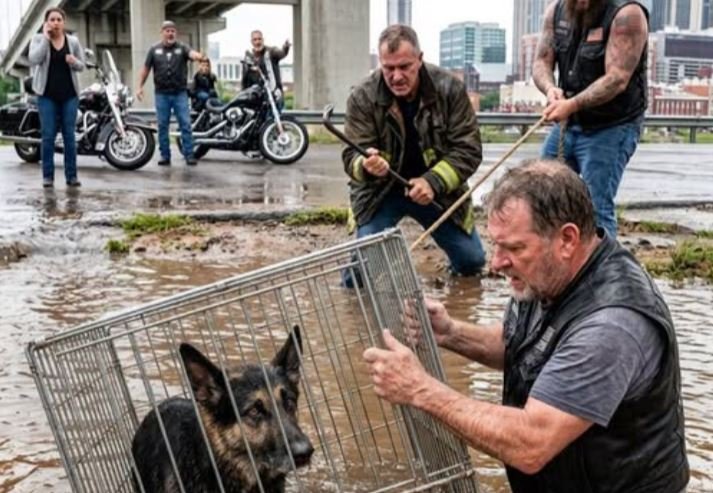
The Cumberland River had been rising for three days. Spring rain had soaked Nashville until the ditches were full, the red clay banks were loosening in slow dirty slides, and the water had turned the color of old coffee left too long in a mechanic’s mug.
Ray Lawson was riding across the Shelby Avenue Bridge with the Iron Mercy Riders when his friend Knox Miller pointed over the railing. At first, Ray thought Knox had seen a tire. Then the tire turned. Metal bars flashed through the water. A black crate spun slowly in the current, bumping against floating branches and trash. Then a dog’s muzzle pushed through the bars.
Ray was fifty-seven years old, six-foot-four, and almost 280 pounds — a body built by machines, bad weather, and a lifetime of lifting things other men needed help moving. Most people called him Hammer. His late wife, Annie, had called him Ray even when she was furious. After she died, he had learned that silence could feel bigger than any room. He worked as a mechanic now. Before that, he had been a water rescue diver. That part of him had never really retired.
At 8:13 a.m., the crate came into view. At 8:14, Maria was shouting for someone to call 911. At 8:15, Preacher was already off his bike and running down toward the riverbank. Preacher was sixty, a retired firefighter, and the calmest man Ray had ever known around panic. Knox threw a rope from the bridge approach, but it landed short.
The crate dipped. The German Shepherd disappeared up to her neck.
Ray did not remember deciding to jump. He remembered the railing under his palm. He remembered Knox yelling his name. He remembered the cold shock of the river swallowing his boots, then his knees, then his chest. The water hit his old shoulder injury like a warning flare.
Then the crate hit a submerged branch and rolled, and the dog’s head vanished. Ray moved.
A Dog Who Refused to Save Herself First
He fought the current with heavy strokes while muddy water slapped his mouth and nose. When he reached the cage, the German Shepherd surfaced again, coughing river water through her nose. Her coat was black-and-tan, plastered tight to her ribs. Gray edged her muzzle. One ear stood up sharp, while the other folded down like wet velvet. A thin moon-shaped scar crossed the top of her nose.
Her amber eyes locked onto Ray’s face with a focus that stopped him colder than the water. She was not looking at him like a victim. She was looking at him like a partner who had arrived late.
Ray grabbed the cage with both hands. The current shoved the crate sideways, dragging him with it. The Shepherd pressed her nose through the bars and touched his wrist. Not biting. Not snapping. Guiding.
Ray looked down. The latch was underwater. A padlock hung from it, cold and slick. His stomach turned. Whoever had done this had not panicked and dropped the cage by mistake. They had locked it. They had made a decision. Cruelty often looks wild from far away. Up close, it is usually organized.
Ray took one breath and went under. He felt along the cage with both hands, fingers sliding over rusted edges, bent wire, sharp corners, and finally the lock. He pulled once. Nothing. He braced his boots against the crate and pulled again. The lock did not move. His lungs tightened. He surfaced hard, coughing.
The Detail That Changed Everything
The river twisted the crate again. The Shepherd slammed sideways into the bars. Ray expected her to claw toward him. She did not. She shoved her shoulder toward the back of the cage.
That was the detail that made his chest go tight in a different way. She was not trying to get out first. She was trying to keep something else from going under.
Ray wiped water from his eyes and looked past her. The back corner of the crate was dark. The crate tilted again. Water climbed over the dog’s chest. The Shepherd turned her head toward the corner, then back to Ray. There was no mistaking it now. She wanted him to look.
Ray pressed his face close to the bars. For a second, he saw only shadow, wet metal, and the dog’s trembling body blocking most of the space. Then he heard it. It was small enough that the river almost swallowed it. A thin cry. Not a bark. Not the Shepherd. Smaller.
Ray’s hands tightened on the bars until his knuckles hurt. “Preacher!” he shouted.
Four Tiny Lives
Preacher reached the lower bank and dropped to one knee in the mud. Knox came sliding behind him with rope wrapped around his forearm. Maria stayed above them, phone in hand, giving the dispatcher the bridge name, the river, the crate, the dog, the fact that there were sounds inside. Ray heard her say, “No, not just the dog. I think there’s more.”
The word more changed the air. Even the men on the bridge went quiet. The Iron Mercy Riders were not quiet men. But when that tiny cry rose out of the crate again, nobody joked. Nobody moved wrong.
“Bolt cutters!” Preacher shouted. Nobody had them close enough. What came down the bank was not enough — a tire iron, a small pry bar, a pocketknife that was useless against a padlock.
Ray shifted one arm under the crate and felt his shoulder scream. The Shepherd saw it happen. That dog, half-drowned and locked inside a sinking cage, pressed her nose to his wrist again. Steady. That was what it felt like. Not a plea. An order.
“Hit the hinge,” Ray told Preacher. Preacher’s eyes moved from the lock to the hinge. He understood instantly. If the lock would not open, the door had to fail somewhere else.
Preacher raised the tire iron and swung. The first hit rang out across the riverbank. The hinge dented but did not give. The Shepherd flinched, then immediately turned back to the corner. That was when Ray saw it. A tiny pale shape moved behind her hind legs. Then another.
Puppies.
The word went through him like a current. The German Shepherd had not been looking behind her because she was confused. She had been counting babies.
The Rescue
Preacher swung again. Metal screamed. One of the puppies cried louder. Knox grunted and nearly went down as the rope snapped tighter around his forearm. “Again!” Ray yelled. Preacher swung a third time. The hinge bent open half an inch. Not enough. The water rose higher.
Ray wedged one knee against the crate and one arm through the bars as far as it would go. The metal scraped skin off his forearm. He could see one puppy now. Wet. Tiny. Pressed into the corner behind its mother. Its mouth opened with a sound too small for the size of the world trying to drown it.
The Shepherd looked at Ray. That look stayed with him long after. It was not gratitude. Gratitude comes after safety. This was trust demanded before safety existed.
Preacher swung again. This time the hinge snapped on one side. The cage door sprang crooked, still trapped by the lock but twisted enough for Ray to get both hands into the gap.
“Pull!” Preacher yelled. Ray pulled. The metal bit into his palms. The door bent another inch. The Shepherd tried to move toward the opening, then stopped herself. She turned back again. Of course she did.
Ray reached through the gap. His fingers touched wet fur so small he almost could not believe it was alive. He pulled the first puppy free. It came out limp for one terrible second. Maria made a sound behind him. Then the puppy coughed. A thin thread of river water came from its mouth, and it squeaked. Maria sobbed once and clamped both hands around it.
Ray went back in. Second puppy. Third. The crate dropped again. The Shepherd’s head went under. Ray let out a shout and shoved his arm through the opening until the broken hinge tore his skin. He grabbed the Shepherd by the scruff and collar fur together. She surfaced coughing, but even then she twisted toward the corner. There was one more.
Ray took a breath and went under. Brown water closed over his head. His fingers searched the corner. Metal. Fur. A tiny ribcage moving too fast. He pinched gently, shifted, pulled, and felt resistance. For one awful instant, he thought the puppy was trapped. Then the support bar bent under Preacher’s weight above him. The puppy came free.
Ray kicked upward. He surfaced with the last puppy in one hand and the crate rolling against his ribs.
“All Four”
The bank exploded in voices. Knox and two riders dragged Ray by the rope and the back of his vest. Preacher held the broken door open long enough for the Shepherd to shove herself toward the gap. She tried once and failed. Ray grabbed her under the chest and pulled. The Shepherd came through the twisted door and collapsed halfway across him.
They hit the mud together. For a few seconds, nobody spoke. The river kept moving. The motorcycles kept idling above. Somewhere, Maria was crying into the dispatcher’s open line.
The four puppies were gathered inside jackets, towels, and the front of Knox’s flannel shirt. Tiny bodies. Tiny sounds. The Shepherd lay on her side in the mud, ribs pumping, eyes still searching. Ray understood and pointed.
“All four,” he rasped. “You got them. All four.”
The dog lifted her head. Maria brought the first puppy close enough for her to smell. Then the second. Then the third. Then the fourth. Only after that did the German Shepherd let her head fall back onto the mud. Only after that did she close her eyes.
“After Them”
Fire rescue arrived minutes later. Animal control came behind them. There would be paperwork, because there is always paperwork after cruelty leaves evidence behind.
Ray sat on the riverbank with a blanket around his shoulders and blood running from his forearm into the mud. A young responder asked if he needed medical attention. Ray looked at the Shepherd curled around her puppies inside Maria’s jacket and said, “After them.”
Some men are stubborn because they are proud. Ray was stubborn because the dog had asked him for one thing, and he had not finished answering yet.
A Name for a Hero
At the animal clinic, they cleaned river mud from the Shepherd’s coat and warmed the puppies under heat lamps. The staff checked their breathing, their bellies, their paws, their gums. Ray stood in the waiting area in wet socks, refusing to sit until someone told him the mother had made it.
A receptionist came out with a clipboard. “The mother is stable,” she said. Ray closed his eyes. Nobody made fun of him for the way his breath broke. “The puppies are cold and weak,” she added, “but all four are alive.”
The German Shepherd did not have a collar tag. No microchip turned up on the first scan. For the report, they had to list her as unidentified. Ray hated that. A dog who had fought a river for her babies deserved a name.
Maria suggested Mercy. Knox suggested River. Preacher said nothing for a while. Then Ray looked through the clinic window and saw her lift her head as a tech checked the smallest puppy. Even exhausted, even half asleep, she was still counting.
“Keeper,” Ray said. The room went quiet. Then Maria nodded.
A Shift in the Silence
Keeper stayed at the clinic for days. Ray came every morning before the shop opened and every evening after closing. He brought clean towels. Maria brought formula. Knox brought a crate that did not lock from the outside and made a point of showing the vet staff the latch. Preacher brought silence, which sometimes helped more than words.
A week later, when the clinic let him sit beside her, she placed her nose against his wrist. The same place she had touched him through the bars. Ray had spent years thinking the quietest place in his life was the house after Annie died. He learned he was wrong. The quietest place was the moment after an animal trusts you and you know you have to become worthy of it.
Months later, when people told the story, they usually made Ray the hero. He hated that version. Ray had jumped, yes. Preacher had broken the hinge. Knox had held the rope. Maria had made the call and kept the puppies warm. The Iron Mercy Riders had filled the bridge with noise and fear and action.
But Keeper had done the hardest thing first. She had stayed alive without using survival as an excuse to stop protecting what mattered.
A drowning dog should look at air. A drowning dog should look at shore. Keeper looked behind her. That was why four tiny lives made it out of the Cumberland River that morning.
And that was why, on the day Ray finally brought Keeper home, with her puppies safe, fed, and tumbling over one another in a clean pen by the garage, he stood in his driveway beside the old pickup truck and felt something in his empty house shift. Not heal all at once. Life does not usually work that kindly. But shift.
Keeper stepped onto the porch, paused under the small flag by the door, and looked back at him as if checking whether he was coming too. Ray laughed for the first time that day. Then he followed her.