Mara hadn’t set foot in the Pinecrest Motor Lodge since she was twelve, and she still remembered which floorboard in the office creaked. It creaked now, under a stranger’s boots, as the new owner walked her back to the storage room behind Room 6.
“Your mother rented this unit for twenty-two years,” he said. “Paid every month, even after she moved to Bangor. Never explained why.”
Mara didn’t have an explanation either. Her mother had died three weeks ago without ever mentioning a storage unit, a motel, or the small cedar box sitting on the single shelf inside — a box with Mara’s name burned into the lid, and no visible keyhole.
The room smelled like salt and old wood smoke. Outside, the lake was flat and gray under a sky that couldn’t decide on rain.
She turned the box over. On the bottom, in her mother’s handwriting: For Mara, when she’s ready. Room 6 knows why.
Mara had grown up with exactly one story about her father: he left when she was four, and her mother never spoke his name again. She’d built a whole private mythology around that silence — a man who couldn’t handle a family, who chose somewhere else over them. She’d made peace with it, mostly. Now a locked box was asking her not to.
She found the old guest ledger in a drawer, water-stained but legible. Her mother’s neat handwriting logged decades of guests. One name reappeared more than any other, always for Room 6, always on the worst weather nights: D. Fenn.
“Regular customer,” the owner shrugged, when she showed him. “Storms, mostly. People used to ride them out here before the new bridge went in.”
She kept looking. In a shoebox of old photographs, she found one of her mother laughing outside this same office, sunlight on her face, half-turned toward someone whose arm was all that made it into the frame — a canvas work jacket, a patch stitched crooked above the pocket: FENN’S HARDWARE.
Not her father, then. Someone else. For the first time, Mara let herself consider a harder story than abandonment — that maybe her mother hadn’t been left. Maybe she’d left. Maybe this Fenn was the reason.
A woman at the town’s one open diner remembered the name without being asked twice. “Fenns had a temper on them, way back. Whole family did. Ask anyone.” She said it like a warning, like she assumed Mara already knew to be careful.
It fit too easily. Mara spent the night convinced the box held proof of something her mother had run from — a man, an affair, a reason a marriage quietly ended and a father conveniently vanished from the story altogether.
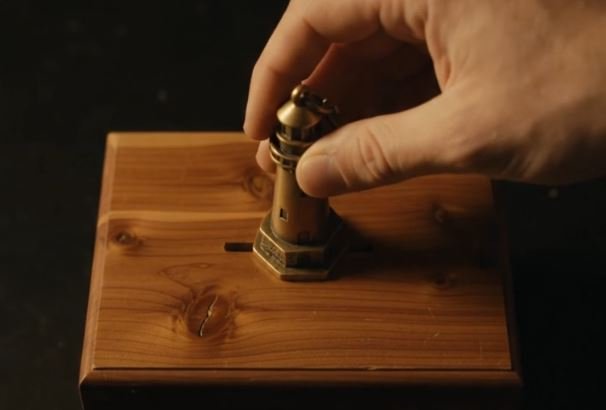
She still had one object from her father: a small brass lighthouse on a keyring, the only thing of his her mother had ever kept. “Don’t use it,” her mother told her once, when Mara was maybe nine and had asked to play with it. “Some doors are better left shut.” Mara had always assumed she meant the past.
The cedar box had no lock. It had a slot — narrow, shaped exactly like the base of a lighthouse charm.
The lighthouse wasn’t decoration. It was a key her mother had told her never to use, sitting in a drawer for twenty years, because using it meant opening this.
Inside were letters — not from a man who’d fled, and not from a man having an affair. They were dated the year Mara turned four. In them, Daniel Fenn thanked her mother for a debt he said he could never fully repay: that her husband — Mara’s father — had pulled him out of the lake during a November storm the night Room 6’s chimney caught fire, and hadn’t made it back out himself.
Her father hadn’t left. He’d died a hero three weeks before Mara turned four, in the water outside this motel, and her mother — twenty-six, alone, unable to say the words out loud to a small child for years and then unable to find a later moment that felt right — had let a silence become a story, and let Mara build a father out of absence instead of grief.
Fenn had quietly paid into that storage unit for over two decades, the letters explained, as a way of paying forward what he felt he owed. Not guilt for wrongdoing. Guilt for being the one who lived.
Mara sat on the floor of Room 6 with the letters in her lap and finally understood the temper the diner woman meant — grief, calcified into something that looked, from a distance, like a family secret worth avoiding. It had never been a scandal. It had been a mother protecting her daughter from a grief she didn’t know how to hand over gently, one storm season at a time, until it was too late to hand over any other way.
She kept the lighthouse key. She didn’t need it to stay locked anymore.