Route 9 Diner sat at the point where the interstate gives up and becomes actual road — a chrome-and-neon box that served truckers, drifters, and the occasional romantic-comedy situation. I’d worked the closing shift for three years, knew every regular by order, and had exactly one rule: don’t learn their names. Names made them people. People made you care about where the highway took them.
She broke the rule without trying. Corner stool, Thursdays, 9:45 PM. Cherry pie, two coffees, one refill. She paid cash, tipped exactly twenty percent like she was following a regulation, and never once said anything except “pie” and “thanks.” She drove a rig with no company logo — owner-operator, the truckers told me, which on Route 9 meant either independent or mysterious. The other drivers called her Ghost, because she’d roll in out of the fog and vanish into it before sunrise.
I called her Pie. Not to her face. In my head, where I kept the list of things I wasn’t going to think about.
Thursday, week one hundred and four — I counted later, during the three days that changed everything — the fog came down on Route 9 like a curtain. State police closed the highway at midnight. The diner’s regulars trickled out until it was just me, the coffee pots, and Ghost at the corner stool, watching the fog erase the truck stop lights across the road.
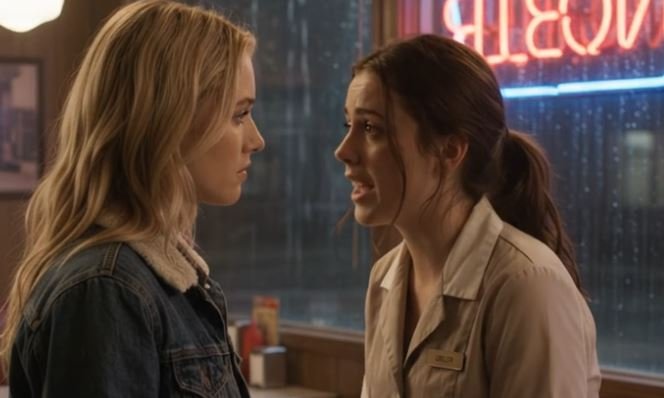
“We close at eleven,” I told her, finally, because the silence had gone on so long it became a third person. “You’ve been on Route 9 for ten years. And you’re untying my apron instead of paying your check. The fog will lift. The highway will open. You’ll be three states away by breakfast. That’s the whole arrangement, right? Pie, coffee, gone.”
She looked at me for a long moment — the first time she’d ever really aimed those eyes at me, and they were the color of the highway at dusk.
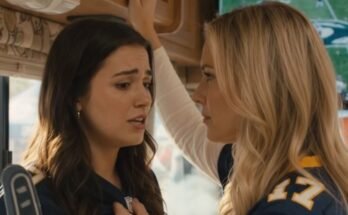
Then she stood, walked around the counter, and stepped between my knees like the stool, the counter, the two-year arrangement had all been a waiting room.
“If my manager comes out of that office,” I whispered, and the neon sign buzzed through the window turning everything rose and electric, “you’ll be banned from the best coffee on this highway.”
“You are the best coffee on this highway,” she said. First full sentence. Ever.
She kissed me like she’d been rehearsing it at sixty miles an hour for two years. Slow. Refilled. Tasting like burnt coffee and every cherry pie I’d ever served her.
The office door opened. “Elena? You still out there?”
She didn’t jump. She took her trucker jacket off, draped it around my shoulders over the apron she’d just untied, and said — to my manager, to the fog, to the whole highway — “Fog’s too thick, boss. I’m grounded.”
My manager looked at the jacket around me, the apron on the floor, the two of us, and said the most Route 9 sentence ever uttered: “Coffee’s still on. Don’t burn the place down.”
She didn’t leave for three days.
The rig stayed in the lot — a whole semi, parked across four spaces, hazard lights off, looking like a sleeping animal. She stayed in the corner booth, helping me roll silverware, fixing the fryer’s pilot light with a pocket multitool, teaching me the names of the constellations you could see when the diner lights went off. She told me her name was Sloane. She told me she’d been hauling freight on Route 9 for eleven years, since she was twenty-two. She told me — on day two, over eggs at 4 AM — that Thursdays had stopped being about the pie somewhere around month three, but she hadn’t known what to do with that except keep showing up.
On day three the fog lifted, and I watched her walk to the rig with my heart doing something I’d need a mechanic for.
She came back the next Thursday. And the one after. And every single one for a year — pie at 9:45, except now she stayed past closing, and now I knew her name, and now the rule about not learning names had been replaced by a worse one: never asking her to stay.
She solved that too. One Thursday she slid a napkin across the counter with writing on it — her handwriting, blocky and careful:
I BOUGHT A HOUSE. TWENTY MINUTES FROM HERE. IT HAS A KITCHEN. YOU KNOW HOW TO COOK PIE. DISCUSS.
The regulars figured it out before we did. Of course they did — they’d watched two years of Thursdays. When we finally held hands across the counter on a slow night, the whole row of truckers at the bar applauded with their coffee cups, and one old guy named Walter said, “Took you two long enough. I been running a pool.”
She doesn’t drive Route 9 much anymore. She teaches at the community college now — diesel mechanics, and let me tell you, the enrollment in that class is a scandal. But every Thursday at 9:45, she sits at the corner stool of a diner she no longer has any reason to visit, orders one cherry pie and two coffees, and waits for the fog to come down.
It always does.