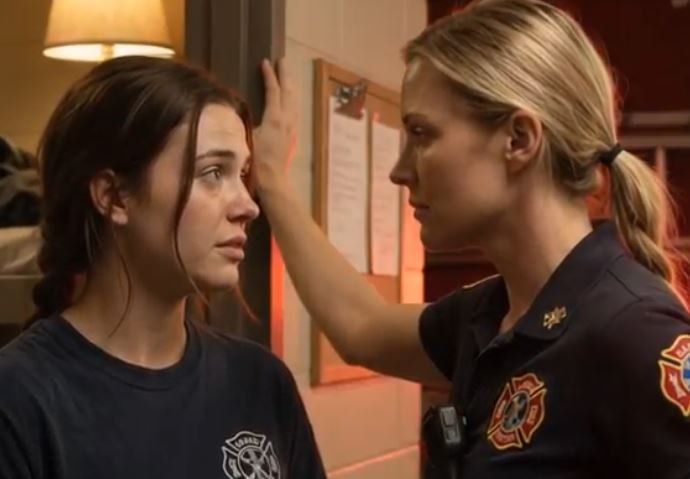
Nobody warns you about the doorway shifts. Firehouse romance novels mention the pole, the truck, the heroic carry. They never mention that a fire station at 2 AM is a building full of sleeping people and one long hallway where the rookie’s bunk room and the lieutenant’s office face each other across six feet of polished concrete — six feet that take approximately four shifts to stop feeling like a mile.
I was three weeks into my probationary year, which in the fire service means you are furniture with a pulse. You wash the truck, you learn the district, you cook when told, you speak when spoken to, and you absolutely do not develop feelings for Sloane, the lieutenant, who ran drills like she was mad at gravity and had once carried a grown man down a ladder while reading him his blood pressure.
She noticed me the way a drill instructor notices a wobbly knot: professionally. “Probationary. Your bunk check’s late.” “Probationary. SCBA drill, you hesitated.” “Probationary. Your chili has no salt.” One critique per shift, delivered in passing, never repeated. I lived for them, which was my first red flag, and started staying up past bunk check to engineer the passing encounters, which was my second.
The doorway conversations started week two. Ten seconds. Thirty. By week three, 2 AM had become our scheduled unscheduled meeting: me with tea I never drank, her with her radio, both of us performing interest in the other’s day like we hadn’t engineered this exact collision.
“I’m the new rookie,” I whispered that night — the night — while she leaned on my doorframe in the red glow of the bay lights. “Three weeks in. You’re the lieutenant. There’s a regulation about this somewhere, and we both know it.”
“Which regulation concerns you?” she asked, the closest thing to flirtation she’d ever attempted.
“The one I’d be citing if I were smart.”
She reached up and turned her radio down one notch. In a firehouse, that’s a declaration. Radios live at full volume; turning one down means you’re accepting risk with your eyes open.
“If the tones drop,” I breathed, “you’ll have to run, and I’ll have to pretend I was asleep, and six people will have heard my pulse on the station monitor—”
She kissed me. Slow. On-Call. Fifteen seconds of the most insubordinate silence of my career.
The tones dropped.
She was gone before the second alarm — through the bay, into her gear, on the truck in a flow that looked choreographed because it was, because she’d drilled it ten thousand times and still somehow had room in the sequence for one look back at me in the doorway, one look that said this isn’t over louder than the siren.
The call was a kitchen fire on Fifth — grease pan, minor, everyone home before we cleared the hydrant. I rode as the extra, wedged between the senior firefighter, Diaz, and the pump panel, and I made it exactly four blocks before Diaz looked at me in the mirror, looked at the pulse clip on my glove, and said:
“Your pulse is 140, rookie. Station monitor showed flatline at 2 AM. Care to explain the gap?”
“I was drinking tea.”
“Your bunk’s down the hall from the LT’s office.”
“Tea travels.”
Diaz held the mirror stare for one more block, then said the sentence that ended my secrecy: “Rookie, this crew’s been waiting three weeks for one of you to make a move. Betting pool’s at two hundred. Garcia had week four. You’re costing her money.”
The crew knew. Of course they knew — six people who trust each other with their lives read doorways the way other people read texts. The betting pool, it turned out, was the most organized thing in the station that didn’t have a checklist. Garcia had week four; Diaz had the doorway itself; the chief — the actual chief, a man named Ruiz with twenty-eight years and no patience — had “before month two” and collected forty dollars the next morning.
We expected discipline. We got a closed-door meeting that lasted eleven minutes, at the end of which Chief Ruiz said: “Regulations exist so people don’t get hurt or play favorites. I’ve watched you two for three weeks. She drills you harder than anyone. You take it harder than anyone. Transfer requests are on my desk if either of you wants out of the station — otherwise, keep it professional on shift, keep it private off shift, and Rookie?” He pointed at me. “Your pulse on a call is a crew resource. Get it under control or take up running.”
“Yes, Chief.”
“And Lieutenant. One notch is unprofessional. Two notches gets you written up.”
“Understood, Chief.”
Sloane and I were engaged by the following spring, in the bay, next to the engine, during a pancake breakfast fundraiser. She proposed by radio — the whole district heard it on channel 3: “Station 12 to all units, announcing an engagement, over.” Every station in the county keyed up. It took dispatch four minutes to restore order. Diaz cried into his pancakes and denies it to this day.
The chief gave me away at the wedding, because my father couldn’t stop crying long enough to walk in a straight line, and because Ruiz said — and I quote — “I managed the risk. I should sign the paperwork.”
The regulation still exists. We looked it up, eventually, out of curiosity. It’s four paragraphs long and very serious.
The radio on the mantel of our house — the one from that first night, retired after twenty years of service and gifted to us by the crew — is set to one notch below full volume.
Some declarations you keep.