I was 28 years old, living in New York City, and completely alone on Christmas Day.
My father had passed away three years ago. My mother had remarried and moved to Florida. My siblings were scattered across the country. I had spent the morning eating cereal alone in my tiny apartment, watching other people’s happy family photos flood my social media feed.
I decided to take the subway downtown. Just to get out. Just to feel like I was part of something.
That’s when I saw it. A worn brown leather wallet, wedged between the subway seats. I picked it up and opened it. Inside was an ID for an 85-year-old man named Arthur. A few crumpled dollar bills. And a faded photograph of a young woman in a wedding dress.
The address on the ID was in Brooklyn. I had nothing else to do. So I decided to return it.
I knocked on the door of a small, modest apartment. An elderly man opened it—Arthur himself. He had kind eyes, a weathered face, and hands that trembled slightly. When I handed him the wallet, his eyes filled with tears.
“I didn’t even know I lost it,” he whispered. “This was my wife’s. She passed away ten years ago. The photo inside—that’s her on our wedding day. I’ve carried it with me every single day since she died.”
He invited me in for tea. I couldn’t say no.
His apartment was a museum of memories—photographs on every wall, old records, a dusty piano in the corner. We talked for hours. He told me about his wife, Margaret. How they met in 1958. How she loved to dance. How he held her hand as she took her last breath.
I told him about my father. How I missed him. How I felt like I had no family left.
Arthur looked at me with those kind, tired eyes. “You have family,” he said. “You just haven’t met them yet.”
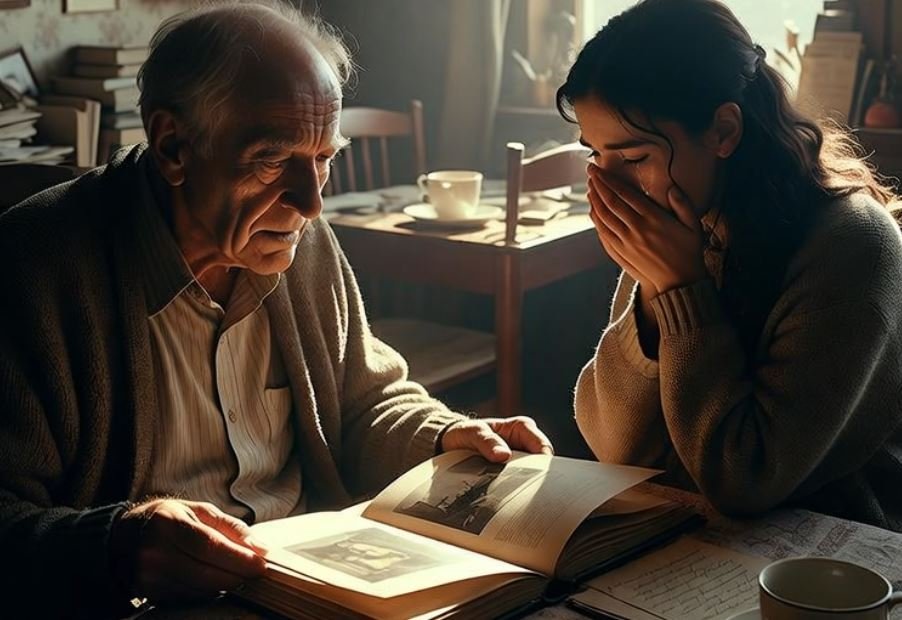
He pulled out a photo album from 1962. In it was a picture of a young man in a military uniform—my father. Arthur was standing right next to him.
“We served together in the Army,” Arthur said, tears streaming down his face. “Your father saved my life in Vietnam. He pulled me out of a burning vehicle. I’ve been looking for him for fifty years. I never found him. And now I find out he’s gone.”
I stared at the photograph. My father. Young. Brave. A hero I never fully knew.
“He never told me,” I whispered. “He never told me he saved someone’s life.”
“That was your father,” Arthur said. “He never talked about himself. He just did what was right.”
We sat there, two strangers bound by a wallet, a photograph, and a man we both loved.
Arthur reached into his wallet and pulled out a faded, folded letter. “He wrote this to me before he left the service,” he said. “He told me if I ever needed anything, to find him. I never had the courage. I thought I’d be a burden.”
He handed me the letter. I read my father’s handwriting for the first time in three years.
“Dear Arthur, if you’re reading this, I hope life has been kind to you. You’re a good man. If you ever need a place to stay, a meal, or just a friend—my door is always open. Your brother in arms, James.”
I broke down. I cried for my father. I cried for the years I lost with him. I cried for the stranger who had been searching for him for five decades.
Arthur held my hand. “You’re not alone,” he said. “You have me now. And I have you. That’s what your father would have wanted.”
Today, Arthur is my adopted grandfather. I visit him every Sunday. We drink tea, look at photographs, and talk about my father. He tells me stories I never heard. He tells me about the man my father was before he became a dad.
And every Christmas Day, I take the subway to Brooklyn. I knock on his door. And we celebrate together. Not as strangers. But as family.