The rumor was everywhere: that Professor Sloane’s grades were negotiable if you knew how. It was nonsense — anyone who’d taken her class knew she graded like a court of appeal — but the rumor persisted because she was young, unmarried, and unreadable, and grad students will monetize anything.
I got a B+ on my methods paper. My funding required an A average. Panic does math quickly: one B+, one rumor, one rehearsed walk-in.
Her office smelled like old paper and bergamot. She sat behind a desk stacked with journals, red pen in hand, my paper — my B+ paper — on top. I leaned on the desk. Launched my speech.
What she did next rewired the story entirely. She didn’t get angry. She didn’t call security. She put the pen down and told me, in the calmest voice I’d ever heard, that whatever the rumor promised, the answer was no — grades weren’t currency and she wasn’t for sale — and then, devastatingly, that I was too smart for the rumor anyway.
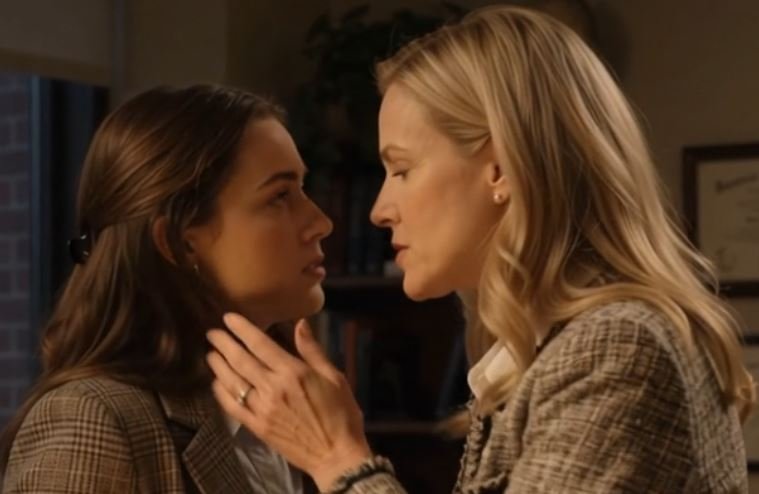
And then she leaned across the desk and kissed me.
“If you’re going to be reckless,” she said against my mouth, “at least be reckless about something real. That B+ isn’t you. I know what you wrote. I also know what you were capable of writing, because your midterm showed it. You coasted, Elena. The grade stands. The retake offer stands. And dinner—” she sat back down, red pen in hand, suddenly all professor again, “—dinner I will ask you about in three months, when the semester is filed and I am merely a woman who noticed you, not a woman who can be accused of anything except good taste.”
On my paper, in red, she’d written: RETAKES.
I took the retake. I earned the A — and knowing what I know now about how she grades, that A is the one credential on my CV I never doubt. We had dinner exactly ninety days later, the first evening of the new term, at a restaurant two towns over where no one knew either of us. She’d booked it weeks in advance.
“You checked the department chair’s conference schedule before I ever walked in,” I said over dessert. “Admit it.”
“I’ve known you were going to do something reckless since week four of the semester,” she said. “You got a ninety-two on the midterm and looked angry about it. Only perfectionists and people in love look angry at a ninety-two. I was hoping to find out which.”
“And now?”
“Both, I think.”
We kept it invisible for a year — different buildings, different disciplines, a relationship conducted in bookstores and neighboring towns like a spy operation with better food. The university’s policy was clear: faculty and students, no. Former students, fine. So we waited, and the waiting turned out to be its own kind of courtship — she read my thesis drafts as “a colleague,” I argued with her margins at 1 AM, and the first time she called me her girlfriend it was at a conference in another state, in a hotel bar, four hundred miles from anyone who could care.
She’s tenured now. I’m faculty at a different university, an hour’s drive we make every weekend like commuters. At my doctoral graduation, she was in the audience as “Professor Sloane, mentor,” and at the reception she handed me a card. Inside, in red pen:
A. Obviously. — RETAKES, accepted in full.
The B+ is framed in my office too. Students ask why I keep a B+ on the wall. I tell them it’s the most honest grade I ever got — the one that was earned before I understood what earning meant.
The rumor about Professor Sloane still circulates in the grad lounge. It’s changed, though. Now they say there’s a way to change her grade, but only one person ever found it, and she did it by taking the class twice.