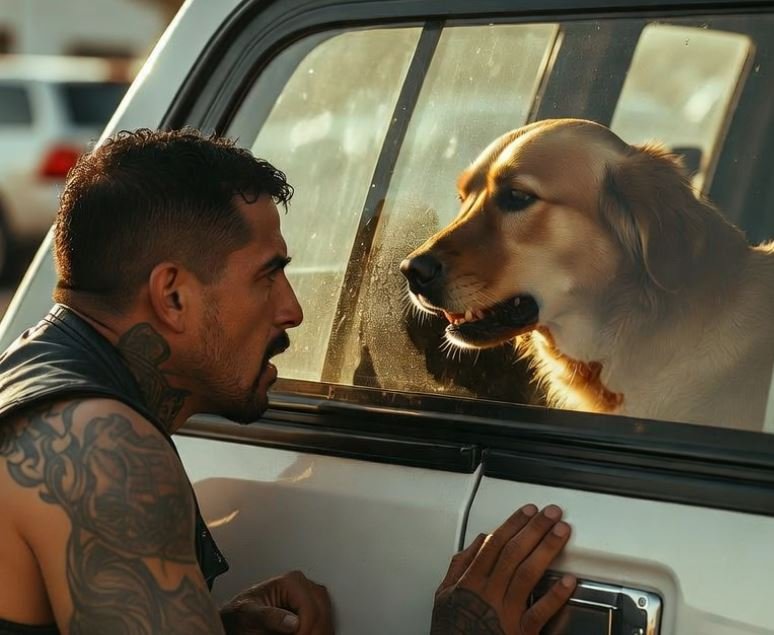
My name is Luis Vega, and I am thirty-six years old. I have been hot before. I have ridden through Death Valley in July, wearing leather that soaked through with sweat and made my hands slip on the grips. But I have never felt heat like I did on the afternoon of July 14th, standing in a Walmart parking lot in Phoenix, Arizona, looking through the dirty glass of a truck bed canopy at a dog who was dying in front of me.
The Iron Mercy Riders were on a summer supply run. We had delivered fans, water, and sunscreen to a senior center in South Phoenix, and we had stopped at a Walmart Supercenter for cold drinks and ice before the ride back to our motel. Six bikes. Six people looking for shade. The parking lot was asphalt, black and radiating, the kind of heat that comes up through your boots and makes the air shimmer.
Luis was walking to the store when he stopped. A white Ford pickup, maybe five years old, parked in the far corner of the lot, away from the shade. The truck bed had a canopy, white fiberglass, the windows tinted. And through the rear window, pressed against the dirty glass, was a nose.
“Dog,” Luis said. His voice was sharp. “In the truck bed.”
We walked over. The truck was locked. The canopy was locked. The windows were up. The sun was directly overhead, beating down on the white fiberglass, turning the enclosed space into an oven.
I touched the canopy. It was burning hot.
“How long?” Eddie asked.
A woman walking past with a shopping cart stopped. “That truck’s been there since I came out,” she said. “Forty-five minutes ago.”
I looked through the window. The dog was a golden retriever mix, maybe sixty pounds. She was lying on her side, her chest heaving, her tongue hanging out and purple at the edges. Her eyes were half-closed, glazed, the look of an animal whose body was shutting down. She was panting, but the panting was slowing, becoming shallow, the sign of heat exhaustion becoming heat stroke.
“Call 911,” I said.
“Already on it,” Luis said. But he was already moving.
He pulled the tire iron from his belt. Not a weapon. A tool. We carry them for roadside repairs, for prying open stuck gates, for the hundred obstacles charity riders face. He walked to the tailgate and he gripped the latch.
“Sir!” A Walmart manager was running toward us, his blue vest flapping. “You can’t—”
“Watch me,” Luis said.
He struck the lock with the tire iron. Once. Twice. The fiberglass cracked. The lock snapped. The tailgate dropped open.
Heat poured out. It was like opening a furnace. The air that hit my face was 127 degrees, maybe higher. The dog didn’t move. She was lying on a blanket in the truck bed, her body limp, her breathing shallow.
Luis reached in and lifted her. She was heavy, limp, her body radiating heat. He cradled her against his chest and he stepped back, into the shade of a nearby cart corral. Eddie had a bottle of water. He poured it over her head, her neck, her chest. Darlene had a thermal blanket. She spread it on the asphalt and Luis laid the dog down.
“She’s not responding,” Darlene said. She checked the dog’s gums. They were pale. Her eyes were rolled back. “We need a vet. Now.”
But the dog was looking at the truck bed. Even in her state, even as her body failed, she was looking at the tailgate, at the open bed, at something inside.
“What’s wrong?” I asked.
Luis looked. He walked back to the truck. He leaned into the bed. The blanket was covering something. He lifted it.
Under the blanket, on the metal floor of the truck bed, was a floor mat. The kind that covers the spare tire well. And on the mat, huddled in a depression, was a puppy.
A tiny puppy. Maybe two weeks old. White, with golden patches. Its eyes were closed. Its body was limp. It was breathing, but barely.
Luis lifted the puppy. It was cold, somehow, in the heat of the truck bed. The mother had been lying on top of it, shielding it with her body, keeping the direct heat off, but the ambient temperature had been rising, and the puppy was failing too.
“She was protecting it,” Luis said. His voice broke. “She was baking herself to keep the heat off her baby.”
The Walmart manager who had run out to stop us stood there for thirty seconds. He didn’t speak. He just looked at the dog on the asphalt, the puppy in Luis’s hands, the broken lock on the tailgate. Then he turned and walked back into the store. He returned with a case of water, a bag of ice, and a first-aid kit.
The veterinarian arrived in twelve minutes. The mother dog — we later named her Phoenix — was suffering from severe heat exhaustion, dehydration, and organ stress. The puppy, who we named Ash, was hypothermic and underweight, but alive. The mother had kept her body temperature high enough to sustain the puppy, but low enough to keep her alive, for two hours in 127-degree heat.
Phoenix and Ash came home with Luis. The owner of the truck was found in the store, shopping for forty-five minutes. He was cited. The case made local news. Phoenix became the face of a campaign to change Arizona’s hot car laws, making it legal to break a window to save a dog.
Phoenix is four years old now. She is golden and thick-furred, with eyes that watch everything. She loves the cold. She lies on the tile floor in summer, pressed against the air conditioning vent. She will not get into a closed vehicle. If the windows are up, she whines. She presses her nose to the glass. She remembers.
Ash is her shadow. He is small, smaller than he should be, a reminder of the heat that tried to take him. But he is healthy and happy and deeply attached to his mother. They sleep together, eat together, and when Luis rides, they ride in a ventilated carrier with a fan, their heads out, their ears flapping.
Some people see a broken truck lock and they see vandalism. They see a crime. They see a man who should have waited for the police.
But Phoenix sees something else. She sees the man who opened the furnace and pulled her out. She sees the arms that held her on the asphalt while the world argued about who was right. She sees the puppy who lived because she baked herself to keep him cool.
And that’s enough.