I was a photographer with a specific disease: I photographed harbors. Not weddings, not babies — harbors. My agent called it “a niche,” my mother called it “a phase,” and my portfolio called it three years of mornings at the same marina, waiting for the light to do the thing it only does over moored boats — that doubled, trembling gold, rigging lines crossing the sun like sheet music.
And in half the good shots, blurred at the frame’s edge or sharp against the water: the same man.
He worked on a boat called Second Chance — a classic wooden sloop, older than both of us, maintained with a devotion usually reserved for cathedrals. The first summer, he was just background texture. The second summer, I started noticing I’d frame wider than I needed to. The third summer, I developed a whole ritual: arrive before dawn, shoot the light, and only then allow myself to look at the dock where he’d already be — sanding, varnishing, coiling line with the meditative repetition of a man keeping time by maintenance.
We’d never spoken. Three years. He’d nod once if I passed on the pier; I’d raise my camera in greeting, which is photographer for “hello” and coward for everything else.
The harbormaster — a woman named Ruth, seventy, waterproof notebook, zero patience — watched this arrangement with growing despair. “You two,” she told me, in June of year three, “are the slowest courtship in the history of this marina, and I once watched a man court a boat.”
“He’s never said a word.”
“His boat’s called Second Chance and he maintains it like a shrine. What do you think he’s waiting for, a larger boat?”
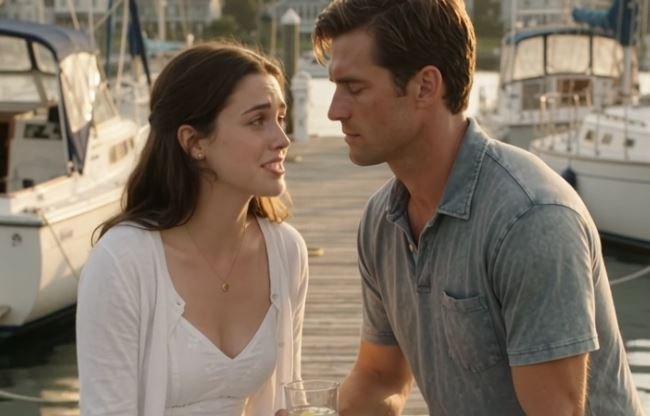
The evening of the story, the light was doing the thing — impossible gold, glass water, the whole harbor holding its breath. I’d taken maybe forty frames when I realized he’d stopped working and was simply standing on his dock, looking at me, with an expression three years in the making.
And then he knelt. By the cooler. And opened it. And the whole pier seemed to inhale.
“I’ve photographed this marina for three summers,” I whispered, sitting down on the dock cleat because my knees had voted no confidence. “You’ve been in half my shots without knowing it. And now you’re kneeling on this dock like a proposal I didn’t agree to.”
He didn’t speak. He stood — lemonade in hand, condensation on the glass, his sunset-lit face carrying three summers of unsent letters — and stepped close.
“If the harbormaster comes down the pier,” I breathed, “she’ll see the photographer and the boat guy, and my camera’s on the dock, and I can’t document my way out of this one—”
He turned my face with a hand on my jaw and kissed me. Slow. Moored. The harbor did its gold-trembling thing all around us, and for once I didn’t reach for the camera, which is how I know it was real, because I’ve never once in my life not reached for the camera.
“Daniel!” Ruth’s voice, from up the pier, having timed her arrival with the precision of a woman who had been waiting for this for three years. “You filling that cooler or proposing to it?”
He didn’t let go of my face. He turned his head — the only man in history to address a harbormaster mid-kiss — and called back, with unbearable calm: “Both. Give me a minute.”
“A MINUTE? I’VE GIVEN YOU THREE SUMMERS!”
We laughed into the kiss, and it broke, and we stood on that dock while Ruth marched down the pier, inspected us with the satisfaction of a general accepting surrender, and informed me — I had a name now, I was “the photographer,” capital T — that I would be joining the marina’s lobster bake on Saturday, that Daniel had been “practicing conversation” with her for three years (“he’s terrible at it, be patient”), and that if we broke up before fall she’d be “very disappointed in both of us, and the boat.”
The lobster bake became monthly. The conversation practice worked — haltingly, then suddenly, the way a sail fills. He told me about Second Chance: bought eleven years ago, the year his divorce finalized, named in a moment he’d regretted and then come to understand. “Not a second chance at marriage,” he said. “A second chance at paying attention. The first one, I sailed past everything.”
I showed him my shots — three summers of contact sheets, the accidental archive of him. He was quiet for a long time, turning pages, and then pointed at one: year one, blurred, him coiling a line at dawn, back to the camera.
“This one’s my favorite.”
“It’s out of focus.”
“So was I.”
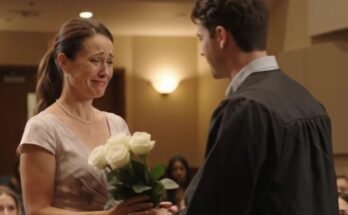
We married the following June, on the dock, twenty guests standing between the moored boats, Ruth officiating with her waterproof notebook — she got ordained online specifically, she loves telling people, “for the express purpose of speeding up slow men” — and the harbor doing its gold thing on cue, as if Ruth had scheduled it.
The nameboard went on at the reception. I’d had it made in secret: Second Chance on the starboard side, unchanged — and on the port side, new paint, my work photographed and printed and sealed under varnish:
FIRST CHOICE.
He saw it at the dock the next morning, stood in front of it for a full five minutes, and then did the only thing that ever made him speechless: he cried, once, hard, efficiently, like a man who’d learned to do everything with economy, and then he kissed me against the hull while Ruth, from up the pier, yelled — because Ruth is always watching, Ruth is the harbormaster of us all:
“ABOUT TIME! THREE SUMMERS!”
Some light you wait for. Some light waits for you.
The good harbors have both.