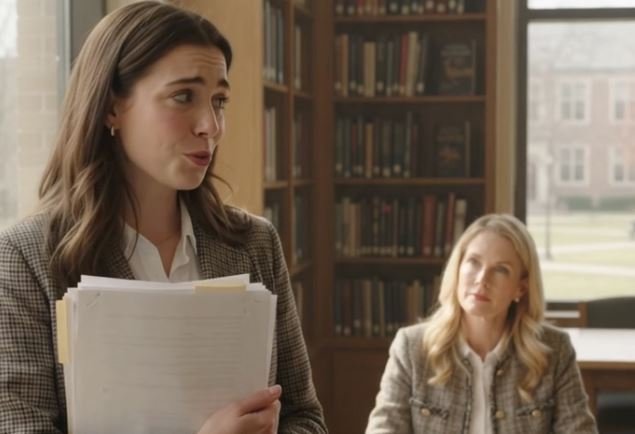
The letter. Everything was in the letter.
I learned this from the dean — Dean Ruiz, whom I knew from my doctoral program as the terrifying evaluator of my dissertation defense, and who turned out to be the third member of a conspiracy spanning two years and two states.
“When Sloane Voss,” he said, settling into the armchair across from us in his office, an hour after the lounge kiss, “writes me a recommendation letter about a former student, I read it twice. She has never once recommended a former student. The letter was three pages. It read like a sonnet with footnotes.”
Sloane had kept every rule. Two years, no contact beyond a single Christmas card with a margin drawing of two coffee cups. She’d tracked my career through publications and conference programs, the way you track weather. And when my doctoral advisor mentioned, at a panel they both attended, that I was on the market — “the market is BRUTAL this year, she may have to leave academia” — Sloane had gone home and written the letter that same night.
“I recommended you,” she told me, in the dean’s office, holding my hand with the calm of a woman out of patience, “because you were the best student I ever had and the worst-kept secret I ever kept. Both of those are recommendations. I sent it before I could re-read it and lose my nerve.”
The bet — Dean Ruiz and Sloane, a bottle of single malt, staked on whether I’d accept the offer. She’d bet “within a week.” He’d bet “you’ll dither for a month.” I accepted in four days, which, per the dean, “no one won, which is the only fair outcome, pour me a glass anyway.”
The faculty lounge kiss footage does not exist, but the dean’s retelling does, and it has become department legend: “I walked in on the new hire and Professor Voss in an embrace that suggested orientation was going well. I said, ‘Two years, six months, eleven days. I win.’ Professor Voss said, ‘Nobody won, you bet on the month.’ We agreed to split the bottle.”
We were careful anyway — two professionals, different departments, both grown women with tenure trajectories and a shared history that predated the job posting. HR’s relationship policy got its obligatory review; the university counsel, informed of the timeline (“the relationship began before the employment, counselor, we have the Christmas card”), ruled it boring and stamped it.
The first dinner — the one she’d promised in red ink — happened a week later, at the restaurant two towns over she’d booked two years earlier and kept re-booking, monthly, on standing reservation, “just in case.” The owner knew her by name. The corner table was always held. She’d been tipping a future that entire time.
“You re-booked for TWO YEARS?”
“Twenty-six reservations,” she said. “You cost me a fortune in unattended appetizers.”
The manuscript on the lounge table that day turned out to be a book — hers, her first monograph, and the acknowledgment page, which she showed me that night over the unattended appetizers’ revenge, read: “For E., who took the retake. The grade stands. Everything else is still under review.”
We’re engaged now. The ring is — she has a type — red. The wedding is in the spring, on campus, and the dean is officiating, because he won the bet, because he claims he always wins, because he read three pages of a recommendation letter and understood immediately what he was holding.
The original paper — “RETAKES” in red pen — hangs in her office. Students ask about it constantly. She gives them the same answer every time, and it’s become something of a department motto:
“Take the retake. The honest grade is the only one that leads anywhere worth going.”
Mine led to the fourth floor. To a red pen set down on a table. To two years, six months, eleven days, ending in a doorway.
She was right about everything, that first day. Especially the margins.