At exactly 2:17 a.m. on a cold October morning, veteran security guard Daniel Mercer began what should have been another routine patrol inside the abandoned Ridgeway Shopping Center outside Columbus, Ohio.
The mall had closed nearly fifteen years earlier. Most stores sat empty behind dusty glass, and only a handful of maintenance workers visited during daylight hours. At night, Mercer was completely alone.
According to maintenance logs, his first few patrols were uneventful.
Then something changed.
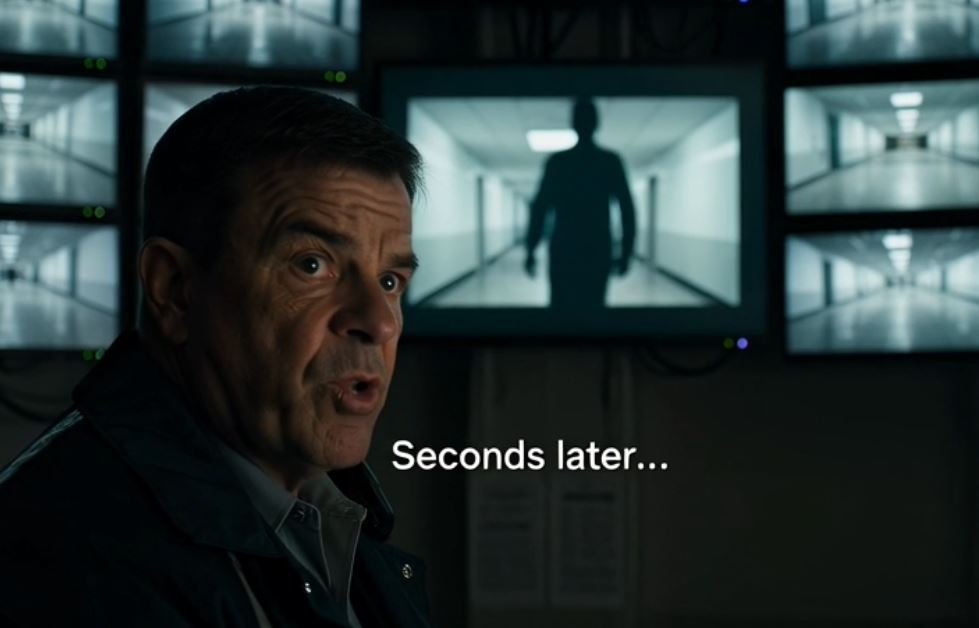
Security footage later reviewed by investigators shows Mercer suddenly stopping in front of the CCTV monitors. He leans closer to one screen displaying the east corridor.
For less than two seconds, what appears to be a dark figure can be seen standing motionless near an old department store entrance.
Mercer immediately radios dispatch.
“I’ve got someone inside.”
That would be the last confirmed communication anyone ever received from him.
Police later reconstructed his movements using dozens of surveillance cameras.
The footage shows Mercer leaving the security office carrying his flashlight. Calm but alert, he walks through several deserted hallways before approaching an aging steel maintenance door near the former loading docks.
Then something unusual happens.
As Mercer reaches the door, every nearby camera experiences brief static interference lasting approximately four seconds.
When the picture returns…
Mercer is gone.
No one is seen entering.
No one is seen leaving.
Only his flashlight remains lying on the concrete floor, its beam shining directly into darkness.
Search teams arrived before sunrise.
Officers carefully examined every accessible room, storage area, rooftop entrance, ventilation shaft, and basement tunnel.
They found no trace of Mercer.
No signs of violence.
No blood.
No fingerprints belonging to anyone else.
Nothing.
While reviewing old architectural records, investigators made another surprising discovery.
The hallway where Mercer’s flashlight was found didn’t appear on the official blueprints submitted during the mall’s construction.
Later renovations had apparently created a narrow maintenance corridor that had never been documented in updated plans.
When crews entered the hidden passage, they found it ended at a solid concrete wall.
There was nowhere for anyone to go.
Despite extensive forensic testing, investigators found no hidden exits or secret rooms.
Yet the surveillance footage clearly shows Mercer walking toward that corridor moments before disappearing.
Years later, the mystery remains unsolved.
Some former employees insist there had always been rumors surrounding that section of the building. They recalled hearing unexplained footsteps after closing, security alarms triggering in empty stores, and maintenance workers refusing to enter the eastern service corridor alone.
Others believe the explanation is much simpler.
Perhaps Mercer encountered an intruder who somehow escaped before police arrived.
Perhaps the aging camera system failed at the worst possible moment.
Or perhaps the incomplete building records still hide something investigators never discovered.
What keeps this case alive is not speculation—but evidence.
The flashlight.
The missing four seconds of surveillance footage.
The undocumented hallway.
And one unanswered question.
If Daniel Mercer walked into a dead-end corridor…
How did he never come back out?
Even today, local investigators acknowledge that the disappearance remains one of the area’s most puzzling unsolved cases. No body has ever been found, no suspect has ever been identified, and no credible explanation has managed to account for every piece of evidence.
Sometimes, the most unsettling mysteries aren’t the ones with impossible answers.
They’re the ones with almost enough evidence to make you believe there should be one.