The haunted house was called The Hollow, and it was the real deal — a converted textile mill on the edge of town, three floors of black curtains and fog machines, and a local legend status that meant October lines wrapped around the building. My friends went every year. I went every year under protest, screamed through every room on schedule, and spent the rest of the year insisting haunted houses weren’t fun.
The coffin room was new that season. A long corridor of antique coffins, most empty, one occupied — the actor springs out at the exact moment your eyes adjust to the dark. I knew the mechanic. I’d read the reviews. I walked in prepared, phone in hand, filming for my friends’ group chat, narrating in my bravest whisper: “Okay, coffins. One of these is fake. Probably the middle one—”
The middle one opened like a heartbeat.
I have never screamed louder. My phone left my hand in a ballistic arc that a physicist would frame. The actor — tall, dark-eyed, corpse-pale — hit his mark, loomed, and then, breaking character in a way the reviews had definitely not mentioned, said, very softly: “You dropped this. Later. Find me.” And pressed a torn ticket stub into my palm.
I found him. Obviously I found him — the stub had a number on it, Booth 3, actor break station, and my friends, when I told them, formed a human wall and marched me there like a jury delivering a verdict.
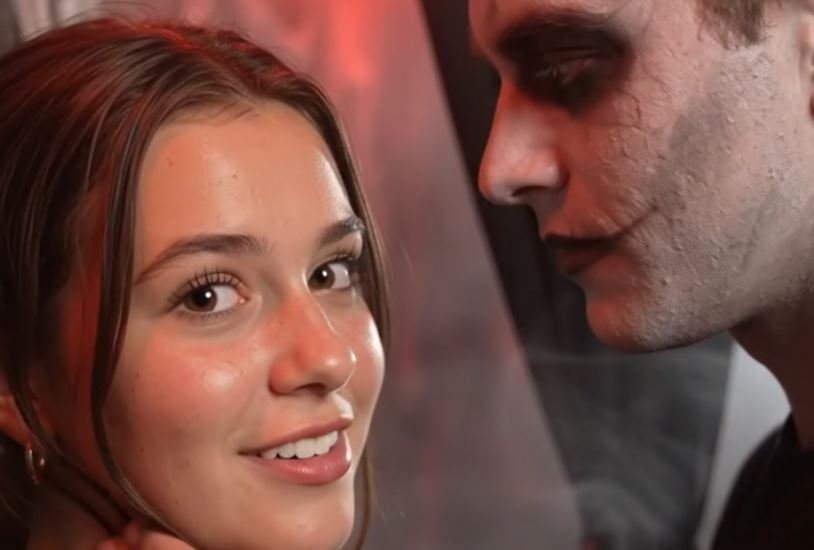
The curtain. The red bulbs. The fog. The half-removed makeup. The phone in his hand — my phone, cracked corner, eleven missed calls glowing on the lock screen, evidence of the ballistic arc.
“I dropped my phone running from a man with a chainsaw,” I whispered, and the absurdity of the sentence stood between us like a third person. “You jumped out of a coffin at me. And now you’re holding my phone hostage.”
He didn’t speak. Scare actors, it turns out, take the silent thing seriously — six seasons in, he’d perfected a communication style of looming and meaningful stillness that absolutely did not work outside the coffin corridor and absolutely worked on me anyway.
He typed something on my cracked phone. Turned the screen around.
It was his number. The contact he’d created read: THE COFFIN.
“If your manager pulls this curtain,” I breathed — and this is where I lost the thread of every sensible plan I’d ever had — “she’ll see a visitor off the route—”
He kissed me. Slow. Unmasked. Fog at our ankles, screams filtering through three floors of mill, and the strange electricity of October, the one month a year when darkness is decorative and fear is communal and kissing a stranger with half-removed corpse makeup behind a curtain feels not just permitted but themed.
“Break’s over, Daniel! And why is there a GUEST back here?!”
The manager — a woman named Roxie, headset, clipboard, haunted-industry lifer — swept the curtain aside. We separated like a jump scare in reverse. Daniel straightened, held up my phone with total professionalism, and said the line he’d clearly been saving:
“She dropped her phone. I was returning it.”
“Through your FACE?”
“Customer service is our brand.”
Roxie looked at me, looked at him, and delivered the verdict of a woman who has managed haunted-house actors for nineteen years: “Six seasons. Six seasons I’ve watched you scare people, Daniel, and you’ve never once broken character, and NOW you choose the coffin room to develop a PERSONALITY?” She pointed at me. “You. Is he bothering you, or is this mutual?”
“Mutual,” I said, and my face went as red as the bulbs.
“FINE. Visitor exit’s that way, actor’s off at ten, and Daniel—” she was already walking away — “if your scares are soft tonight, I’m telling everyone WHY.”
He was off at ten. I was at the waffle place across the parking lot at 9:55, pretending to read a menu I’d memorized. He arrived still half in makeup — the parking lot lights caught the pale paint, and a passing family screamed at him reflexively, and he raised one apologetic hand, and I decided, watching that, that I was going to love this man, which was insane, because I knew four things about him: his name, his coffin, his phone number, and his customer service philosophy.
We closed the waffle place. We talked until the staff stacked chairs around us. He told me about six seasons in The Hollow — the clown hallway (he refused; “a man has limits”), the chainsaw corridor (his specialty, the saw was fake, the cardio was real), and the coffin room, which he’d designed himself. “You narrated,” he said, grinning. “Everyone screams. You narrated. ‘Probably the middle one.’ I’ve done the coffin four hundred times. Nobody ever says which coffin they think it is. I had to know who said that.”
“That’s why you broke character?”
“That’s why I broke character.”
We dated through November, which is the strange, quiet aftermath season for haunted-house people — like dating a teacher in July, everything shuts down. He was, it turned out, a structural engineering grad student who did the scare acting for the adrenaline and the discount on The Hollow’s off-season storage unit. “The coffin is real,” he said, offhandedly, month one, and I had to put down my drink. “Antique. 1890s. I restored it. That’s the whole reason I auditioned — I wanted to work on the building. Roxie said the only opening was acting. So now I engineer by day and lie in a coffin by weekend.”
I photographed The Hollow for their website that off-season — my actual job, photography, and I understood mid-shoot that the season of screams was held together by quiet people with clipboards and dry-ice knowledge, and that the most haunted thing in the building was how much care went into it.
The proposal happened in the coffin corridor, obviously, in September, before the season opened, in an empty mill. No makeup. No fog. He’d put a single light in the middle coffin and rigged it to glow when I opened the lid, and inside, on the velvet, a ring box and a note:
“You guessed the middle coffin. Everything since has been you being right.”
We’re married two Octobers now. Every season, I do one shift at The Hollow — Roxie’s rule, “family policy” — and I work the coffin room. My coffin. His design. I lie in it in full makeup, and when the visitors file through, narrating and guessing, I spring out on schedule — but once a night, at exactly 10:40, I break character, exactly like he did.
I hand someone a torn ticket stub. Number on the back. Booth 3.
Roxie pretends to hate it. She schedules me for it.
And Daniel stands in the actor break station, behind the black curtain, phone in hand, waiting to be found.