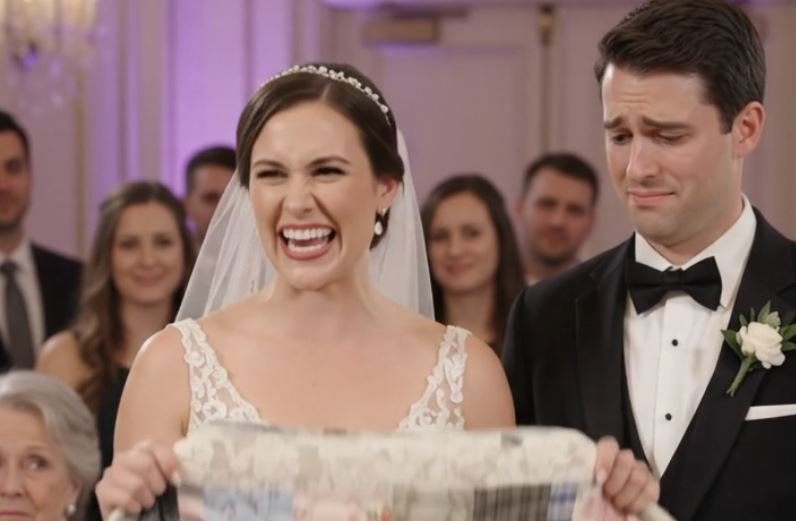
Chapter 1: The Gift They Laughed At
My grandson watched his new wife humiliate me in front of four hundred wedding guests.
But the cruelest part of that night wasn’t what she said about my gift.
It was what he didn’t say.
And when I finally found the strength to stand up and walk away, a hand caught mine, a chair scraped against the marble floor, and a man whose voice nobody in that ballroom dared ignore rose to his feet.
What happened afterward changed my family forever.
But to understand why, you need to know what was inside that quilt.
And why an eighty-two-year-old woman spent six months sewing together the last pieces of her life.
My name is Margaret Wilson.
I’m eighty-two years old. A widow. A mother who buried her only child. A grandmother who once believed love could survive anything.
I live in a little wooden house on the edge of a small Pennsylvania town. My husband, Thomas, built it nearly fifty years ago, back when his hands were strong enough to swing a hammer from sunrise to sunset.
The porch leans a little now. The roof complains every winter. One kitchen window hasn’t shut properly in years.
But it’s home.
It’s where my husband kissed me good morning for forty-three years.
It’s where our son, Michael, learned to walk.
And it’s where my grandson, Daniel, spent most of the happiest days of his childhood.
When Michael died, Daniel was only eleven.
His mother had been gone from his life for years, and there was nobody left to raise him except Thomas and me.
We never once considered it a burden.
Daniel was our boy.
Our reason to get up in the morning.
Our second chance to fill a house with laughter.
I taught him how to bake apple pie. Thomas taught him how to fix a bicycle chain. Every Saturday the three of us ate pancakes at the kitchen table while Daniel told stories that made us laugh until our sides ached.
Then Thomas died.
And suddenly the house became terribly quiet.
Daniel was grown by then, building his career in Philadelphia, and I was proud of him.
So proud.
He had become handsome, intelligent, successful. He wore tailored suits and worked in an office with windows overlooking the city.
Sometimes I barely recognized the confident businessman in the photographs he sent.
But whenever he called me Grandma, I could still hear the little boy who used to climb into my lap during thunderstorms.
At least, I thought I could.
When Daniel told me he was marrying a woman named Olivia Bennett, I cried with happiness.
I had always worried he would spend too much of his life working and not enough of it loving someone.
He told me Olivia was beautiful, sophisticated, and came from a prominent family.
“She’s different from us, Grandma,” he said once.
I remember smiling into the telephone.
“Different isn’t bad, sweetheart. As long as she’s kind.”
There was a pause.
Then Daniel laughed.
“Of course she is.”
I believed him.
I wanted to believe him.
Six months before the wedding, I began making their gift.
I couldn’t afford expensive appliances or designer furniture. My pension barely covered groceries, electricity, and the medication that kept my aching joints manageable.
But I could sew.
And I had something no department store could sell.
Memories.
I made a quilt from pieces of our family’s past.
A square from Daniel’s first baby blanket.
A piece of his school uniform.
Fabric from the shirt Thomas wore the day he taught Daniel to ride a bicycle.
A strip of lace from my wedding veil.
And stitched carefully into one corner, the words:
Daniel & Olivia. Together Forever.
I imagined them sleeping beneath it one day.
Maybe when they had children, Daniel would point to the faded squares and tell them about their great-grandfather.
Maybe the quilt would outlive me.
Maybe it would remind him that long before he became a successful man, he had been a little boy who was loved more than anything in this world.
I never imagined it would become a joke.
Yet there I was, standing beneath the glittering chandeliers of a luxury ballroom, watching Olivia hold my quilt between two fingers.
“Oh my God,” she said into the microphone. “What is this? Secondhand?”
Laughter rippled through the room.
I felt my face burning.
Daniel stood beside her in his black wedding suit.
He recognized the blue fabric. I saw it in his eyes.
But he said nothing.
Olivia lifted the quilt higher.
“Someone please tell Grandma we have actual stores in Philadelphia.”
More laughter.
I clutched my old leather purse.
For the first time in eighty-two years, I wished I could disappear.
And then I realized something.
I didn’t have to remain there.
I could simply leave.
So I stood up.
What I didn’t know was that someone had been watching from the other side of the ballroom.
Someone who had finally seen enough.
And the moment I reached the aisle, that person rose from his chair.
Chapter 2: Six Months of Love in Every Stitch
The first time I met Olivia, she looked at my house the way someone might look at a building scheduled for demolition.
Daniel brought her out on a Sunday afternoon.
I spent two days preparing.
I baked an apple pie using Thomas’s old recipe, polished the good silverware, and put fresh flowers in the chipped porcelain vase my son gave me one Mother’s Day.
I even covered the worn armchair with a clean crocheted throw.
When their expensive car rolled into my gravel driveway, I hurried out onto the porch.
Daniel stepped out first.
“Grandma!”
For one wonderful moment, he was my little boy again.
He hugged me so tightly my glasses slipped down my nose.
Then Olivia emerged from the passenger side.
Tall. Blonde. Impossibly elegant in cream trousers and a jacket that looked more expensive than my monthly pension.
“Olivia, sweetheart,” I said. “Welcome.”
She gave me a brief hug.
“Hi, Margaret.”
Not Grandma.
Not Mrs. Wilson.
Margaret.
I told myself it didn’t matter.
Inside, she looked around the living room without removing her sunglasses.
“Oh,” she said quietly.
Daniel glanced at her.
“What?”
“Nothing. It’s just… very rustic.”
I laughed.
“Well, the house has seen a few winters.”
Olivia smiled politely.
“Yes. I can tell.”
Over lunch, I asked about the wedding plans.
Olivia brightened immediately.
She described the ballroom, the flowers imported from overseas, the orchestra, and a cake so enormous it required a special delivery vehicle.
“Four hundred guests,” she announced proudly.
“Goodness,” I said. “That’s practically the whole town.”
She laughed.
“Well, we have a lot of important people coming.”
I noticed Daniel’s smile looked a little tight.
When I offered Olivia another slice of pie, she shook her head.
“I don’t really eat things with that much sugar.”
“Oh, I’m sorry, dear.”
“It’s fine.”
Later, while Daniel carried dishes into the kitchen, Olivia noticed the old blue blanket folded over my sewing chair.
“What’s that?”
“Daniel’s baby blanket.”
She touched it with one finger.
“You’re still keeping that?”
“Of course.”
“Wow. You really don’t throw anything away, do you?”
She laughed.
I tried to laugh with her.
But something in her voice reminded me of children mocking another child’s worn-out shoes.
That afternoon I started worrying about what on earth I could give them.
Everything they needed seemed already purchased.
They had registered at shops where a single dinner plate cost more than my weekly grocery budget.
When I mentioned making something myself, Daniel smiled.
“You don’t have to get us anything, Grandma.”
“I know I don’t have to. I want to.”
Olivia looked up from her phone.
“Just don’t put yourself under any financial pressure. We’re pretty particular about our home.”
Her words were polite.
Her meaning wasn’t.
A week later, I took Daniel’s old blanket out of the cedar chest.
I spread it across my bed.
The faded blue fabric was thin in places, and one corner still carried a tiny yellow stain from the time he spilled orange juice during a thunderstorm.
I remembered his frightened little face.
“Grandma, will the thunder hurt us?”
“No, sweetheart.”
“Promise?”
“Promise.”
I cut the first square with tears in my eyes.
Over the next six months, I worked every evening.
Some nights my fingers moved easily.
Other nights arthritis made even the smallest stitch feel like pushing a needle through stone.
I used the same wooden sewing box Thomas gave me for our twentieth anniversary.
Inside were buttons, spools of thread, and a little silver thimble he bought after watching me prick my finger.
“Can’t have you bleeding all over my shirts,” he’d teased.
I still heard his voice sometimes.
Especially at night.
Each square brought back another memory.
The blue blanket.
The school uniform.
Thomas’s brown work shirt.
A patch from Michael’s favorite flannel.
And the lace from my wedding veil.
I hesitated before cutting that lace.
For more than sixty years it had stayed wrapped in tissue paper.
But then I thought about Daniel building a new family.
And I wanted a small part of the old one to go with him.
When the quilt was finished, I sat for a long time looking at it.
The stitches were uneven.
The colors didn’t match perfectly.
One corner was slightly crooked.
But it was warm.
It was real.
And it carried nearly eighty years of love.
I folded it carefully, wrapped it in white paper, and tied it with the blue ribbon from Daniel’s high school graduation.
The evening before the wedding, I set the package beside my church dress.
Then I sat on the edge of my bed and whispered into the quiet room.
“Thomas, I wish you could see our boy get married.”
I thought I was prepared for the wedding.
I wasn’t.
Because the next day, I would discover that being poor wasn’t the most painful thing about growing old.
Being made to feel worthless by someone you love was far worse.
And Olivia knew exactly where to strike.
Chapter 3: Four Hundred Witnesses
The morning of the wedding, I woke before sunrise.
For a few seconds, lying beneath my faded cotton sheets, I forgot what day it was.
Then I saw the navy-blue dress hanging on my closet door.
My grandson was getting married.
I smiled.
I had waited a long time to see this day.
I made myself a small breakfast, took my medicine, and carefully arranged my silver hair into a neat bun. My hands weren’t as steady as they used to be, so it took three attempts to fasten the little pearl earrings Thomas gave me on our thirtieth anniversary.
I stood before the bathroom mirror.
The woman looking back had deep wrinkles, tired blue eyes, and shoulders that had grown slightly rounded with age.
My dress was almost fifteen years old.
I’d repaired the sleeves twice, and the hem had been let down after my knees began bothering me.
Still, it was clean and pressed.
“Not bad, Margaret,” I told my reflection.
Then I picked up the quilt.
I had wrapped it so carefully that I almost hated to see the paper opened.
On the kitchen table was a wedding card.
Inside, I’d written:
Dear Daniel and Olivia,
May your home always be filled with patience, laughter, forgiveness, and the kind of love that grows stronger through difficult years.
This quilt carries the memories of those who loved Daniel before he was old enough to remember them. I hope it brings warmth to your new life together.
All my love,
Grandma
I slipped the card beneath the ribbon.
Then I turned off the kitchen light and locked the front door.
A neighbor had offered to drive me into town, where a wedding shuttle would take guests to the hotel.
The shuttle was already half full when I boarded.
I recognized nobody.
Women in beautiful dresses chatted about jewelry and vacations. Men discussed investments and golf memberships.
I held the quilt on my lap.
A young woman across the aisle smiled at me.
“Are you related to the bride or the groom?”
“The groom,” I answered proudly. “I’m his grandmother.”
“Oh, how lovely.”
She looked at my package.
“Is that your gift?”
“Yes. I made it myself.”
“How sweet.”
I should have noticed the slight change in her expression.
But I was too happy to care.
The hotel rose above the city like a palace.
Tall glass doors opened into a lobby filled with marble columns, enormous floral arrangements, and staff members in black suits.
I stopped just inside the entrance.
For a moment I couldn’t move.
Everything shone.
Everything smelled of fresh roses and expensive perfume.
Even the air seemed different.
A young attendant approached.
“May I help you, ma’am?”
“I’m here for the Bennett-Wilson wedding.”
He smiled. “Of course. May I have your name?”
“Margaret Wilson.”
He checked a tablet.
Then his expression brightened.
“You’re the groom’s grandmother.”
“Yes.”
“Welcome, Mrs. Wilson.”
He took my coat and offered to carry my gift.
I almost refused.
Something about handing over the quilt frightened me.
But he assured me it would be placed with the other presents.
I watched it disappear through a doorway.
Then I went to find my seat.
The ceremony itself was beautiful.
Daniel stood beneath an arch of white roses. Olivia approached him wearing a sparkling gown with a long train carried by two attendants.
She looked like a princess.
I thought about the first time I’d seen Daniel in a little black suit.
He had been seven years old, standing beside his grandfather at church. The sleeves were too long, and he kept tugging at his collar.
“Grandma,” he’d whispered, “do I look like a businessman?”
“You look like the most handsome businessman in the world.”
That memory made me smile as he exchanged vows with Olivia.
When the officiant pronounced them husband and wife, everyone stood and applauded.
I stood too, though my knees protested.
I clapped until my palms stung.
There was a time when I’d imagined Thomas sitting beside me on this day.
I pictured him wiping his eyes and pretending it was only allergies.
He would have been proud.
So would Michael.
During the reception, the guests entered a ballroom more magnificent than anything I’d ever seen.
Crystal chandeliers glittered overhead. A live orchestra played near the stage. Gold-covered tables surrounded a polished dance floor, and white roses climbed the walls in enormous arrangements.
I looked down at my old shoes.
For a moment, I felt painfully out of place.
My assigned seat was near the back of the room, far from the wedding party.
The place card read Margaret Wilson in elegant gold lettering.
Beside me sat a middle-aged couple who introduced themselves as friends of Olivia’s family.
The woman wore a diamond necklace.
The man had a watch that flashed every time he lifted his glass.
“I’m the groom’s grandmother,” I told them.
“How nice,” the woman said.
Then they turned back to their conversation.
I ate slowly.
The food was delicious, though I couldn’t pronounce half the things on the menu.
Occasionally I caught a glimpse of Daniel.
He was laughing with guests, shaking hands, accepting congratulations.
I waited for him to come over.
He didn’t.
I told myself he was busy.
Of course he was busy.
It was his wedding day.
But after the main course, when I saw him speaking with friends near the bar, I made my way toward him.
“Daniel, sweetheart.”
He turned.
“Grandma!”
He kissed my cheek.
“Are you having a good time?”
“Oh, yes. Everything is beautiful.”
“Good.”
I looked at Olivia, who stood beside him.
“You look lovely, dear.”
“Thank you, Margaret.”
I hesitated.
“Daniel, there’s something I’d like to tell you about my wedding present. When you open it—”
Olivia interrupted.
“Oh, we’re opening selected gifts onstage later. Our planner arranged a little presentation.”
My stomach tightened.
“Onstage?”
“Yes. It’ll be fun.”
I looked at Daniel.
“I was hoping you could open mine privately.”
He smiled distractedly.
“Don’t worry, Grandma. I’m sure it’s wonderful.”
“But there’s a story behind it.”
“I know. We’ll talk afterward, okay?”
Someone called his name.
He squeezed my shoulder and walked away.
Olivia followed.
I stood there for a moment, feeling strangely foolish.
Then I returned to my table.
Later, the reception host stepped onto the stage.
“Ladies and gentlemen, we’d like to share a few special gifts with our newlyweds!”
The lights dimmed.
A spotlight settled on the gift table.
The first present was a set of designer luggage.
Everyone applauded.
The second was an expensive coffee machine.
Olivia squealed with delight.
The third was a large framed piece of modern art.
There were cheers and jokes about the couple’s new apartment.
I tried to relax.
Perhaps my gift wouldn’t be chosen.
Perhaps Daniel and I could talk quietly afterward.
Then the host lifted a white package tied with a faded blue ribbon.
“And now, a special gift from Grandma Margaret!”
My heart began to pound.
Olivia stepped forward.
“Oh, this should be interesting.”
A few guests laughed.
She untied the ribbon and tore away the paper.
The quilt unfolded beneath the chandeliers.
I held my breath.
Daniel stared at it.
For one brief second, his expression changed.
He reached toward a faded blue square.
“Wait,” he murmured. “Is that—”
Olivia lifted the quilt away from him.
“Oh my God.”
She looked directly at the audience.
“What is this? Secondhand?”
Laughter scattered across the tables.
I felt the blood rush into my face.
Olivia shook the quilt.
“Seriously, guys. Is it vintage, or just budget-friendly?”
More laughter.
The host chuckled nervously.
Daniel looked at the blue square again.
I waited.
Surely he would explain.
Surely he would say that it had been his childhood blanket.
Instead, he looked toward the audience and gave an uncomfortable little smile.
Olivia continued.
“I mean, it’s thoughtful, I guess. But we’d prefer a designer bedspread, not something that looks like it came from a garage sale.”
Someone clapped.
Someone whistled.
A man near the front raised his phone and started recording.
Olivia pinched the lace square between her fingers.
“And what’s this? Old curtains?”
My breath caught.
My wedding veil.
She was holding a piece of the veil I’d worn when I married Thomas.
For sixty-one years, that lace had represented one of the happiest moments of my life.
Now it was being treated like trash.
I looked at Daniel.
His face had gone pale.
He knew.
I could see that he knew.
But he lowered his eyes.
That was the moment I stopped waiting for him to defend me.
I had survived losing my husband.
I had survived burying my son.
I had survived lonely Christmas mornings and birthdays when the telephone never rang.
But I couldn’t sit there and watch the last person I loved allow strangers to laugh at everything our family had been.
I pushed back my chair.
My knees trembled.
The woman beside me glanced up.
“Are you all right?”
“Yes,” I whispered.
I wasn’t.
I picked up my purse.
I didn’t want to make a scene.
I didn’t want revenge.
I only wanted to get outside before the tears came.
I walked toward the aisle, keeping my head down.
The laughter continued behind me.
Then, just as I reached the edge of the dance floor, a hand closed around mine.
Not roughly.
Firmly.
Warmly.
I looked down.
It belonged to a tall man with silver hair and a dark blue suit.
His chair had scraped loudly against the marble.
He stood beside me, holding my hand as though he was afraid I might fall.
“Mrs. Wilson,” he said quietly. “Please don’t leave.”
I recognized him.
I’d been introduced to him briefly before the ceremony.
His name was Richard Bennett.
Olivia’s father.
He looked toward the stage.
Then, without releasing my hand, he spoke in a voice that carried across the entire ballroom.
“Olivia.”
Something in his tone made the nearest guests turn.
“Put that quilt down.”
The laughter began to fade.
Olivia looked at him.
Her smile froze.
“Dad?”
Richard didn’t smile back.
“Put it down. Now.”
The orchestra fell silent.
The reception host lowered his microphone.
And then Richard Bennett said something that made four hundred people turn toward me.
“Before anyone else laughs at this woman, I think you should all understand what you’re laughing at.”
Chapter 4: The Man Who Refused to Remain Seated
For several seconds, nobody moved.
I could hear the faint hum of the air-conditioning.
Somewhere behind me, a glass touched a table.
Richard Bennett stood beside my chair with my hand resting in his.
I’d met him only twice.
The first time had been during a family dinner two months before the wedding.
The second had been that morning, when he greeted me outside the ceremony room.
He was a successful man, that much I knew. Daniel had once told me Richard owned several businesses and employed hundreds of people.
But I hadn’t paid much attention to his wealth.
What I remembered was how he had looked directly into my eyes when he shook my hand.
And how he had asked about the little wooden house Daniel sometimes spoke of.
“You still live in the house your husband built?” he’d asked.
“Yes, sir.”
“That must be something special.”
“It is to me.”
He’d smiled.
“I can imagine.”
Now he stood in front of me, his expression hard.
Olivia held the quilt against her gown.
“Dad, what are you doing?”
Richard looked at her.
“I’m asking you to stop humiliating an elderly woman at your wedding.”
A sharp silence followed.
Olivia gave a little laugh.
“Oh, come on. It’s just a joke.”
“Was she laughing?”
Olivia blinked.
“What?”
Richard gestured toward me.
“Margaret. Was she laughing?”
Olivia looked in my direction for the first time since opening the gift.
I wished she hadn’t.
My eyes were wet, and I could feel my cheeks trembling.
“Well, obviously she doesn’t understand our humor,” Olivia said.
Richard’s jaw tightened.
“Then perhaps the humor is the problem.”
A few people shifted uncomfortably.
Olivia glanced toward Daniel.
“Daniel, say something.”
There it was again.
That terrible expectation.
I looked at my grandson.
He stood beneath the chandelier, one hand hanging at his side, the other gripping the edge of the gift table.
His face was red.
He opened his mouth.
Then closed it.
Richard watched him for a moment.
“Daniel,” he said, “do you know what that quilt is made of?”
Daniel swallowed.
“Yes.”
“Then perhaps you’d care to explain it.”
Olivia turned sharply.
“Explain what? It’s a blanket.”
Daniel looked down at the quilt.
“No,” he said softly.
It was the first word he’d spoken since Olivia began making jokes.
Richard waited.
Daniel touched the faded blue square.
“That’s my old baby blanket.”
The room remained silent.
Olivia frowned.
“What?”
“My blanket,” Daniel repeated. “From when I was little.”
He ran his fingers across the fabric.
I remembered how he’d held that blanket beneath his chin when he was frightened.
How I’d washed it a hundred times.
How he’d refused to sleep without it until he was nearly eight.
Daniel touched another square.
“This was my school uniform.”
His voice sounded strained.
I pressed my lips together.
“And that brown piece,” he continued, “was my grandfather’s shirt.”
Olivia stared at him.
“How would you even know that?”
“Because he wore it almost every weekend.”
Daniel’s hand stopped over the lace.
He looked toward me.
“Grandma?”
I couldn’t answer.
He lifted the corner carefully.
“Is this from your wedding dress?”
“My veil,” I whispered.
Richard heard me.
He turned slightly.
“Your wedding veil?”
I nodded.
“The one I wore when I married Thomas.”
For the first time, Richard looked genuinely shaken.
He glanced at the lace, then back at Olivia.
“My daughter just mocked your wedding veil in front of four hundred people.”
“Richard,” a woman said from the front table.
I recognized Olivia’s mother, Catherine.
Her expression was pale.
“Perhaps we should handle this privately.”
Richard looked at her.
“That would have been a wonderful idea before the microphone came out.”
Nobody answered.
Olivia’s face darkened.
“This is ridiculous. You’re making it sound like I committed some terrible crime.”
“No,” Richard said evenly. “I’m making it clear that you’ve hurt someone.”
Olivia crossed her arms.
“On my wedding day.”
“Yes,” he replied. “On your wedding day.”
Her eyes filled with angry tears.
“You are embarrassing me.”
Richard looked at the guests.
Then at the quilt.
“Interesting, isn’t it?”
“What?”
“How quickly embarrassment becomes important when you’re the one feeling it.”
That line seemed to hang beneath the chandeliers.
I wanted to pull my hand away.
I wanted to disappear.
But Richard held on gently.
“Mrs. Wilson,” he said, lowering his voice, “would you be willing to tell us about the quilt?”
My first instinct was to refuse.
I had never spoken before four hundred people.
I’d spent most of my life working quietly, raising a family, making meals, washing clothes, and doing the kind of things nobody notices until they stop getting done.
I was not a woman accustomed to microphones.
And I was frightened.
Not of Olivia.
Not even of the people watching me.
I was frightened that if I spoke, I might begin crying and never be able to stop.
“I don’t think I can,” I whispered.
Richard nodded.
“Then you don’t have to.”
He gave my hand a small squeeze.
“You don’t owe anyone here an explanation.”
That sentence did something unexpected.
It gave me a choice.
For the first time that evening, someone had spoken to me as though my wishes mattered.
I looked at the stage.
At Olivia in her sparkling gown.
At Daniel, holding the quilt as if he had only just realized what it contained.
I thought about six months of aching fingers.
About Thomas’s old shirt.
About the veil.
About a little boy standing on my porch, asking if I would be waiting when he came home from school.
And suddenly, I didn’t want to leave without saying something.
Not because I wanted to shame anyone.
Because if I walked away silently, the people in that room would remember only Olivia’s joke.
They would never know about the love she’d been holding in her hands.
I straightened my shoulders.
“Mr. Bennett,” I said.
“Richard, please.”
“Richard. I think… I think I would like to explain.”
He searched my face.
“Are you certain?”
I nodded.
He offered his arm.
I took it.
Every step toward the stage felt impossibly long.
The marble floor seemed to stretch beneath my shoes.
I could hear chairs shifting as people turned to watch.
A young server near the aisle lowered his tray and stepped aside.
The reception host stood frozen at the microphone.
When Richard and I reached the stage, he gestured toward the host.
“Would you please give Mrs. Wilson the microphone?”
The young man hurried to obey.
I accepted it with trembling fingers.
It felt heavy.
Much heavier than I’d expected.
I looked out at the crowd.
Four hundred faces.
Four hundred people who had been laughing only moments earlier.
And somewhere in that sea of strangers, I saw a young woman wiping her eyes.
I took a breath.
“My name is Margaret Wilson,” I began.
My voice came out thin and shaky.
I cleared my throat.
“I’m Daniel’s grandmother.”
I glanced at him.
He was watching me now.
Really watching me.
“For those of you who don’t know, Daniel’s father was my only son.”
The room was silent.
“His name was Michael. He died when Daniel was eleven years old.”
Daniel lowered his head.
“My husband, Thomas, and I raised Daniel after that. We didn’t have much money, but we had a little house, a garden, and enough love to make the days feel full.”
I paused.
“My husband died nine years ago.”
Someone near the front murmured softly.
“So when Daniel told me he was getting married, I wanted to give him something from all the people who couldn’t be here.”
I looked at the quilt.
“Would you mind unfolding it, sweetheart?”
Daniel’s hands shook as he opened it.
For the first time, the quilt was spread flat instead of being held up like a joke.
Under the ballroom lights, its faded squares seemed almost painfully ordinary.
A patch of blue.
A patch of brown.
A strip of lace.
Little pieces of fabric most people would have thrown away.
I pointed to the blue square.
“That was Daniel’s baby blanket.”
I smiled despite my tears.
“He used to drag it everywhere. Once he dropped it into a puddle and cried for an hour because he thought it was ruined. I washed it, dried it by the stove, and told him his blanket was tougher than it looked.”
A few guests smiled.
Not cruelly this time.
Gently.
I pointed to the gray fabric beside it.
“This was part of his first school uniform. He was frightened on his first day. He stood on my porch and asked if I’d still be there when he got home.”
I looked at Daniel.
“I told him I would always be waiting.”
Daniel pressed his lips together.
His eyes were wet.
I continued.
“The brown square was cut from Thomas’s work shirt. He wore it the day he taught Daniel to ride a bicycle without training wheels.”
A memory rose so clearly that for a moment I could almost smell freshly cut grass.
“Thomas ran behind him all the way down our driveway, holding the seat. When he finally let go, Daniel kept pedaling. He didn’t realize he was riding by himself until he reached the road.”
I laughed softly.
“Then he turned around, saw his grandfather standing fifty feet away, and fell straight into the grass.”
This time, the laughter was different.
Warm.
Affectionate.
The kind of laughter I’d hoped the wedding would contain.
I pointed to a red-and-black square.
“That came from my son Michael’s old flannel shirt. Daniel’s father used to wear it when he took him fishing.”
My voice faltered.
“Michael didn’t get to see his boy become a man. He never got to teach him how to drive or stand beside him on his wedding day.”
I stopped.
The pain was still there after all those years.
It always would be.
“But I thought… perhaps a little piece of him could be here anyway.”
Someone began crying quietly.
I didn’t look to see who.
Finally, I touched the lace.
“And that was from my wedding veil.”
I looked toward the chandeliers.
“Thomas and I were married when we were very young. We didn’t have money for a grand wedding. My mother helped me make my dress, and the reception was held in the church basement.”
I smiled at the memory.
“We had sandwiches, lemonade, and a cake that leaned to one side because the icing was too soft.”
A few people laughed softly.
“But we were happy.”
My throat tightened.
“We were very happy.”
I looked at Olivia.
Her expression had changed.
She was no longer smiling.
“For sixty-one years, I kept that veil wrapped in tissue paper. When I heard Daniel was getting married, I cut a piece from it because I wanted to share something from the happiest day of my life.”
I lowered my eyes.
“I know the quilt isn’t fashionable.”
My hands trembled.
“I know the colors don’t match.”
I looked at the beautiful tables, the enormous flowers, the diamond necklaces.
“And I know it doesn’t belong in a room like this.”
“No,” Richard said quietly from beside me.
I turned toward him.
He shook his head.
“That’s not true.”
His eyes were shining.
“Please continue.”
I swallowed.
“I spent six months making it. Some nights my hands hurt so badly I couldn’t hold the needle. But I kept working because I thought Daniel might want something that reminded him of home.”
I looked directly at my grandson.
“You don’t have to use it, sweetheart.”
His face crumpled.
“You don’t even have to keep it.”
“Grandma—”
I lifted my hand gently.
“Please. Let me finish.”
He fell silent.
“I never expected an expensive gift in return. I didn’t make this because I wanted anyone to admire my sewing.”
My voice became steadier.
“I made it because one day I won’t be here.”
A woman near the front covered her mouth.
“And when that day comes, I wanted Daniel to have something he could hold. Something that reminded him he was loved before he had a good job, before he wore expensive suits, before he knew anyone important.”
I looked at the quilt one last time.
“I thought maybe, when he touched these old pieces, he would remember us.”
Silence.
Not an uncomfortable silence.
Something deeper.
I could hear someone breathing near the stage.
I looked down at the microphone.
Then I said the words I’d been holding inside me since Olivia first laughed.
“I came here today because I love my grandson. I didn’t come here to be laughed at.”
My voice broke.
“And I certainly didn’t come here to watch him stand silently while someone made fun of his father and grandfather.”
Daniel flinched.
I hadn’t meant to hurt him.
But the truth had finally escaped.
I handed the microphone back to the host.
“I’m sorry for interrupting your celebration.”
I turned toward Richard.
“Thank you for your kindness.”
Then I stepped away.
I had said everything I needed to say.
I didn’t want applause.
I didn’t want sympathy.
I wanted to go home.
But before I could leave the stage, Daniel spoke.
“Grandma.”
I stopped.
His voice sounded different.
Small.
Uncertain.
Like a little boy who had done something wrong and was afraid to face the person he’d hurt.
“Grandma, please.”
I turned slowly.
He was standing beneath the lights, still holding the quilt.
Tears ran down his face.
And for the first time that evening, he looked directly into my eyes.
“I remember,” he whispered.
Then he said something that brought tears to my own eyes all over again.
“I remember every single piece.”
Chapter 5: The Apology That Came Too Late
I had dreamed of hearing Daniel say those words.
For months, while stitching the quilt beneath my kitchen lamp, I had imagined his expression when he recognized the pieces.
I thought he might laugh at the memory of his old blanket.
I thought he might run his fingers over his grandfather’s shirt and tell Olivia about the summer he learned to ride a bicycle.
I even imagined him embracing me.
But I had never imagined he would recognize those memories while standing in front of four hundred silent strangers, with tears on his face and shame in his eyes.
“I remember every single piece,” he repeated.
His voice trembled.
He looked down at the quilt.
“Grandpa wore this shirt when he taught me to ride my bike. I remember because he tore the pocket on the fence that afternoon, and you were angry with him.”
Despite everything, I smiled faintly.
“I wasn’t angry, sweetheart. I was worried he’d hurt himself.”
Daniel gave a broken little laugh.
“He told me not to tell you he’d fallen.”
“He told me the same thing.”
There was a soft ripple of sympathetic laughter from the audience.
Daniel touched the blue square.
“And this blanket…”
He stopped.
I could see him struggling.
“I used to sleep with it every night.”
“Yes.”
“Even after Dad died.”
My throat tightened.
“Especially after your father died.”
He lifted his eyes.
“You used to sit beside my bed until I fell asleep.”
I nodded.
“Some nights you were afraid I’d leave.”
Daniel wiped his cheek with the back of his hand.
“I remember.”
For a moment, the ballroom seemed to disappear.
There was only my grandson and me.
The grown man and the frightened boy.
The expensive suit and the little blue blanket.
Then Daniel looked toward Olivia.
And the spell broke.
Olivia stood beside the gift table, her cheeks flushed beneath her makeup.
Her expression was a mixture of embarrassment, anger, and something I couldn’t quite identify.
She wasn’t looking at me.
She was looking at the guests.
At their faces.
At the phones still pointed toward the stage.
“Can we please stop this?” she asked sharply.
Daniel turned.
“Olivia—”
“This has gone far enough.”
Richard stepped forward.
“Olivia.”
“No, Dad. Seriously. This is supposed to be my wedding reception, and somehow everyone’s acting like I’ve done something unforgivable.”
Catherine rose from her chair.
“Sweetheart, lower your voice.”
Olivia stared at her mother.
“You’re taking their side too?”
Richard looked exhausted.
“There aren’t sides, Olivia. There’s a woman you humiliated and an apology you haven’t offered.”
Olivia folded her arms.
“Oh, I’m sorry. Is that what everybody wants to hear?”
I felt something cold settle in my stomach.
I had known people like Olivia before.
People who believed that saying the word sorry was the same as feeling it.
She turned toward me.
“Margaret, I’m sorry you were offended.”
Richard closed his eyes.
I looked at her calmly.
“Thank you, dear.”
She seemed surprised.
Perhaps she’d expected an argument.
Perhaps she wanted me to accuse her so she could defend herself.
But I had no desire to fight with a young woman on her wedding day.
I simply wanted to leave.
Richard, however, wasn’t finished.
“That’s not an apology, Olivia.”
She threw up her hands.
“What do you want me to say?”
“The truth.”
“What truth?”
“That you deliberately made a kind woman feel small because her gift wasn’t expensive enough for you.”
Olivia’s eyes flashed.
“I didn’t deliberately do anything!”
Richard nodded toward the microphone.
“You held her gift up for an entire room to laugh at.”
“It was a joke!”
“Then explain the joke to me.”
She stared.
“What?”
“Explain what’s funny about an elderly woman spending six months making something for her grandson.”
Olivia said nothing.
Richard continued.
“Explain what’s funny about a piece of his dead father’s shirt.”
Her face went pale.
“Or a wedding veil that his grandmother kept for sixty-one years.”
“Dad, stop.”
“Explain it.”
“I said stop!”
Her voice cracked across the ballroom.
Several guests looked away.
I felt a strange sadness watching her.
She looked young suddenly.
Not innocent.
But young.
Like someone who had never been forced to consider what her words could do to another person.
Richard took a slow breath.
“I’m not trying to destroy your wedding, Olivia.”
“Well, you’re doing a wonderful job.”
“No. You began doing that yourself when you turned someone else’s love into entertainment.”
He looked toward Daniel.
“And you helped her.”
My grandson went very still.
Richard’s voice softened, but the words remained firm.
“Daniel, I know you’ve worked hard to build your career. I know you want to fit into Olivia’s world. But no promotion, no business connection, no expensive wedding is worth what you just did to the woman who raised you.”
Daniel stared at him.
For a moment, I saw something pass across my grandson’s face.
Recognition.
Not of the quilt.
Of himself.
I remembered how he’d changed over the years.
At first, it had been small things.
He stopped calling every Sunday because he was busy.
Then he began apologizing for the way he spoke around his new friends.
Once, when I visited his apartment, he quietly asked me not to mention how little money we’d had when he was growing up.
“People don’t need to know all that, Grandma,” he’d said.
I’d thought he was simply private.
Now I wondered whether he had slowly begun to feel ashamed of where he came from.
Of our little house.
Of our old clothes.
Of the life Thomas and I had given him.
The thought hurt more than I wanted to admit.
Daniel turned toward me.
“Grandma, I’m sorry.”
His voice was barely audible.
I held my purse against my stomach.
“I know, sweetheart.”
“No. You don’t understand.”
He stepped closer.
“I saw what Olivia was doing.”
I waited.
“I knew it was wrong.”
His eyes filled again.
“And I just stood there.”
Nobody spoke.
Daniel looked at the guests.
“I knew that was my baby blanket. I knew that was Grandpa’s shirt. When she started laughing, I wanted to tell her to stop.”
“Then why didn’t you?” Richard asked.
Daniel swallowed.
“Because I was afraid.”
Olivia made a disbelieving sound.
“Afraid of what?”
Daniel looked at her.
“Of embarrassing you. Of starting an argument. Of ruining everything.”
He gestured helplessly at the ballroom.
“All these people. Your family. The wedding. Everything we’ve planned.”
Olivia stared at him.
“So you’re blaming me?”
“No.”
He shook his head.
“I’m blaming myself.”
Those words seemed to cost him something.
He turned back toward me.
“I spent so long trying to become someone important that I forgot what was important.”
Tears rolled down his cheeks.
“I was ashamed to tell people where I grew up.”
I felt my heart squeeze.
He continued.
“Not because you did anything wrong. Because I was afraid they’d think less of me.”
I looked at him.
“My boy…”
He shook his head.
“And now you’ve stood here and told four hundred people exactly where I came from.”
His voice broke.
“And it’s the best thing anyone has said about me tonight.”
I covered my mouth.
For a moment, I wanted to go to him.
I wanted to wrap my arms around him and tell him everything was forgiven.
That no matter what happened, he would always be my boy.
But something stopped me.
Maybe it was age.
Maybe it was grief.
Or maybe, after eighty-two years, I had finally learned that loving someone didn’t mean protecting them from the consequences of hurting you.
Daniel stepped down from the stage.
He stopped a few feet away.
“Grandma, can you forgive me?”
Four hundred people seemed to be holding their breath.
I looked at the man I’d raised.
The boy who’d once brought me dandelions and called them flowers.
The teenager who’d cried in my kitchen after failing his driving test.
The young man who’d promised me that no matter where life took him, he’d never forget his family.
I still loved him.
Nothing could change that.
But I could not pretend the past twenty minutes hadn’t happened.
“Daniel,” I said softly, “I have loved you since the day you were born.”
He nodded, tears falling freely.
“And I will love you until the day I die.”
He took a step toward me.
“But love doesn’t make what happened disappear.”
He stopped.
I looked into his eyes.
“You didn’t have to embarrass your wife. You didn’t have to make a speech. You didn’t even have to argue.”
My voice trembled.
“All you had to do was stand beside me.”
He closed his eyes.
“Grandma…”
“Just one sentence, Daniel. That’s all I needed.”
I wiped a tear from my cheek.
“She’s your grandmother. She made that with love.”
His shoulders shook.
“One sentence would have been enough.”
He began crying openly.
I had seen him cry many times as a child.
But never like that.
I wanted to comfort him.
Instead, I reached out and touched his cheek.
“You must learn something tonight, sweetheart.”
He opened his eyes.
“Being a good man isn’t about the suit you wear, the money you earn, or the people who invite you to dinner.”
I took a breath.
“It’s about what you do when someone you love is being hurt.”
Richard looked away.
Several guests were wiping their eyes.
“And tonight,” I whispered, “you let me down.”
Daniel’s face crumpled.
“I know.”
I nodded.
“Then don’t forget how this feels.”
For several seconds, neither of us moved.
Then he held out the quilt.
“Please take it back,” he whispered.
I looked at him.
“Why?”
“Because I don’t deserve it.”
I studied the quilt.
The faded squares.
The uneven stitches.
The little corner embroidered with their names.
I remembered the nights I’d sat sewing, imagining his future.
Then I shook my head.
“No, Daniel.”
He looked confused.
“I made that for you.”
“But—”
“It belongs to you now.”
I touched the blue square.
“What you do with it is your choice.”
Then I turned toward Richard.
“I think I’d like to go home.”
He nodded immediately.
“Of course.”
Daniel reached for my arm.
“Grandma, let me take you.”
I gently stepped away.
“No, sweetheart.”
He froze.
“You should stay. You have a marriage to begin.”
I looked at Olivia.
She stood motionless, her expression unreadable.
Then I turned back to Daniel.
“And I have some things to think about.”
His hand fell to his side.
Richard offered me his arm.
I accepted it.
As we walked toward the ballroom doors, I heard a sound behind us.
One person had begun clapping.
Then another.
Then another.
Within seconds, applause filled the room.
I kept walking.
I didn’t turn around.
Because I knew the applause wasn’t what mattered.
The truth had finally been spoken.
And no amount of clapping could make it painless.
At the ballroom entrance, Richard leaned toward me.
“Mrs. Wilson, may I ask you something?”
“Of course.”
He glanced back toward the stage.
“Did anyone offer you a private place to sit when you arrived?”
I shook my head.
“Or arrange for someone to help you get home?”
“No. I was planning to take a taxi.”
His face hardened again.
Then he said quietly, “There’s something I’d like to tell you about your grandson. Something I think you deserve to know.”
I stopped.
For a terrible moment, I wondered whether there was more humiliation waiting for me.
Richard looked at me with genuine sadness.
“Daniel once told me that everything good in his life began with you.”
My eyes filled.
“Then I wish he’d remembered that tonight.”
Richard nodded.
“So do I.”
And for the first time all evening, I felt that someone truly understood.
Chapter 6: The Quiet After the Laughter
Richard arranged for a driver to take me home.
He offered to have someone bring my coat and belongings from the ballroom, but I told him my purse was all I needed.
He walked with me through the hotel lobby.
The polished floors reflected the overhead lights, and the sound of the wedding reception faded behind us.
Outside, the October air was cool.
I took a deep breath.
It was the first breath that hadn’t felt trapped in my chest for hours.
Richard waited beside me while the car was brought around.
“I’m sorry, Margaret,” he said.
I looked at him.
“You have nothing to apologize for.”
He shook his head.
“I raised Olivia. I love my daughter, but I won’t pretend her behavior tonight was acceptable.”
I studied his face.
Under the hotel lights, he looked older than he had that morning.
“Parents can’t always control what their children become,” I said gently.
“No,” he replied. “But sometimes we help create their worst habits without realizing it.”
I said nothing.
He looked through the glass doors toward the ballroom.
“Olivia grew up surrounded by people who praised everything she did. When she was little, I thought giving her the best of everything meant being a good father.”
He gave a tired smile.
“I didn’t always remember to teach her what was worth having.”
I understood that regret.
Every parent carries a few.
Every grandparent too.
“I imagine she has good qualities,” I said.
Richard looked at me.
“She does.”
“Then I hope she remembers them.”
He seemed surprised.
“After what she did?”
I nodded.
“Anger won’t make me younger, Richard. And it won’t give me back this evening.”
I adjusted the strap of my purse.
“But I won’t let her treat me that way again.”
He gave a slow nod.
“That’s fair.”
The driver arrived.
Richard opened the car door himself.
Before I climbed inside, I turned toward him.
“Thank you for stopping me.”
He smiled sadly.
“I couldn’t let you walk out of there believing everyone agreed with her.”
I gripped his hand.
“That meant more than you know.”
As the car pulled away, I looked back at the hotel.
The enormous windows glowed against the dark sky.
Inside, hundreds of people were still gathered beneath the chandeliers.
I wondered whether the music had started again.
Whether Olivia had wiped away her tears and returned to smiling for photographs.
Whether Daniel was still holding the quilt.
I wondered what would happen between them after everyone went home.
Then I closed my eyes.
I was too tired to think about it anymore.
The drive took nearly an hour.
When we reached my house, the driver insisted on walking me to the porch.
He waited until I found my keys and switched on the hall light.
“Good night, Mrs. Wilson.”
“Good night. Thank you for bringing me home.”
I stepped inside.
The familiar smell of old wood and lavender greeted me.
My worn armchair sat beside the window.
Thomas’s photograph rested on the mantel.
A half-finished crossword lay on the kitchen table.
Nothing had changed.
Yet I felt as though I’d returned from a place where something precious had been taken from me.
I set down my purse.
Then I sat in Thomas’s chair.
For a long time, I stared at his photograph.
“You would have said something,” I whispered.
I could almost hear his answer.
Of course I would, Maggie.
Thomas had never been a loud man.
He didn’t enjoy arguments.
But when something was wrong, he had a way of standing straight, looking a person in the eye, and speaking the truth without raising his voice.
I remembered an afternoon from many years earlier.
Daniel had been nine.
A boy at school had mocked him because his shoes were worn.
He came home furious and embarrassed.
“Why can’t I have shoes like everyone else?” he’d demanded.
Thomas sat him down at the kitchen table.
“Are your shoes hurting your feet?”
“No.”
“Can you run in them?”
“Yes.”
“Then what’s wrong with them?”
Daniel looked down.
“People laugh.”
Thomas was silent for a moment.
Then he said, “Son, there will always be people who think a price tag tells them what something is worth.”
Daniel frowned.
“What does that mean?”
“It means the people who love you don’t care what your shoes cost.”
Daniel thought about that.
Then Thomas added, “And if someone laughs at another person for having less, don’t laugh with them. That’s the moment you decide what kind of man you’re going to be.”
I remembered those words so clearly.
I’d heard Thomas say them only once.
And now I wondered whether Daniel remembered them at all.
I began crying.
Not loudly.
Just quiet, exhausted tears.
I cried for the little boy with the worn shoes.
For the husband who had taught him kindness.
For the son who would never know what his own child had become.
And for myself.
Because I had spent so much of my life being strong for other people that I had almost forgotten I was allowed to be hurt.
Eventually, I went to bed.
I left my phone on the kitchen table.
I couldn’t bear the thought of hearing Daniel’s voice.
The next morning, I woke to sunlight falling across my bedroom floor.
For a few seconds, everything seemed normal.
Then I remembered.
I lay still.
My chest felt heavy.
When I finally made my way to the kitchen, my phone showed seventeen missed calls.
Twelve from Daniel.
Three from a number I didn’t recognize.
Two from my neighbor, Helen.
There were messages too.
Grandma, please call me.
I need to talk to you.
I’m so sorry.
Please let me know you got home safely.
I put the phone down.
Made tea.
And sat at the kitchen table.
I wasn’t ready.
An hour later, Helen knocked on my door.
She was seventy-six, widowed like me, and had lived across the road for more than thirty years.
We’d helped each other through illnesses, funerals, power outages, and enough lonely winters to know when the other was pretending to be fine.
She came inside carrying a plate of muffins.
“Margaret,” she said, “what happened?”
I looked at her.
“What do you mean?”
She held out her phone.
A video was playing.
I recognized the ballroom immediately.
Olivia stood onstage, holding the quilt.
I heard her voice.
“What is this? Secondhand?”
Then the laughter.
I felt sick.
Helen stopped the video.
“Someone sent this to me. It’s all over the internet.”
I stared at her.
“All over?”
She pulled out a chair.
“People have been sharing it since last night.”
My stomach tightened.
“Oh, Helen.”
She reached across the table.
“I saw what happened after that too.”
I looked away.
“I wish nobody had seen any of it.”
“I know.”
“I didn’t mean to make a spectacle of myself.”
Her expression changed.
“Margaret Wilson, don’t you dare apologize for telling the truth.”
I tried to smile.
She took my hand.
“I watched you explain that quilt. I watched the bride’s father stand up. And I watched that young man finally realize what he’d done.”
I lowered my eyes.
“It was awful.”
“I know.”
She squeezed my fingers.
“But you didn’t make yourself look foolish.”
Tears filled my eyes.
“You looked like a woman who knew what love was worth.”
We sat quietly for a while.
Then Helen asked, “What are you going to do about Daniel?”
I looked toward the window.
Outside, the oak tree Thomas had planted was beginning to lose its leaves.
“I don’t know.”
“Do you want to forgive him?”
“Of course I do.”
“Then what’s stopping you?”
I thought about that.
“Because he thinks forgiveness is something I can give him so he’ll stop feeling guilty.”
Helen nodded slowly.
“And it isn’t?”
“No.”
I looked down at my hands.
“Not this time.”
For years, I had forgiven Daniel for forgotten birthdays, missed visits, and promises he couldn’t keep.
Whenever he called to apologize, I told him not to worry.
Whenever he canceled a visit, I said I understood.
Whenever he forgot something important, I reminded myself that young people had busy lives.
I thought being a loving grandmother meant never asking for anything.
Never complaining.
Never making him feel guilty.
But I had begun to understand something.
Every time I told him his neglect didn’t matter, I was teaching him that it didn’t matter.
And it did.
Not because I wanted expensive gifts.
Not because I needed constant attention.
Because I was a person.
Because I missed him.
Because I loved him.
And because love should never make one person feel entitled to hurt another.
“I’ll forgive him,” I said finally.
Helen smiled.
“When?”
“When I believe he understands what he’s asking me to forgive.”
That afternoon, Daniel called again.
I watched the phone ring.
This time, I answered.
“Hello, sweetheart.”
For a moment, there was no sound.
Then I heard him breathe.
“Grandma?”
“Yes.”
“Oh, thank God.”
His voice cracked.
“I’ve been trying to reach you.”
“I know.”
“Are you okay?”
I looked around my kitchen.
At the old cupboards.
The chipped teacup.
The little vase of flowers.
“I’m home,” I said.
“Can I come see you?”
I hesitated.
“Not today, Daniel.”
He went silent.
“Grandma, please.”
“I need some time.”
“Just let me explain.”
I closed my eyes.
“Explain what, sweetheart?”
He didn’t answer.
“What could you tell me that I didn’t already see?”
A long silence followed.
Then he whispered, “Nothing.”
I nodded, though he couldn’t see me.
“That’s what I thought.”
I heard him crying quietly.
“Olivia and I had a terrible argument.”
My heart sank.
“Daniel—”
“She says I humiliated her. She says her father humiliated her. She says everyone turned against her because of you.”
I stared at the wall.
“Because of me?”
“I told her it wasn’t your fault.”
I felt a sad little smile touch my face.
“That’s something.”
He inhaled shakily.
“Grandma, I don’t know what to do.”
I looked toward Thomas’s photograph.
A lifetime ago, I would have rushed to soothe him.
I would have told him to apologize to his wife, make peace, and forget the whole thing.
But I knew that wasn’t what he needed.
“Daniel,” I said, “you’re a married man now.”
“I know.”
“You made promises yesterday.”
“Yes.”
“And promises matter.”
He was silent.
“But marriage doesn’t mean one person gets to be cruel while the other looks away.”
He sighed.
“I know.”
“Do you?”
Another silence.
Then he said, “I’m starting to.”
I swallowed.
“Then you have some decisions to make.”
“About Olivia?”
“About yourself.”
He began to cry again.
And for the first time in his life, I didn’t rush to fix everything.
I loved him enough to let him think.
Before we ended the call, he asked one more question.
“Grandma?”
“Yes, sweetheart?”
“Do you want the quilt back?”
I looked at my empty sewing chair.
“No.”
“Are you sure?”
“Yes.”
“Why?”
I took a slow breath.
“Because I didn’t make it for the man who stood silent yesterday.”
I paused.
“I made it for the boy I raised.”
Daniel’s breathing changed.
“And I hope that boy is still somewhere inside you.”
Then I said goodbye.
After the call, I sat alone for a long time.
My heart hurt.
But beneath the sadness was something I hadn’t expected.
Peace.
I had finally stopped pretending that everything was fine.
And whatever happened next, I knew I could not return to the way things had been.
Chapter 7: The Quilt That Came Home
Three weeks passed before I saw Daniel again.
During that time, he called almost every evening.
At first, he apologized again and again.
Sometimes he cried.
Sometimes he talked about Olivia.
Sometimes he told me how ashamed he felt when he thought about the wedding.
I listened.
But I didn’t tell him everything was forgiven.
Not yet.
Instead, I asked him questions.
“Did you eat dinner?”
“Are you taking care of yourself?”
“Have you spoken to Olivia calmly?”
And sometimes I asked the question that mattered most.
“Have you thought about why you stayed silent?”
At first, his answers were vague.
He had been overwhelmed.
He hadn’t wanted to create a scene.
He hadn’t known what to say.
But as the days passed, his answers changed.
One evening, he said, “I think I was afraid of losing the life I thought I was supposed to have.”
I sat at my kitchen table, listening.
“What life is that, sweetheart?”
“The one where everything looks perfect.”
He paused.
“The expensive apartment. The right friends. The perfect wedding. The wife everyone admires.”
“And what about being happy?”
He was quiet.
Then he said, “I don’t think I stopped to ask myself that.”
I looked toward the window.
The sky was turning pink above the bare trees.
“Your grandfather and I didn’t have a perfect life, Daniel.”
“I know.”
“We argued. We worried about money. We spent entire winters trying to keep the house warm.”
I smiled at the memories.
“Sometimes we had to choose between repairing the car and buying something we needed for the house.”
Daniel said nothing.
“But there was one thing I never doubted.”
“What’s that?”
“That your grandfather would stand beside me when things got hard.”
He exhaled slowly.
“I wish I were more like him.”
I thought about the little boy who used to follow Thomas around with a toy hammer.
“You still have time.”
A week later, Daniel asked if he could visit.
This time, I said yes.
He arrived on a rainy Saturday afternoon.
I heard his car pull into the driveway just after two.
When I opened the door, he stood on the porch holding a small paper bag.
He looked different.
His hair was untidy.
He wore jeans and an old gray sweater instead of one of his expensive suits.
There were dark circles beneath his eyes.
For a moment, neither of us spoke.
Then he smiled uncertainly.
“Hi, Grandma.”
My heart twisted.
“Hello, sweetheart.”
He looked down at the bag.
“I brought you some groceries.”
I almost laughed.
“You didn’t have to do that.”
“I know.”
He swallowed.
“I wanted to.”
I stepped aside.
“Come in before you get soaked.”
He entered the house slowly.
I watched his eyes move across the living room.
The faded curtains.
The worn furniture.
The little bookshelf Thomas had built.
The photographs on the mantel.
For years, Daniel had seemed uncomfortable here.
He would arrive looking at his watch and leave before I finished making coffee.
But that afternoon, he stood quietly in front of the family photographs.
He picked up a picture of himself at seven, sitting on Thomas’s shoulders.
“God,” he whispered. “I’d forgotten this one.”
I came to stand beside him.
“That was the county fair.”
He smiled faintly.
“Grandpa bought me a balloon.”
“Three balloons.”
“Three?”
“You let the first two go.”
Daniel laughed.
Then his face crumpled.
He set the photograph down carefully.
“I’m sorry, Grandma.”
I reached for his hand.
“Come sit down.”
We went into the kitchen.
I made tea.
He sat in his old chair near the window.
For several minutes, we spoke about ordinary things.
The rain.
His drive.
A neighbor’s new dog.
Then Daniel looked at me.
“Grandma, I need to tell you something.”
I put down my cup.
“All right.”
He took a breath.
“Olivia and I aren’t living together right now.”
My heart sank.
“Oh, Daniel.”
He shook his head.
“Please don’t think this is because you did something wrong.”
“I wasn’t going to.”
He nodded.
“We’ve been talking. A lot.”
“That’s good.”
“Not all of it has been good.”
I waited.
He looked toward the kitchen door.
“After the wedding, she was furious about the video.”
I remembered Helen showing it to me.
“People were saying awful things about her,” he continued. “Some were cruel. Some were just angry. But all she wanted to talk about was how embarrassed she felt.”
I sighed.
“Public shame can make people defensive.”
“I know.”
He studied his hands.
“But I kept asking her one thing.”
“What was that?”
“Whether she understood why what she did hurt you.”
I leaned forward.
“And?”
“For a long time, she kept saying you were too sensitive.”
I looked down.
“Then one night I asked her how she’d feel if someone had laughed at her mother’s wedding dress.”
He paused.
“She finally stopped arguing.”
I listened.
“She cried,” he said. “Not because people were angry with her. Because she finally admitted she’d been cruel.”
I felt something soften inside me.
“That’s a beginning.”
Daniel nodded.
“She wants to apologize to you.”
I was quiet.
“Would you be willing to see her?”
I looked at the rain sliding down the kitchen window.
I thought about Olivia holding the quilt.
The laughter.
The way she’d pinched my wedding veil between two fingers.
Then I looked back at Daniel.
“Someday, perhaps.”
He nodded immediately.
“Okay.”
“But not because she wants the video forgotten.”
“I understand.”
“And not because her father wants her to apologize.”
“I know.”
I placed my hand over his.
“If she comes here, Daniel, it must be because she understands that I am a person with feelings, not an inconvenience attached to your family.”
His eyes filled.
“You’re right.”
I took a breath.
“And you need to understand something too.”
He straightened.
“I may be old. I may not have much money. I may live in a house where the windows rattle.”
My voice was calm.
“But I will never again let anyone make me feel ashamed of the life your grandfather and I built.”
Daniel began crying.
“I don’t want you to.”
I squeezed his hand.
“Good.”
We sat together in silence.
Then he asked, “Do you remember when I used to help Grandpa in the yard?”
I smiled.
“You mostly got in his way.”
Daniel laughed through his tears.
“He used to tell me I was his assistant.”
“He certainly did.”
“He paid me a dollar to pick up sticks.”
“And then you’d spend it on candy before supper.”
He grinned.
I hadn’t seen that smile in years.
For a moment, the old house felt alive again.
Then Daniel reached into his jacket pocket.
“I brought something else.”
He took out a folded piece of paper.
It was worn at the edges.
He slid it across the table.
I recognized it immediately.
The wedding card.
The one I’d tucked beneath the ribbon.
I stared at it.
“You kept that?”
He nodded.
“I didn’t even read it on the wedding day.”
My heart ached.
“I found it afterward, when I was folding the quilt.”
He opened the card.
His eyes moved over my handwriting.
Then he read aloud.
“May your home always be filled with patience, laughter, forgiveness, and the kind of love that grows stronger through difficult years.”
His voice broke.
He took a breath.
“This quilt carries the memories of those who loved Daniel before he was old enough to remember them.”
He stopped.
I watched him press his lips together.
“Grandma, I don’t know how to make up for what I did.”
I looked at him for a long moment.
“You can’t undo it.”
He nodded.
“I know.”
“But you can choose what kind of man you’ll be tomorrow.”
He wiped his eyes.
“That’s what Grandpa would say.”
I smiled sadly.
“Yes.”
Daniel looked around the kitchen.
Then he asked, almost shyly, “Would it be okay if I came by more often?”
My chest tightened.
“Of course.”
“Not just for holidays.”
I nodded.
“I’d like that.”
“Maybe every Sunday?”
I smiled.
“Every Sunday sounds wonderful.”
He hesitated.
“And maybe I could help fix some things around here.”
I looked toward the window that never closed properly.
“Well, there’s certainly enough to keep you busy.”
He laughed.
It was a small laugh.
But it felt like sunlight.
Daniel kept his promise.
The following Sunday, he arrived at ten in the morning with a toolbox.
He spent three hours repairing the kitchen window.
He wasn’t particularly good at it.
At one point he dropped a screwdriver behind the stove and had to lie on the floor to retrieve it.
I laughed so hard my sides hurt.
“Grandpa made this look easy,” he muttered.
“Your grandfather had forty years of practice.”
Daniel grinned.
“Then I guess I’d better get started.”
The next weekend, he repaired a loose porch board.
The weekend after that, he cleaned the gutters.
Sometimes we ate lunch together.
Sometimes we talked.
Sometimes we worked quietly, comfortable in the same room.
He began asking questions about his father.
Questions he hadn’t asked since childhood.
“What was Dad like when he was my age?”
“Did he ever want to leave town?”
“Was Grandpa really as patient as I remember?”
I answered honestly.
I told him Michael had been stubborn and funny, that he loved fishing but hated waking early, and that he once tried to impress a girl by baking cookies and nearly set the kitchen curtains on fire.
I told him Thomas could be impatient when he was tired, that he sometimes forgot anniversaries, and that he sang terribly when he thought nobody was listening.
Daniel listened as though every story were a treasure.
And perhaps, in a way, it was.
Because these were pieces of his family he could never buy.
Little memories that would disappear with me if I didn’t share them.
One afternoon, while we were sorting old photographs, Daniel found a picture of Thomas and me on our wedding day.
We were standing outside the church.
My dress was simple.
My veil was long and delicate.
Thomas had one arm around my waist.
We were laughing at something just outside the frame.
Daniel stared at it.
“That’s the veil.”
“Yes.”
He ran his thumb over the photograph.
“The one in the quilt.”
I nodded.
He looked at me.
“Grandma, where did you keep it all those years?”
“In the cedar chest in my bedroom.”
“And you really cut it apart for me?”
“Just a little piece.”
His eyes filled.
“Why?”
I smiled.
“Because I thought it would be nice for some of the love from our wedding to be part of yours.”
Daniel lowered his head.
For a while, neither of us spoke.
Then he whispered, “I wish Grandpa had been there that night.”
I thought about Thomas.
His broad shoulders.
His warm hands.
The way he could quiet an argument simply by saying someone’s name.
“He was there,” I said softly.
Daniel looked up.
I touched the photograph.
“In that quilt. In your memories. And in the part of you that knew what happened was wrong.”
He swallowed.
“The part I ignored.”
“Yes.”
I didn’t soften it.
But I didn’t punish him either.
I was learning that love could be gentle without being dishonest.
It was nearly two months after the wedding when Olivia finally came to my house.
Daniel called beforehand.
“Grandma, Olivia would like to speak with you.”
I was quiet.
“She knows you might say no,” he added. “And she said she’ll understand.”
I thought about that for a moment.
Then I said, “You may bring her Sunday afternoon.”
When they arrived, Olivia wasn’t wearing a designer outfit.
She wore a simple blue sweater, black trousers, and flat shoes.
Her hair was pulled into a low ponytail.
She stood on the porch holding a small bunch of flowers.
For a moment, she looked almost frightened.
“Hello, Margaret,” she said.
“Hello, Olivia.”
She held out the flowers.
“These are for you.”
“Thank you.”
I took them.
Then I stepped aside.
“Come in.”
Daniel followed her into the living room.
I offered them tea.
Olivia accepted.
We sat together.
Nobody seemed to know where to begin.
Finally, Olivia placed her cup on the table.
“Margaret, I owe you an apology.”
I looked at her.
She folded her hands in her lap.
“I’ve tried to think of a way to explain what I did without making excuses.”
I waited.
She swallowed.
“There isn’t one.”
Daniel looked at her quietly.
Olivia continued.
“When I opened your gift, I saw something old. Something homemade. Something that didn’t match the kind of life I thought we were supposed to have.”
Her cheeks reddened.
“And instead of being grateful, I made fun of it.”
My fingers tightened around my cup.
“I wasn’t thinking about you,” she admitted.
She paused.
“That’s part of what makes it so awful.”
I studied her face.
There were tears in her eyes.
Not the angry tears I’d seen at the wedding.
These were different.
“I treated your love like it was worthless because it didn’t cost enough money.”
She wiped her cheek.
“And then, when your feelings were hurt, I acted like you were the problem.”
Daniel looked down.
Olivia took a shaky breath.
“I’m sorry, Margaret. Not because people criticized me. Not because my father was angry. I’m sorry because you came to celebrate our marriage, and I made you feel unwelcome.”
My own eyes filled.
She looked at me.
“I know I can’t erase what happened. And I don’t expect you to forgive me today.”
I was quiet for a long time.
Then I asked her something.
“Olivia, when you saw that old quilt, what did you think it said about me?”
She looked startled.
“I…”
I waited.
She lowered her eyes.
“I thought you couldn’t afford a better present.”
I nodded slowly.
“And that embarrassed you?”
Her lips trembled.
“Yes.”
Daniel looked away.
I took a breath.
“Well, you were right about one thing, dear.”
Olivia looked up.
“I couldn’t afford an expensive gift.”
Tears slipped down her cheeks.
“But I wasn’t embarrassed until you told four hundred people I should be.”
She covered her mouth.
I continued gently.
“My husband worked hard all his life. So did I. We never had much, but we paid our bills, raised our family, helped our neighbors when we could, and tried not to hurt people.”
I looked around my little living room.
“This house isn’t grand. My clothes aren’t fashionable. And I may never own anything as beautiful as the things you received at your wedding.”
I looked directly into her eyes.
“But I have never believed that made my life worth less than yours.”
Olivia nodded through tears.
“I understand.”
“I hope you do.”
She took a breath.
“Would you ever be willing to give me a chance to show you?”
I looked at Daniel.
He was watching us silently.
This time, however, his silence didn’t feel like abandonment.
He was allowing me to speak for myself.
I turned back to Olivia.
“Perhaps.”
She nodded.
“Thank you.”
“But respect must come before affection.”
“I understand.”
“And I won’t pretend we’re close just because you’re married to my grandson.”
She lowered her eyes.
“That’s fair.”
I smiled faintly.
“Good.”
We talked for another hour.
Not about the wedding.
Not about the video.
About ordinary things.
Olivia asked about Thomas.
I told her how we’d met at a church picnic when I was nineteen.
She asked about Michael.
I told her how he loved to play the guitar and how he never managed to remember where he put his keys.
For the first time, she seemed interested in the people whose memories filled my house.
When they left, she embraced me.
It was brief.
Careful.
Not the easy embrace of family.
Not yet.
But it was sincere.
And that was enough for one afternoon.
Winter arrived early that year.
The first snow fell in late November, covering the porch and the old oak tree in white.
Daniel came every Sunday when the roads were safe.
Sometimes Olivia came too.
She never asked me to forget the wedding.
I never mentioned it unless there was a reason.
Slowly, we began building something different.
Not the relationship I’d imagined before they married.
Something more honest.
One December afternoon, Daniel arrived carrying a large cloth bag.
He set it on the kitchen table.
“Grandma, I wanted to show you something.”
I looked at him.
“What have you got there?”
He smiled nervously.
He pulled out the quilt.
My quilt.
For a moment, I couldn’t speak.
It looked just as I’d made it.
The faded blue square.
The brown work shirt.
Michael’s flannel.
My wedding veil.
The uneven embroidery.
Daniel unfolded it carefully across the table.
“I’ve been keeping this in our bedroom,” he said.
I touched the fabric.
“Have you?”
He nodded.
“Every night.”
I looked up.
He smiled.
“Olivia wanted to put it in a display case at first.”
My expression must have changed, because he quickly added, “I told her no.”
“Why?”
“Because it wasn’t made to be displayed.”
He ran his hand across the blue square.
“It was made to keep someone warm.”
I felt tears rising.
He sat beside me.
“Grandma, I’ve been thinking about something.”
“What is it?”
“When you said you wanted me to remember where I came from…”
I nodded.
“I think I finally understand.”
He looked around the kitchen.
“For years, I thought growing up here was something I had to overcome.”
My heart tightened.
He continued.
“I thought success meant getting far enough away that nobody would ever guess I’d been the kid with secondhand clothes and patched shoes.”
I looked at him sadly.
“But then I came back here.”
He smiled.
“And I remembered what it felt like.”
“What?”
“Being safe.”
My breath caught.
He touched the quilt.
“I never worried about whether you loved me. I never worried that Grandpa would abandon me because I made a mistake. You both gave me a home where I could be myself.”
He paused.
“And somewhere along the way, I started thinking that wasn’t enough.”
I reached for his hand.
“Daniel…”
He shook his head gently.
“No, Grandma. I want you to hear this.”
I waited.
“I spent years trying to impress people who wouldn’t remember my name if I lost my job tomorrow.”
His eyes filled.
“And I almost lost the respect of the woman who stayed up with me every night after my father died.”
I could no longer hold back my tears.
He squeezed my hand.
“I’m proud of where I came from, Grandma.”
I looked at him.
“Are you?”
He nodded.
“More than I’ve ever been.”
Then he reached into the bag again.
He took out a small wooden picture frame.
Inside was a photograph from the wedding.
Not of the ceremony.
Not of Olivia’s gown.
Not of the magnificent ballroom.
It was a photograph of me standing on the stage, holding the microphone while Daniel stood beside me with the quilt.
My eyes were wet.
My old navy dress was slightly wrinkled.
My silver hair had begun to fall loose.
But I was standing straight.
Daniel was looking at me.
Not at the guests.
Not at Olivia.
At me.
Beneath the photograph, on a little brass plate, were four words.
Love Is Never Cheap.
I read them twice.
Then I began crying so hard that Daniel put his arms around me.
“I’m sorry,” he whispered.
I held him.
“I know, sweetheart.”
“I wish I’d defended you before anyone else had to.”
I rested my cheek against his shoulder.
“So do I.”
He nodded.
“I’ll never forget that.”
We stayed like that for a long time.
Then I pulled away.
I looked into his eyes.
And I realized something.
The hurt was still there.
A scar doesn’t disappear simply because the wound has healed.
But the anger had changed.
It no longer felt sharp.
It no longer filled every quiet moment.
I could remember that evening without feeling as though I was back beneath those terrible chandeliers.
I could remember Olivia’s laughter and still see the effort she was making now.
I could remember Daniel’s silence and still recognize the man who had begun coming home every Sunday.
Finally, I spoke.
“Daniel.”
“Yes?”
“I forgive you.”
His face changed.
He stared at me.
“Grandma…”
“I forgive you,” I repeated.
He covered his eyes with one hand.
For a moment, he couldn’t speak.
Then he hugged me again.
“Thank you.”
I held him close.
“But don’t make me regret it,” I whispered.
He laughed through his tears.
“I won’t.”
I patted his back.
“Good. Now help me fold this quilt before you wrinkle it any more than it already is.”
He laughed again.
And this time, I laughed with him.
The following spring, Daniel came to help me plant flowers.
It was a beautiful Sunday.
The sun warmed the porch, and the air smelled of fresh earth.
Olivia arrived carrying gardening gloves and a tray of sandwiches.
She had started visiting more often, always asking before she came.
We weren’t suddenly best friends.
We still had awkward moments.
Sometimes I could see her catching herself before making a thoughtless remark.
Sometimes I had to remind myself not to judge everything she said through the memory of that terrible night.
But we were trying.
And trying mattered.
That afternoon, while Daniel worked near the fence, Olivia sat beside me on the porch.
She watched him digging.
“He’s happiest here,” she said quietly.
I smiled.
“He always loved being outside.”
She looked at me.
“I didn’t know that about him.”
“There’s a lot you don’t know about each other yet.”
She nodded.
Then she hesitated.
“Margaret, can I ask you something?”
“Of course.”
“Do you think Daniel and I can have the kind of marriage you and Thomas had?”
I looked toward the garden.
Daniel was kneeling beside a flower bed, pulling weeds with the same serious expression he’d worn as a little boy.
I thought about my husband.
Our wedding in the church basement.
The leaning cake.
The years of hard work.
The disagreements.
The nights we had sat together worrying about bills.
The mornings he’d brought me coffee without being asked.
The way he’d held my hand when Michael died.
And how, even in our worst moments, we’d tried never to make the other person feel small.
“Olivia,” I said, “a good marriage isn’t something you buy.”
She looked down.
“I know.”
“It isn’t a perfect wedding or a beautiful house.”
I touched her hand.
“It’s thousands of ordinary choices.”
She listened carefully.
“Choosing kindness when you’re tired. Choosing patience when you’re angry. Choosing to defend each other when the world is unkind.”
I paused.
“And choosing to admit when you’re wrong.”
Olivia’s eyes filled.
“That’s harder than I thought.”
I smiled.
“Most worthwhile things are.”
She looked toward Daniel.
“I love him.”
“I believe you.”
“I don’t want to hurt him.”
“Then remember that love isn’t only what you feel.”
She turned toward me.
“It’s what you do.”
I nodded.
“Exactly.”
For a moment, we sat quietly.
Then Olivia looked at the flower beds.
“Do you think I could help you plant something?”
I smiled.
“I’d like that.”
She stood and joined Daniel.
I watched them kneel together in the garden.
They laughed when he accidentally spilled soil on her shoes.
She brushed it away.
Then she leaned against his shoulder.
I didn’t know what the future held for them.
No grandmother does.
I couldn’t promise their marriage would last forever.
I couldn’t promise Olivia would never hurt him.
Or that Daniel would never make another mistake.
But I could see them trying to build something that wasn’t made of appearances.
Something that might survive ordinary disappointments.
Something real.
And I thought perhaps that was enough.
That evening, after they left, I went inside and opened my sewing box.
The old wooden lid creaked.
Inside were needles, thread, buttons, scraps of fabric, and Thomas’s silver thimble.
I picked it up.
It still fit my finger.
For a while, I sat beneath the yellow kitchen light.
Then I took out a little square of fabric.
It was leftover material from Daniel’s childhood blanket.
I’d kept it because I couldn’t bear to throw away even the smallest piece.
I held it in my palm.
For years, I’d thought growing old meant slowly losing everything.
First my parents.
Then my son.
Then my husband.
My health.
My strength.
My ability to do the things that once seemed easy.
And on the night of Daniel’s wedding, I’d believed I was losing my grandson too.
But now I understood something I hadn’t understood then.
Sometimes love doesn’t disappear.
Sometimes it gets buried beneath pride, fear, ambition, and the desperate need to impress strangers.
Sometimes the people we love forget who they are.
And sometimes the only way to reach them is to stop protecting them from the truth.
I thought about that night in the ballroom.
The chandeliers.
The laughter.
Olivia’s mocking voice.
Daniel’s silence.
The terrible feeling of standing alone among four hundred people.
And then Richard Bennett’s hand closing around mine.
One person had stood up.
One person had said, Enough.
That single act of kindness had given me the courage to stand up for myself.
But the most important moment hadn’t been Richard confronting his daughter.
It hadn’t been Daniel crying.
It hadn’t even been the applause.
It had been the moment I looked at my grandson and told him that his silence had hurt me.
For the first time, I had stopped trying to make everyone else comfortable at the expense of my own heart.
I had chosen dignity.
And that choice had changed everything.
I folded the little piece of blue fabric and placed it back into the sewing box.
Then I walked to the mantel.
There, beside Thomas’s photograph, stood the picture Daniel had given me.
The one from the wedding.
I looked at the words beneath it.
Love Is Never Cheap.
I smiled.
“Well, Thomas,” I whispered, “our boy finally understands.”
The house was quiet.
But it no longer felt quite so lonely.
I could hear the old clock ticking in the hallway.
The kitchen window shut properly now.
The porch no longer creaked under every step.
And on Sunday mornings, I could usually expect to hear Daniel’s car coming up the driveway.
Sometimes he brought Olivia.
Sometimes he came alone.
Sometimes we talked for hours.
Sometimes we barely spoke at all.
But he came.
And each time he walked through my door, he hugged me as though he remembered what it meant to have someone waiting for him.
One Sunday, just before leaving, Daniel paused on the porch.
“Grandma?”
“Yes, sweetheart?”
He looked at the old house.
“Do you remember what I used to ask you before school?”
I smiled.
“Of course.”
He took my hand.
“Will you be here when I come home?”
For a moment, I couldn’t speak.
I was looking at a grown man, but I could see the frightened six-year-old boy beneath the surface.
The boy with the blue blanket.
The boy who’d lost his father.
The boy who’d needed to know someone would always be waiting.
My eyes filled with tears.
I squeezed his hand.
“As long as I can, sweetheart.”
He nodded.
Then I added something I hadn’t said when he was little.
“But one day, when I’m gone, I hope you’ll remember that home isn’t just a place where someone waits for you.”
He looked at me.
“It’s a place you learn how to love.”
He embraced me.
And I held him for as long as my aching arms would allow.
After he drove away, I stood on the porch watching until his car disappeared around the bend.
Then I went inside.
I made myself a cup of tea.
And I sat beside the window, looking out at the flowers we’d planted together.
I still didn’t have much money.
My dress was still old.
My hands still hurt when the weather changed.
And the quilt I’d spent six months making was still stitched from worn-out clothes, faded blankets, and bits of fabric the world would call worthless.
But it was no longer something Daniel hid.
He kept it folded at the foot of his bed.
And whenever guests asked about it, he told them the story.
Not the story of the terrible wedding.
The story of his family.
Of Michael, who had loved him.
Of Thomas, who had taught him to ride a bicycle.
Of the grandmother who had raised him.
Of a little wooden house filled with more love than money.
And of a quilt made by hands that were growing old but had never stopped loving him.
Sometimes Daniel sent me pictures of it.
Once, he called me after a friend asked why he kept such an old blanket in his beautiful home.
“What did you tell him?” I asked.
He was quiet for a moment.
Then he said, “I told him it’s the most valuable thing I own.”
I closed my eyes.
And I cried.
Not because I was hurt.
Not because I was ashamed.
But because, after everything we’d been through, my grandson had finally understood what I’d been trying to give him.
It was never just a quilt.
It was the memory of a father.
The love of a grandfather.
The promise of a grandmother.
It was our family’s story, sewn into fabric, so that even when the voices were gone, something of our love would remain.
Four hundred people had laughed at that quilt.
But one man had stood up.
One grandmother had found her voice.
And one grandson had finally remembered who he was.
I don’t know how many more years I’ll have.
At eighty-two, you learn not to take tomorrow for granted.
But I know this.
When my time comes, I won’t be taking expensive jewelry, beautiful furniture, or money with me.
I’ll leave behind a little wooden house.
A garden full of flowers.
A handful of photographs.
And a quilt stitched from the pieces of the life I loved.
And if Daniel ever forgets what truly matters, I hope he’ll touch that faded blue square and remember the words his grandfather once taught him:
A person’s worth is never measured by what they own.
It’s measured by how they treat the people who have nothing to offer except their love.
THE END