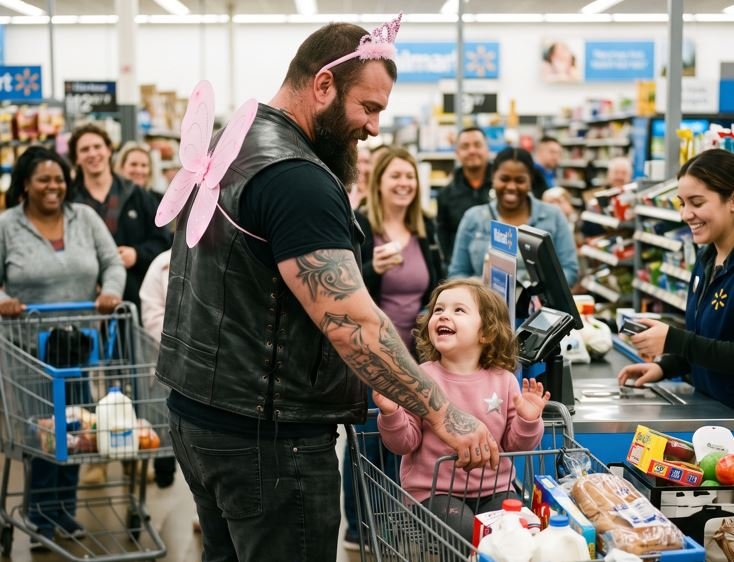
The first time I saw a six-foot-six biker walk into a Walmart wearing a plastic pink princess crown, I nearly dropped a roll of receipt paper. My name is Karen, and I had worked register seven at the Walmart in Lubbock, Texas, long enough to think I had seen every kind of customer.
Then Troy “Mountain” Bridger came through the front doors. He was thirty-nine, broad-shouldered, bearded, and dressed in a black leather vest that looked like it had crossed half the country with him. His boots were heavy, his arms covered in old tattoos, and his face had the serious calm of a man most people would not interrupt.
But on his head sat a crooked pink crown. On his boots were uneven streaks of bubblegum-pink paint. And strapped across his back were tiny glitter fairy wings that looked like they belonged on a preschool costume rack.
In the shopping cart sat his daughter, Ava. She was three years old, small and bright-eyed, with soft brown curls and a pink sweatshirt covered in tiny stars. She looked up at her father’s crown and laughed so hard that people near the checkout lanes turned around.
People stared, of course. Some smiled. Some whispered. One young man lifted his phone, but his mother lowered his hand before Troy even had to look over. Troy noticed everything. But he did not look embarrassed. He pushed that cart like a giant biker in a princess crown was the most normal thing in the world.
When they reached my register, I smiled. “Well,” I said, “you two look ready for a royal parade.” Ava pointed proudly at her father. “I picked it!” Troy nodded. “She is my fashion manager.”
After that, they came almost every weekend. One Saturday, Troy wore the same crown and pink boots. The next, he had a purple tutu tied over his jeans. Another week, he wore rainbow sunglasses, a feather boa, and a sticker on his beard that said BEST PRINCESS. Every visit made Ava laugh. And every visit made the store a little brighter.
For a while, I thought it was just a sweet father-daughter game. Maybe Ava loved princesses. Maybe Troy was one of those rare fathers who did not care what strangers thought.
Then I began to notice things. Ava’s legs were often covered with a blanket. Some weeks, Troy lifted her into the cart instead of letting her climb. Some days, her laugh was softer. And sometimes, when she turned her face away, Troy’s smile disappeared for one second before he forced it back.
One Saturday, Ava fell asleep in the cart before they reached my register. Troy wore a crown, pink boots, and a cape made from an old bedsheet covered in marker hearts. He placed applesauce, medicine, soft socks, and a small pack of stickers on the belt.
I scanned quietly. Then I said, “She really loves dressing you up.” His hand paused over the card reader.
Then he looked down at Ava. “The doctors say her muscles are having trouble listening to her brain,” he said softly. “Some days are good. Some days are hard. We are still fighting for answers.”
My throat tightened. He kept his eyes on the cart. “I promised her I would make her laugh every day,” he said. “Even on the days when laughing takes too much energy.”
I could not think of one perfect thing to say. So I said the only true thing I had. “You are doing a beautiful job.” Troy blinked fast and nodded once. “She is the beautiful part. I am just the guy in the crown.”
That was the day the pink boots stopped looking funny to me. They became a promise.
Over the next year, Ava’s family fought hard. Her mother, Natalie, came with them sometimes. They took her to specialists. They tried therapy. They celebrated tiny progress that other people might not understand.
Then, almost two years after the first pink crown visit, the automatic doors opened and the entire front of the store seemed to pause. Troy walked in wearing his leather vest, pink boots, fairy wings, and the original crown.
But this time, Ava was not sitting in the cart. She was standing beside him. Her hand held tightly to his. She wore a pink dress, white sneakers, and a tiny crown of her own. Her steps were slow and careful, but they were steps.
Troy did not rush her. The greeter covered his mouth. The bakery worker started crying. I stood behind register seven with my hand pressed against my chest.
Ava looked at the bananas, then up at Troy. In a small but clear voice, she said, “Royal bananas, Daddy.”
Troy bent down like she had just handed him the whole world. “Yes, ma’am,” he whispered. “The royal bananas are waiting.”
Today, Troy started something in Ava’s name. He called it the Pink Boots Project. It helped families with children going through long treatments. Not with big medical bills, but with ordinary joy. Costumes. Soft blankets. Movie-night baskets. Princess crowns. Superhero capes. Tiny things that reminded tired families they were still allowed to smile.
Troy explained it to me one Saturday: “Hospitals and doctors helped her body. But laughter helped her keep being Ava.”
Ava turned around and added, “And pink boots.” Troy nodded seriously. “Especially pink boots.”
Years have passed now. I still work at that Walmart. Troy is older. His beard has more gray. But Ava is in elementary school. She walks. She talks. She laughs out loud.
And every year on the anniversary of her first big step back into Walmart, Troy wears the pink boots. Sometimes he wears the crown too. Sometimes Ava rolls her eyes and says, “Dad, you look ridiculous.” And Troy always answers the same way. “That is the point, Your Majesty.”
Customers still stare. Some people see only a huge biker in painted boots. Some see a funny father. But those of us who remember know the rest. We remember a little girl in a cart, laughing beneath bright store lights. We remember a father who chose love over pride.
Never judge a parent by how strange they look in public, because sometimes the thing that seems silly to strangers is the very thing holding a child’s courage together.