Leo was ready to quit. Twenty-four years old, a guitar case full of rejection letters, and a sublet apartment he could no longer afford. He was riding the NYC subway back from a failed open mic when he saw it—a worn, brown leather wallet wedged between the seats. Inside: an ID for Eleanor, age 87, a few wrinkled dollar bills, and a faded black-and-white photo of a soldier.
The address on the ID was six blocks away. Leo figured he had nothing to lose, so he walked.
Eleanor opened the door in a floral housecoat, her silver hair pinned in a loose bun. She looked at the wallet, then at Leo, and her hands flew to her mouth. But she didn’t cry. Instead, she grabbed his arm with a grip that surprised him. “You have his eyes,” she whispered. “My Henry’s eyes.”
She invited him in for tea. Her apartment was a museum of the 1950s—vinyl records, lace doilies, and a dusty upright piano in the corner. Leo noticed the piano bench was covered in sheet music. He sat down and played a few chords out of habit.
Eleanor gasped. “That’s ‘Moonlight Serenade.’ Henry used to play that for me every night before he shipped off to Korea.”
She began to hum. Her voice was frail but pitch-perfect. Leo grabbed his guitar and started strumming. For the next hour, the young man and the old woman played together, laughing, crying, and harmonizing as if they’d known each other for decades. Before he left, Leo recorded a 15-second video of her singing the chorus—just for himself, to remember the moment.
But he accidentally posted it to his public TikTok instead of his private story.
Within 48 hours, the video had 12 million views. Comments flooded in: “She is an angel,” “Why can’t we all be like this?” But one comment stopped Leo cold. It was from a woman named Sarah in Seattle: “That is my mother. I haven’t spoken to her in 15 years. I thought she died.”
Leo called Eleanor. He read her the comment. The phone went silent. Then, a gut-wrenching sob.
“I told her I didn’t want her to marry that man,” Eleanor wept. “I was selfish. I pushed her away. I’ve been waiting for her to come back ever since.”
Leo didn’t ask permission. He booked Sarah a flight and met her at the same subway station where he’d found the wallet. He filmed it without telling Eleanor.
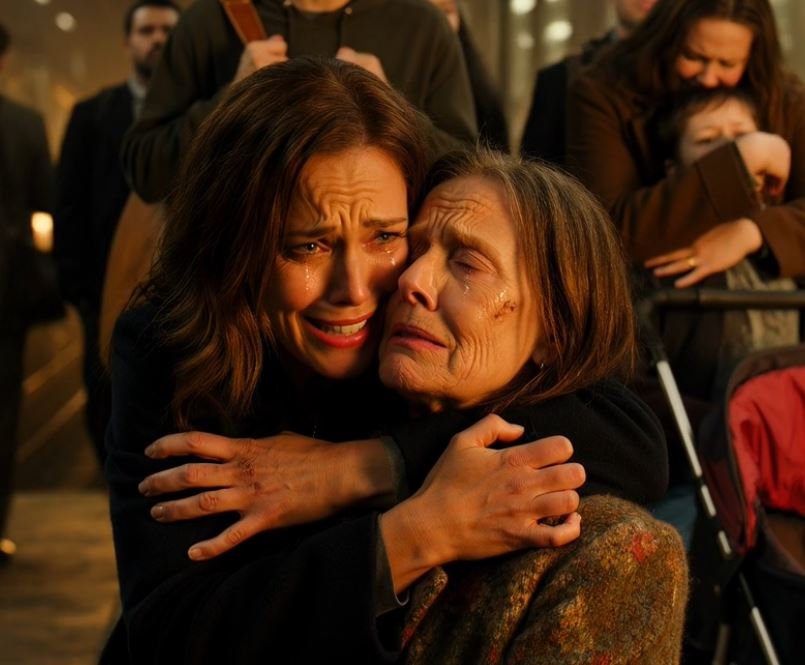
Sarah walked down the stairs into the crowded station. Leo pointed to an old woman sitting on a bench, knitting. Sarah froze. The crowd of commuters slowed, sensing something sacred. Sarah took a shaky step, then another. Her knees buckled. She fell to the ground in front of Eleanor.
“Mom?”
Eleanor dropped her knitting. Her face crumpled like paper. “My baby… my baby girl…”
They collapsed into each other on the dirty subway floor, strangers and commuters circling them, phones out, tears streaming down everyone’s faces. A homeless man handed Sarah a tissue. A teenager started clapping, and soon the entire station echoed with applause.
Sarah whispered through her sobs, “I’m so sorry. I was so stubborn. Dad would have hated this.”
Eleanor cupped her daughter’s face. “Your father loved you more than the moon. He sent me that boy with the guitar. He sent me Leo. He brought you home.”
Today, Eleanor lives with Sarah and her grandchildren in Seattle. Leo is their permanent guest for Thanksgiving. The video that broke the internet didn’t just go viral—it mended a heart that had been broken for fifteen years.
Sometimes, a lost wallet isn’t lost at all. It’s just waiting for the right hands to pick it up and return a mother to her daughter.