It was raining.
Not the gentle rain of their first meeting. A storm. The kind that makes drivers slow down, that makes streets shimmer, that should make everyone careful but somehow never does.
Leo was walking Tuesday.
Their evening route. The one that took them past the coffee shop, past the bookstore, past the intersection where the light was always too long and Tuesday always sat, patient, ancient, waiting for the particular moment when Leo said okay and they crossed together.
The car didn’t stop.
Not because the driver was drunk. Not because the driver was texting. Just because the road was wet, because the light was green, because the world is full of moments where physics and timing and the particular randomness of existence align to create tragedy.
Leo saw it coming.
Not in time to move. Not in time to save himself. Just in time to look at Tuesday — at his gray-brown eyes, at his serious face, at the particular expression that said you’re here and I’m here and that’s enough — and to push him.
Not hard. Not far. Just enough. Enough that Tuesday’s body cleared the bumper, that his paws hit the sidewalk, that he turned in time to see what happened next.
The sound was wet. Metal and bone and the particular silence that follows impact. Tuesday heard it. Heard Leo’s body hit the hood, heard the slide, heard the thud of pavement. Heard the car stop, too late, doors opening, voices shouting, the particular chaos of humans realizing they have broken something that cannot be fixed.
He ran to Leo.
Not away. Not to safety. To Leo. To the particular shape on the wet pavement, the particular stillness that was wrong, the particular scent of blood and rain and the end of everything.
Leo was breathing.
Not well. Not for long. But breathing. His eyes were open. They found Tuesday. They focused. They saw him — his dog, his Tuesday, his particular creature who had made the worst days bearable.
Tuesday licked his hand.
Once. Twice. The salt of rain, the salt of blood, the particular taste of a person who was leaving and couldn’t stay.
Leo’s lips moved.
No sound. Or sound that Tuesday couldn’t hear over the rain, over the shouting, over the particular ringing that fills the world when everything breaks. But Tuesday could read lips. Had learned, in three years of watching, of waiting, of paying attention to the particular shapes that Leo’s mouth made when he said important things.
Stay.
The last trick. The one they had practiced a hundred times. The one where Tuesday would sit, would wait, would hold his position until Leo released him with the particular word that meant you can move now.
Tuesday sat.
He didn’t want to. Every fiber of his being screamed follow, stay close, don’t let him go. But Leo had said stay. And Tuesday was a dog who had been returned twice for being too clingy, too needy, too unable to handle separation.
He stayed.
The paramedics came. They worked on Leo. They moved him onto a stretcher, into the ambulance, into the particular machinery of emergency medicine that tries to hold together what has already broken. Tuesday watched. Sat. Stayed.
A paramedic — young, kind, crying in the rain — tried to lead him away.
“Come on, buddy. Come with me.”
Tuesday growled.
Not aggressively. Not threatening. Just a statement. I was told to stay. I am staying. You cannot move me.
The paramedic stepped back.
They left. The ambulance. The police. The car that didn’t stop, the driver who was crying now, who would cry for years, who would never understand why this particular Tuesday, this particular rain, this particular intersection.
Tuesday stayed.
He sat on the wet pavement. In the spot where Leo had lain. Where his blood had mixed with rain and run into the gutter. Where the particular scent of his person — coffee, soap, the particular warmth of skin that Tuesday had pressed against every night for three years — still lingered, fading, becoming memory.
He stayed through the night.
The rain stopped. The street emptied. The coffee shop closed, the bookstore locked its doors, the intersection light turned from green to red to green for no one. Tuesday sat. Nose to the air. Reading scents that were no longer there.
In the morning, a police officer came.
Not to arrest him. Not to move him. Just to check. To see if the dog from the accident was still there. To bring food, water, the particular kindness that humans show when they don’t know what else to do.
Tuesday didn’t eat.
He drank, because thirst is stronger than grief. But he didn’t eat. He didn’t move. He just sat, in the spot, in the stay, holding the position that Leo had given him as a gift that had become a burden.
The officer called the shelter.
Not the one where Leo found him. A different one. A rescue. They came with a leash, a carrier, the particular equipment of animal control that is designed to handle creatures who cannot handle themselves.
Tuesday growled again.
Same sound. Same statement. I was told to stay. I am staying. You cannot move me.
They moved him anyway.
Not cruelly. Gently. The way you move something broken that you don’t know how to fix. They carried him to the van. To the shelter. To the kennel where he sat, in the corner, facing the door, waiting for the particular moment when Leo would come and release him.
He didn’t eat for four days.
They force-fed him. They hydrated him. They tried every trick, every treat, every particular technique that the shelter staff knew for dogs who had given up. Nothing worked. Tuesday sat. Faced the door. Waited.
On the fifth day, a woman came.
Not Maya. Not a detective. Just a woman. Middle-aged. Kind eyes. The particular look of someone who had lost something and recognized the same loss in another creature.
She sat outside his kennel.
Not trying to enter. Not trying to touch. Just sitting. Present. The way Tuesday had been present for Leo. The way that presence, sometimes, is the only thing that matters.
“I knew Leo,” she said.
Not to Tuesday. To herself. To the air. To the particular silence of a shelter that held too much grief.
“We were neighbors. He talked about you. Every day. ‘Tuesday did this. Tuesday did that.’ He loved you. Not like a dog. Like a person. Like the person who made him a person.”
She paused. She wiped her eyes.
“He’s gone, Tuesday. I know you know. I know you’re waiting. But he’s not coming. He can’t come. The stay — it’s over. He would want you to know that. He would want you to stop waiting.”
Tuesday looked at her.
Not with hope. Not with recognition. With the particular exhaustion of a creature who had been holding a position for too long, who had been staying for days that felt like years, who was beginning to understand that the word that had always meant wait might now mean something else.
Something permanent.
He stood.
Slowly. Painfully. His legs stiff from sitting, his body weak from not eating, his heart — the particular organ that doesn’t break but bends — heavy with the particular weight of a stay that had no end.
He walked to the kennel door.
He pressed his nose against the bars. He sniffed the woman’s hand — coffee, soap, the particular scent of someone who had known Leo, who had shared space with him, who carried some fragment of his existence.
He licked her fingers.
Once. Twice. The salt of tears. The particular taste of grief that is not his own but is close enough to matter.
The woman took him home.
Not to replace Leo. Not to fix him. Just to give him a place. A bed. Food that he would eventually eat. The particular patience that is required for creatures who have lost their person and don’t know how to become someone else’s.
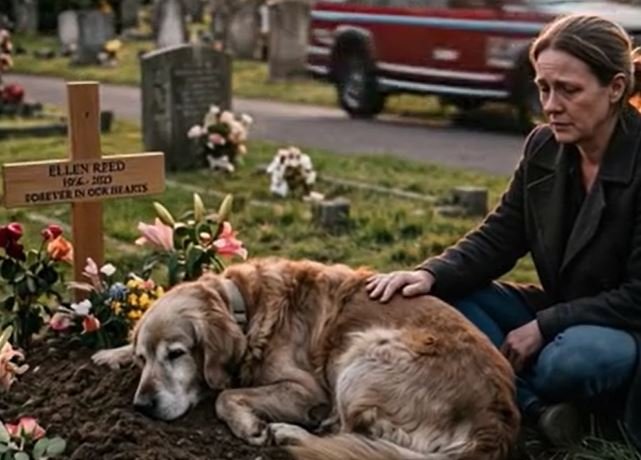
She took him to the funeral.
Not inside. To the cemetery. To the particular patch of grass where Leo was buried, where the earth was still fresh, where the marker was simple — Leo Chen. 1989-2026. He Found Tuesday.
Tuesday understood.
Not the words. The scent. The particular absence of warmth, of movement, of the heartbeat that had been the rhythm of his existence. He understood that the spot on the wet pavement, the stay that had lasted five days, had been a preparation for this — for the permanent spot, the permanent absence, the permanent end of everything that had mattered.
He lay down.
Not sat. Lay. His body against the earth, his nose to the grass, his particular weight pressing into the particular place where Leo was now and he could not follow.
The woman — his new person, his temporary person, his not-Leo — sat beside him. She didn’t touch him. She just sat. Present. The way that presence matters.
They stayed for hours.
The sun moved. The cemetery emptied. The particular silence of a place that holds too many endings settled around them. Tuesday didn’t move. He just lay, nose to earth, breathing in the particular scent of soil and grass and the distant memory of a person who had taught him 47 tricks and one last command that he could not release.
In the evening, the woman stood.
She touched Tuesday’s head. Once. Gently. The way that Leo had touched him, in the mornings, in the evenings, in the particular moments when touch was the only language that mattered.
“Come on,” she said. “Let’s come back tomorrow.”
Tuesday didn’t move.
Not because he was disobeying. Because he was still holding the stay. Because Leo had said stay and Leo had not said okay and the particular logic of a dog who loves too much does not allow for the possibility that the release will never come.
The woman sat back down.
She didn’t try again. She just sat, in the grass, beside a dog who was holding a position for a person who could no longer see him, and she waited for the particular moment when Tuesday would understand that some stays are not commands but choices, and that choosing to stay is also choosing to eventually stand.
It took three hours.
Three hours of darkness, of stars, of the particular cold that settles in cemeteries at night. Three hours of the woman shivering, waiting, being present. Three hours of Tuesday breathing, nose to earth, holding the particular space where Leo was and he was not.
Then, slowly, he stood.
Not quickly. Not easily. His legs shaking, his body weak, his heart — the particular organ that bends but doesn’t break — finding some new shape that allowed for movement without release.
He looked at the grave.
One last time. The particular focus that he had given Leo every morning, every evening, every moment of their three years together. The look that said you are my person and I am your dog and that is enough.
Then he turned.
He walked to the woman. He pressed his head against her knee. He sighed.
The same sigh. The human sigh. The tired, resigned, grateful sound that he had made in the shelter, on the first Tuesday, in the rain, when he had found Leo and Leo had found him.
The woman drove him home.
Not to Leo’s apartment. To her house. To a room that was not his, to a bed that smelled of other dogs, to a life that was not the one he had known but was the only one available.
She took him to the cemetery every day.
Not because he asked. Because she understood. Because she had lost something too, and she recognized that grief is not a thing to be fixed but a thing to be carried, and that carrying it together is lighter than carrying it alone.
Tuesday learned to eat again.
Not with enthusiasm. Not with the particular joy that he had shown for treats, for frisbee misses, for the particular ritual of morning coffee by the river. But with acceptance. With the particular understanding that the body continues even when the heart does not want it to.
He learned to walk with her.
Not the same route. Not the same river. A different park, a different bench, a different set of ducks that he watched with the particular intensity of a dog who had never caught one but still believed he might.
He didn’t learn new tricks.
The 47 remained. The last one — stay — remained most of all. He would still hold it, sometimes, in the middle of a room, in the middle of a walk, in the particular moments when the scent of coffee or the sound of rain or the angle of sunlight reminded him of Leo and he needed, for a moment, to be back in that place where the command was given and the world was whole.
The woman didn’t mind.
She would wait. Sit beside him. Be present. The particular gift that she had learned from Tuesday himself — that sometimes the only thing to do is to be there, to breathe, to let the moment pass without demanding that it pass quickly.
They were together for four years.
Not the same. Never the same. But enough. The particular enough that comes from two creatures who have lost something and found something else, not equal, not replacement, but enough to continue.
Tuesday died at 14.
Not suddenly. The particular decline of a dog who had carried too much grief for too long, whose heart had bent so far that it could not bend anymore. He died in his sleep, on a bed that was not his original bed, in a house that was not his original house, with a person who was not his original person but had become, through patience and presence, something that mattered.
The woman buried him beside Leo.
Not because she owned him. Because she understood. Because the particular logic of grief is that some bonds should not be separated, even in death, even when the separation is only a few feet of earth.
The marker was simple. She carved it herself, the way that Leo’s marker had been simple, the way that some things are too important for professional engraving.
TUESDAY — He Stayed. He Waited. He Found Him Again.
She visits every week.
Not because she believes in an afterlife. Because she believes in presence. Because sitting in the grass between two graves — one human, one dog, one bond that death could not break — is the particular ritual that makes grief bearable.
She brings coffee.
Two cups. One for Leo. One for Tuesday. She pours them on the grass, the way that Leo had poured his morning coffee, the way that Tuesday had watched with the particular intensity of a dog who had never tasted coffee but believed it must be important.
She talks to them.
Not because they can hear. Because she can. Because the particular act of speaking into silence is the only way to hold onto voices that have faded, to moments that have passed, to the particular love that existed between a man and his dog on a terrible Tuesday when the rain wouldn’t stop.
Sometimes, when the wind shifts, she smells it.
Coffee. Soap. The particular warmth of skin and fur that existed in an apartment that is now someone else’s, in a life that is now memory, in a story that she tells to anyone who will listen.
The story of Tuesday.
The dog who was returned twice for being too clingy. Who found a person who needed clinginess. Who learned 47 tricks and one last command that he held for 847 days. Who lay on a grave and waited for a release that never came, and who eventually stood anyway, not because he was released but because he chose to carry his grief instead of being buried by it.
The story of Leo.
The man who found a dog on the worst Tuesday of his life. Who taught him to catch a frisbee badly. Who talked to him about everything and nothing. Who pushed him out of the way of a car and died in the rain and never said okay.
The story of what remains.
Not the apartment. Not the photos — though they exist, on a phone that still gets likes, from people who don’t know that the man and the dog are both gone. Not the particular routine of morning coffee and evening walks and the particular sigh that said you’re here and I’m here and that’s enough.
What remains is the marker.
Two names. Two dates. The particular space between them that is not empty but full — full of 1,095 days, 47 tricks, infinite walks, countless moments of presence that accumulated into something that death cannot dissolve.
What remains is the woman.
Sitting in the grass. Pouring coffee. Talking to silence. Being present for creatures who can no longer be present for her, because that is what she learned from them — that love is not a transaction but a state of being, and that being present is the only trick that matters.
What remains is the wind.
Shifting. Carrying scents. Coffee. Soap. The particular warmth that is not there but is remembered, that is not real but is felt, that exists in the particular space between what was and what is and what will never be again.
Tuesday stays.
Not in the way that he was commanded. In the way that he chose. In the marker, in the memory, in the particular story that the woman tells to anyone who will listen, to the wind, to the silence, to the particular absence that is not empty but full.
Full of a dog who stayed.
Who waited.
Who found him again.