Grace Holloway had run the day-to-day operations of her father’s ranch for six years before anyone in her family accused her of stealing from it, and when the accusation finally came, it arrived in the worst possible place — the county cattle auction, in front of nearly every rancher within fifty miles.
Her father, Walt Holloway, had suffered a stroke eighteen months earlier that left him unable to manage the ranch’s daily demands, and the responsibility had fallen, almost by default, to Grace — the only one of Walt’s three children who’d stayed local, who understood the herd rotation schedules and the aging equipment and the complicated relationships with the neighboring lease-holders well enough to keep the operation running without her father’s direct oversight. Her brother Denny had moved two states away for a job in equipment sales fifteen years earlier and visited rarely, always with a faint, unspoken resentment that Grace had somehow ended up controlling what he still, privately, considered partly his inheritance to manage.
The trouble began quietly, months before the public accusation, when Denny started making occasional visits home more frequent than usual, always coinciding, Grace would later realize, with the periodic herd counts the ranch’s insurance required each season. He’d ask pointed questions about the numbers, comment on discrepancies that Grace could usually explain — calves lost to predators in the spring, animals sold at market that hadn’t yet been logged in the shared family spreadsheet — but each explanation seemed to satisfy him less than the last.
Grace hadn’t thought much of Denny’s growing suspicion until the spring herd count came back twenty head short of projections, a number large enough that even Grace, who understood ranch losses better than anyone in her family, found genuinely difficult to explain through the usual combination of predation, disease, and market timing. She’d spent weeks quietly investigating it herself — checking fence lines for breaches, reviewing the ranch’s GPS cattle-tracking system, a relatively recent investment she’d pushed for two years earlier specifically to modernize record-keeping after a smaller, unexplained loss had frustrated her father.
What she found, buried in the tracking data, wasn’t proof of theft by an outside party, but a pattern of unusual nighttime movement in the ranch’s back pasture — the same isolated section bordering the county road that only she and her father held keys to, according to the family’s understanding, though Grace discovered, cross-referencing gate access logs, that a spare key had gone missing from the ranch office nearly a year earlier, around the same time Denny’s visits had started increasing.
She hadn’t confronted him with any of this. She’d planned, instead, to bring the full data set to her father directly, once she’d finished cross-referencing every log against the family’s own vehicle GPS units, a project she was still completing the week of the county’s spring cattle auction — an event the whole family traditionally attended together, buying and selling breeding stock among the wider ranching community.
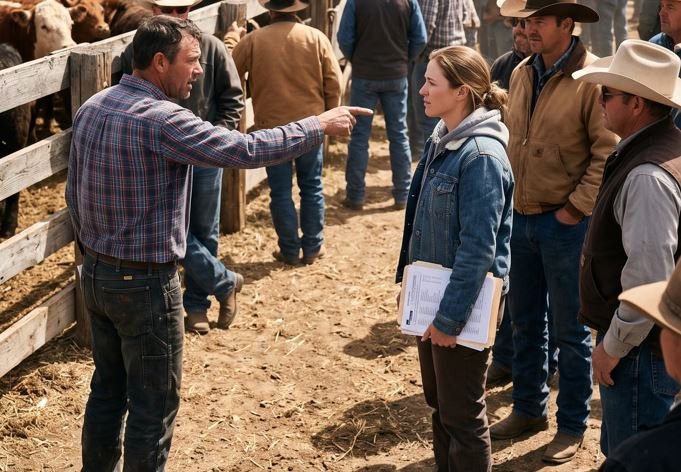
Denny arrived at the auction that year in an unusually combative mood, and it became clear within the first hour that he’d been building toward something. He cornered Grace near the holding pens, initially in a lowered voice, accusing her outright of having sold off the missing twenty head herself and pocketed the proceeds, using her control over the daily books to hide the discrepancy from their father.
Grace tried, at first, to keep the conversation private, aware of how many familiar faces surrounded them in the crowded auction yard. Denny, however, seemed to want an audience, his voice rising steadily until it carried clearly across the pens.
“Twenty head missing from Dad’s herd this spring,” he said, loud enough that several nearby ranchers turned to look, “and everybody knows you’re the only one with keys to that back pasture!”
The crowd quieted, the auction’s usual background noise fading as attention shifted toward the confrontation. Grace felt the old, familiar urge to smooth things over quietly, the way she’d absorbed Denny’s resentment for years without pushing back directly. Instead, she reached into the folder she’d been carrying all morning — not originally intended for this moment, but ready regardless — and pulled out the printed GPS logs she’d spent weeks compiling.
“Funny you’d bring this up here,” she said, her voice steady despite the growing audience. “I’ve got the GPS collar logs from every head we moved this spring, timestamped. Might want to see where your truck was parked those same nights.”
Denny’s confident posture faltered visibly. “That’s — those logs don’t prove anything,” he said, though his voice had lost some of its earlier certainty.
“They prove the herd movement happened at night, through the back pasture gate, on four separate occasions over six weeks,” Grace said, flipping to a marked page and holding it up for him, and, whether she’d intended it or not, for the small crowd of ranchers now watching closely. “And they line up, within twenty minutes each time, with your truck’s own GPS pinging off the same county road, according to the tracking app you set up on the family account two years ago so Dad could keep tabs on the equipment trailer.”
A murmur moved through the gathered crowd. Denny’s face had gone from red-faced aggression to something considerably paler. “I can explain that,” he said, though nothing followed the sentence for a long, uncomfortable moment.
It was one of the older ranchers nearby, a longtime friend of Walt’s named Curtis Ferris, who finally broke the silence. “Denny,” he said, not unkindly but firmly, “your sister’s been running that operation single-handed since your daddy’s stroke, keeping it in the black the whole time from what I’ve heard. Might want to think real carefully before you finish that sentence in front of this many witnesses.”
Denny didn’t finish it. He left the auction yard within the hour, and Grace, rather than pursuing the confrontation further in public, simply gathered her folder and returned to the business of the day, letting the crowd’s attention drift back to the auction itself.
The full explanation came out two weeks later, not through another confrontation, but through a quiet, difficult conversation between Grace, Denny, and their father, once Walt had reviewed the same GPS logs himself. Denny, it turned out, had been quietly selling off small portions of the herd himself over several months, using the spare key he’d taken without telling anyone, to cover a series of gambling debts he’d been too ashamed to admit to the family, debts that had grown considerably worse in the two years since his last visit home. He’d planned, he admitted, to eventually blame the losses on predators or market miscounts, and had grown increasingly anxious as Grace’s meticulous record-keeping made that story harder to sustain — anxious enough, in the end, to try preemptively shifting suspicion onto her before she could uncover the truth herself.
Walt, still recovering physically but entirely sharp mentally, didn’t press criminal charges against his own son, but he did restructure the ranch’s ownership documents within the month, formally transferring full operational control to Grace alone, with Denny’s share of any future proceeds explicitly tied to a repayment plan for the missing herd’s value.
Denny didn’t attend the following year’s county auction. Grace did, standing in the same pens where she’d once been publicly accused, quietly proud of an operation that, whatever damage the past two years had done within her family, remained — thanks in no small part to a modest investment in GPS tracking two years earlier — exactly as honest on paper as she’d always known it to be in practice.
THE END