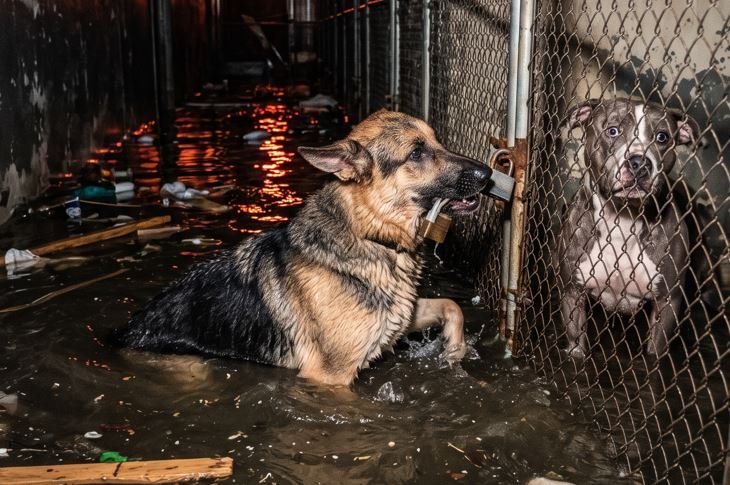
Rex became famous.
Not immediately. The video — filmed by a firefighter’s body cam, shaky, dark, the particular chaos of a rescue that no one had planned — went viral three days later. 100 million views in 48 hours. The algorithm — that mysterious, merciless god — had found its offering. A dog. A flood. A miracle that was not a miracle but intelligence, persistence, the particular refusal to accept that some lives are disposable.
The comments were a flood.
“They called him unmanageable. He managed to save 47 lives.”
“The dog they couldn’t adopt opened 47 cages with his teeth.”
“Rex didn’t need training. He needed someone to believe he was already enough.”
“153 died. 47 lived. The math of rescue is brutal. But Rex did the math.”
Rex didn’t care.
He was in a foster home. Not a shelter. Not a cage. A house with a lever handle that he could open, that he did open, that he opened every morning to check on his foster family, to confirm they were still there, still safe, still present.
He didn’t open it to escape.
He opened it to know. To assess. To be the particular creature he had become in a flooding building — the guardian, the watcher, the one who made sure that no one was left behind.
The foster family adopted him.
Officially. Permanently. The particular commitment of people who had watched the video, who had cried, who had understood that “unmanageable” was just another word for “not understood yet.” They gave him a bed. A yard. A family.
They gave him lever handles.
Every door. Every cabinet. Every particular mechanism that he could manipulate, that he could open, that he could control. They didn’t fear his intelligence. They celebrated it. They learned, as he had learned, that the world is full of locks that yield to the right pressure, the right angle, the particular application of will.
Rex lived four more years.
Not as a rescue dog. Not as a hero. Just as a dog. A dog who opened doors. Who checked on his family. Who sat by windows during storms, nose to the glass, watching the water, remembering.
He died in his sleep.
Not from flood damage. Not from trauma. Just from age. From the particular decline of a body that had done too much in too short a time, that had pushed beyond every limit and now, finally, needed rest.
His family buried him in their garden.
Not deep. Not hidden. In a spot where the morning sun reached, where the grass was soft, where they could sit and remember. They carved a marker — simple, stone, the particular permanence that words give to love.
REX — Returned 3 Times. Opened 47 Cages. Proved That “Unmanageable” Just Means “Not Understood Yet.”
They visit every day.
Not to mourn. To remember. To tell the particular story of a dog who saved lives because he was smart, because he was brave, because he was given a room with a lever handle and decided that the world needed more open doors.
And sometimes, when it rains, they sit by his grave and they listen.
To the water. To the particular sound of a storm that doesn’t care about maps or plans or the particular calculus of survival. And they remember that in every storm, in every flood, in every drowning world, there is a creature who is smart enough to open locks and brave enough to try.
There is always a Rex.
Not trained. Not expected. Not believed in. Just present. Just watching. Just waiting for the moment when the world goes wrong and someone needs to do the particular math of rescue — brutal, imperfect, never enough, but always, always worth trying.
Because 47 is not 200.
But 47 is not zero.
And zero — the particular nothing that would have happened if Rex had been a different dog, if he had been less intelligent, less brave, less “unmanageable” — is the only number that truly means failure.
Rex refused zero.
He opened cages. He led dogs. He stood in windows and waited for rescue and refused to leave until the last possible moment. He did what no one had trained him to do, what no one had believed he could do, what no one had even thought to ask.
He saved 47.
And in saving 47, he saved something else — the particular belief that the dogs we throw away, the dogs we label, the dogs we call “unmanageable” and “destructive” and “too smart for their own good” — are exactly the dogs we need.
When the storm comes.
When the water rises.
When the world is drowning and the only way out is together.