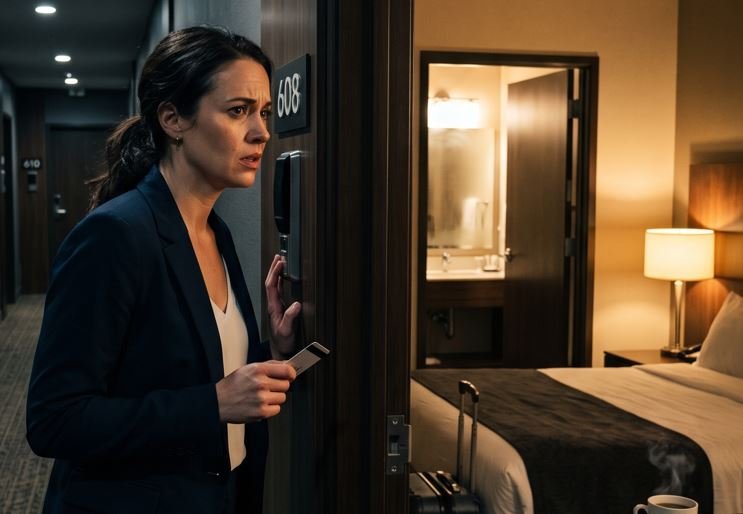
The incident began just before midnight at a business hotel outside Chicago.
Emily Carter arrived exhausted after driving nearly six hours to attend a sales conference the next morning.
The receptionist apologized for the late hour, handed her a keycard, and assigned her Room 608.
Nothing about the check-in seemed unusual.
Security cameras later confirmed that Emily walked directly to the sixth floor without stopping.
She reached Room 608 and tapped her keycard against the electronic lock.
The green light flashed.
The door unlocked.
Inside, the lights were already on.
Emily assumed housekeeping had forgotten to switch them off.
Then she noticed the television quietly playing a local news channel.
A cup of coffee sat on the desk.
Steam still rose from the surface.
Someone had made it only moments earlier.
She looked toward the bathroom.
Water slowly dripped from the sink.
The mirror was covered with fresh condensation.
It looked as though someone had just finished washing their hands.
Emily immediately checked the bed.
The blankets were perfectly smooth.
No one was there.
Then she noticed a black suitcase standing beside the bed.
It wasn’t hidden.
It wasn’t abandoned.
It looked as though someone planned to unpack it.
Feeling uncomfortable, Emily returned to the front desk.
The receptionist looked confused.
According to the hotel computer, Room 608 had remained vacant all day.
No guest had checked in.
No housekeeping staff had reported entering after 5 p.m.
Thinking a software error had occurred, the hotel manager reviewed the electronic lock records.
Only one keycard had opened the room that evening.
Emily’s.
There were no earlier entries.
No master key.
No staff key.
No maintenance access.
Yet the surveillance cameras showed something impossible.
Ten minutes before Emily reached the room, the hallway camera briefly captured the door to Room 608 opening by itself.
No one walked in.
No one walked out.
The door remained open for nearly five seconds before quietly closing again.
Investigators checked every camera covering the elevators and stairwells.
No unidentified person ever reached the sixth floor.
The suitcase inside the room was searched.
It was completely empty.
No clothing.
No documents.
No fingerprints except Emily’s and the hotel’s investigators.
The coffee cup contained freshly brewed coffee from a machine located inside the room.
According to maintenance records, the machine had not been used for over three weeks.
The television logs showed it had turned on automatically at exactly 11:27 p.m.
Three minutes before Emily arrived.
Engineers inspected the room’s electrical system.
Nothing unusual was found.
To rule out human error, the hotel repeated the electronic lock test dozens of times.
The system never failed.
Months later, during a renovation, technicians replaced every electronic lock in the building.
While removing the old display outside Room 608, they discovered something unexpected.
Behind the display panel was a faded paper label.
It wasn’t part of the hotel’s original construction plans.
Someone had written a room number by hand years earlier.
Not 608.
609.
No record has ever explained why the number was changed.
The hotel continues to rent Room 608 today without incident.
Officially, the case was closed as an unexplained technical error.
But one question has never been answered.
If Emily’s keycard was truly the first one to unlock that room that day…
Who made the fresh coffee only minutes before she arrived?