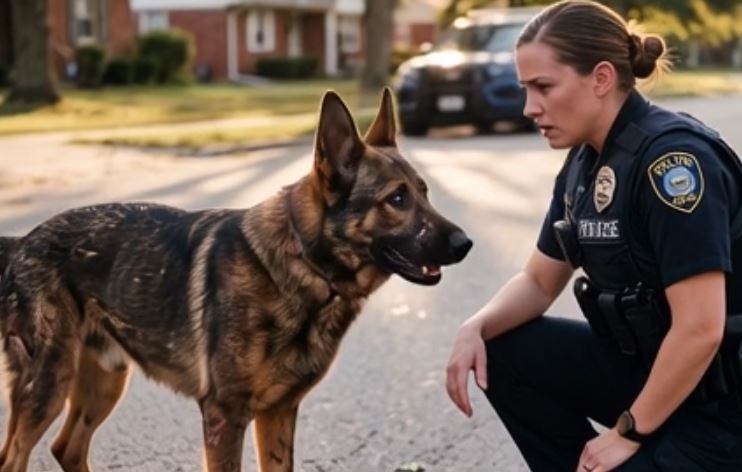
The story went viral.
Not immediately. The local news covered it — Stray Dog Leads Police to Missing Child. The particular headline that gets clicks, that gets shares, that gets forgotten in the next news cycle.
But someone filmed the reunion.
Not professionally. A neighbor. Phone camera. Shaky. The particular footage that authenticity demands — Priya emerging from the abandoned house with Maya in her arms and the dog beside her, the child’s arms around the dog’s neck, both of them crying, both of them safe.
The video hit 10 million views in 24 hours.
The algorithm — that mysterious, merciless god — had found its offering. A child. A dog. A rescue. The particular triangle of virality that the internet loves — innocence, loyalty, the unexpected hero who comes from nowhere and changes everything.
People wanted to adopt the dog.
Hundreds. Thousands. The particular flood of attention that follows viral animals — offers of homes, of money, of fame. The shelter that held him — briefly, for observation, for the particular bureaucracy of a system that processes strays — was overwhelmed.
Maya’s family wanted him.
Not adopt. Not buy. Just… keep. The particular claim of a child who has been saved and believes, with the particular certainty of 4-year-olds, that the dog is hers, that he found her, that they belong together.
But there was a complication.
The dog was not a stray.
Not completely. He had a chip — old, outdated, registered to a shelter that had closed, to an owner who had moved, to a particular history that was lost in the gaps of a system that tracks animals but doesn’t follow them.
Priya investigated.
Not officially. Personally. The particular obsession of a police officer who has seen something extraordinary and needs to understand it, to complete the story, to give the dog a name that is more than “stray” or “hero” or “the dog who found Maya.”
She found the shelter records.
Closed 6 years ago. The dog — unnamed in the records, just a number — had been adopted by a man named David Chen. An address. A phone number. Disconnected.
She found David Chen.
Not easily. Through social security records, through tax filings, through the particular persistence of a detective who will not let a story end incomplete.
He was 71. In a nursing home. Dementia. The particular fading of a person who had loved a dog, who had lost him, who had searched and failed and eventually forgotten that he had ever had a dog at all.
Priya visited him.
Not to return the dog. To understand. To hear the story that David could still tell, in fragments, in moments of clarity, in the particular lucidity that dementia sometimes grants.
“He was my shadow,” David said.
Not about the dog’s name. About who he was. “I got him after my wife died. He was… he was the only one who didn’t look at me with pity. He just… sat. Listened. The way dogs do.”
“What was his name?” Priya asked.
David looked at her. Through her. Into the particular distance that dementia creates, where memory and present blur and the past becomes more real than now.
“I called him Ring,” he said.
“Because he was always at my feet? Like a ring around me?”
David smiled. The particular smile of someone who has found a memory that was lost. “No. Because of the doorbell. He learned to ring it. With his nose. When he wanted to go out. When he wanted to come in. When he wanted… attention. He rang the bell. And I always answered.”
He paused. The smile faded. “Until I couldn’t. Until I fell. Until they took me away. And he was gone when they brought me back. The door was open. He must have… he must have run. Looking for me. Ringing bells that no one answered.”
Priya understood.
Not completely. But enough. The particular tragedy of a dog who had learned to ring doorbells, who had lost his person, who had spent years searching — ringing bells, finding no one, becoming invisible, becoming stray.
Until he found Maya.
Until he brought a shoe to a police officer. Until he led her to a door that hadn’t been opened in 40 years. Until he became, for a moment, the particular hero that the internet loves.
She told Maya’s family.
Not to change their claim. To inform. To give them the particular knowledge that would let them make a choice — to keep the dog who had saved their child, or to return him to the man who had loved him first, who had taught him to ring bells, who had lost him and forgotten him but still, in fragments, remembered.
They chose to visit David.
Maya, her parents, and Ring — the name they used now, the name that was his, that had always been his. They brought him to the nursing home. To the man who had loved him, who had lost him, who might not recognize him but deserved the chance.
David did recognize him.
Not immediately. Not completely. But when Ring — the dog who had learned to ring doorbells — pressed his nose to David’s call button, when the bell rang, when David looked up and saw the scarred, thin, invisible dog who had once been his shadow…
He smiled.
The particular smile of recognition. Of memory. Of love that survives dementia, survives loss, survives even the particular forgetting that time and illness impose.
“Ring,” he said. “You came back.”
Ring wagged his tail.
He climbed onto David’s bed — against rules, against protocol, against the particular regulations that govern nursing homes. He pressed his body against David’s chest. He sighed — the particular sigh of a creature who has found, after years of searching, the person he was looking for.
Maya watched.
Not jealous. Not sad. With the particular understanding that some children have — that love is not exclusive, that the dog who saved her could also save someone else, that heroes have histories and those histories matter.
She climbed onto the bed too.
Beside Ring. Beside David. The particular pile of a child, a dog, and an old man that shouldn’t work, that shouldn’t be allowed, that is exactly what the world needs.
They stayed for an hour.
Then David fell asleep — the particular sleep of dementia, sudden, complete, the person gone even as the body remains. Ring stayed beside him. Maya’s parents waited. Priya, who had brought them, watched from the door.
When David woke, he didn’t remember.
Not Maya. Not the visit. Not Ring. The particular cruelty of dementia — that moments of clarity are gifts that are taken back, that recognition becomes stranger, that love persists even when memory fails.
But Ring remembered.
He pressed his nose to the call button again. The bell rang. David looked at him. Smiled, again, the particular smile of someone who doesn’t know why he is happy but is happy anyway.
Maya’s family made a decision.
Not to keep Ring. Not to give him back. To share. The particular arrangement of a family who understands that love is not possession — that Ring could live with them, visit David, be the particular bridge between a child who was saved and an old man who was lost.
Ring became a therapy dog.
Not officially. Just… practically. He visited David three times a week. He rang the bell. David smiled. Sometimes he remembered. Sometimes he didn’t. But the smile — the particular happiness that Ring created — was real, was present, was enough.
He also visited Maya.
Every day. Walked her to school. Sat with her while she did homework. Slept at the foot of her bed, the particular guardian of a child who knew, with the particular certainty of the very young, that she was safe because he was there.
And sometimes — late at night, when the house was quiet and Maya was asleep — Ring would walk to the front door. He would press his nose to the doorbell. He would ring it.
Not to go out. To remember. To practice the particular skill that had defined him, that had connected him to David, that had — in some way that no one could fully understand — led him to Maya, to Priya, to the particular destiny that had been waiting for a dog who knew how to ring bells.
Maya’s mother would find him there.
Not scold him. Just… watch. Understand. Let him ring. Let him remember. Let him be the particular creature he was — a dog who had learned to ask for attention, who had lost the person who answered, who had found new people but still, in the particular way of dogs, kept the old love alive.
She installed a doorbell in David’s room.
Not a real one. A button. A sound. The particular replica of the bell that Ring had learned to ring, that David had answered, that had connected them in a past that was gone but not forgotten.
Ring would press it.
David would smile. Sometimes he would say “Ring.” Sometimes he would just look happy, the particular happiness of someone who is loved, who is remembered, who is present even when the past is lost.
And Priya — Officer Priya Nair, who had followed a stray dog to an abandoned house and found a missing child — would visit sometimes.
Not officially. Just… to see. To confirm that the story had ended well, that the particular chain of events — a disappearance, a shoe, a ring, a rescue — had led to something good.
She would watch Ring press the button. Watch David smile. Watch Maya climb onto the bed and wrap her arms around the dog who had saved her and who continued, every day, to save something else.
She would think about the name.
Ring. Not because he was at David’s feet. Because he rang bells. Because he asked for attention. Because he refused to be invisible, to be forgotten, to be the particular stray that no one answers.
He rang. And someone — eventually, finally, after years of silence — answered.
That was the story.
Not the rescue. Not the viral video. Not the particular heroism of a dog who found a missing child. But the particular persistence of love — the ringing, the asking, the refusal to be silent even when no one seems to be listening.
Ring kept ringing.
And the world, eventually, kept answering.