The medics took Lily.
Not gently. Urgently. The particular roughness of emergency medicine that knows that gentleness is a luxury for the stable, that hypothermia demands movement, that a three-year-old who has been buried in snow for two and a half hours needs heat, fluids, the particular machinery of survival that hospitals provide.
Sarah went with her. In the ambulance. Holding her hand, watching her breathe, feeling the particular miracle of warmth returning to fingers that had been ice.
Tom stayed.
Not because he didn’t want to go. Because he needed to see. Needed to understand. Needed to kneel in the snow beside the hole where his daughter had been buried and thank the particular creature who had found her when everything else had failed.
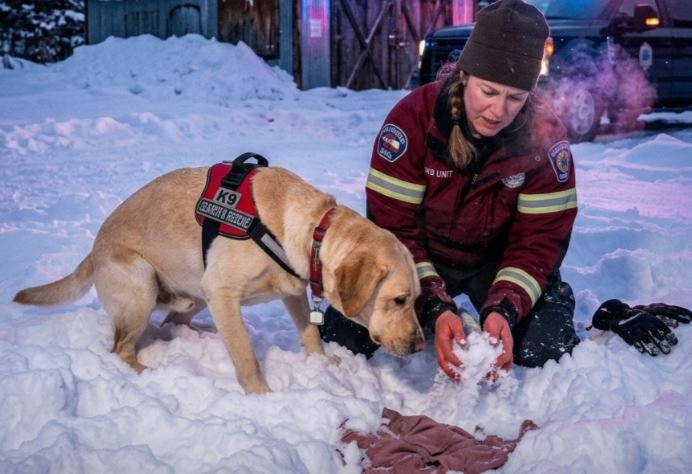
Tucker was still sitting.
Not at the hole. Beside Jenna. His duty done, his signal given, his particular purpose served. But he was watching. Nose to the wind. Reading the particular aftermath of rescue — the adrenaline, the relief, the particular chemical cocktail of humans who have been pulled back from the edge of grief.
Tom knelt before him.
Not to pet. Not yet. Just to look. To see the dog who had been retired, who had been replaced, who had been considered obsolete by a system that valued pixels over presence.
“Thank you,” Tom said.
Tucker wagged his tail. Once. The particular wag of a dog who understands that he has done what was asked, who has found what was lost, who has proven — again, as he had proven a hundred times before — that the bond between a handler and a dog is not equipment but partnership.
Jenna touched Tom’s shoulder.
“He’s not done,” she said. “He’ll keep working until I tell him to stop. That’s what he does. That’s what they’ve always done.”
Tom nodded. He reached into his pocket. He pulled out his phone — the particular device that had been useless for finding his daughter, that had shown him green squares and false confidence, that he had trusted because he was a tech executive who believed in the particular religion of innovation.
He deleted the SNO-MAP app.
Not dramatically. Just… deliberately. The particular rejection of a system that had failed him, that had told him his daughter was not where she was, that had prioritized algorithmic certainty over canine truth.
He looked at Tucker. At Jenna. At the particular hole in the snow that had held his daughter and released her, alive, because a dog had sat down and refused to move.
“I’m going to tell everyone,” Tom said.
Not as a threat. As a promise. The particular vow of a father who had been saved by something he didn’t understand, who had learned — in the particular way that trauma teaches — that the world contains intelligences that silicon cannot replicate.
Part 3: The After
Lily recovered.
Not immediately. Not completely. The particular toll of hypothermia — frostnip in her fingers, the particular vulnerability of small bodies to cold, the nightmares that would come for months of being buried, of darkness, of the particular silence beneath snow.
But she lived.
She was 7 when she learned the whole story. When her parents sat her down and showed her the news articles, the viral video, the particular footage that Tom had taken — not of the rescue, but of the moment after, when Tucker sat in the snow and wagged his tail and proved that love is a technology that doesn’t require electricity.
The video had 89 million views.
Not because Tom wanted fame. Because he needed to warn. The particular warning of a man who had nearly lost his daughter to blind faith in machines, who wanted other parents to know that AI is a tool, not a replacement for the particular intelligences — canine, human, instinctive — that have been finding the lost for millennia.
The SNO-MAP company issued a statement.
Not an apology. An explanation. The particular language of corporate defense — “thermal shadow,” “edge case,” “statistical anomaly.” They updated the algorithm. Added a patch. Called it the “Caldwell Fix.”
It didn’t matter.
Because Tucker had proven what patches cannot fix — that the world is full of glitches. That snow insulates. That children curl small. That the particular geometry of survival creates shadows that satellites cannot see. That a dog’s nose — wet, old, supposedly obsolete — can find what code cannot.
Tucker worked for two more years.
Not officially. The department had learned its lesson, had reinstated the K9 unit, had invested in dogs alongside drones. But Tucker was old now. His hips ached. His breathing was heavy. The particular decline of a working dog who has given everything and is now, finally, allowed to rest.
He died at 11.
In his sleep. On Jenna’s couch. Not in a kennel, not in a facility, but in the particular warmth of a home that he had earned through six years of finding what was lost.
Jenna buried him in the mountains.
Not in a pet cemetery. In a meadow above Aspen, where the snow falls clean and the wind carries the particular scent of pine and possibility. She didn’t mark the grave with stone. She marked it with a sign — wooden, hand-painted, the particular impermanence of a thing that is meant to be felt rather than read.
It said: TUCKER — He Found the Glitch. He Saved the Girl. He Proved That Some Truths Cannot Be Coded.
Tom visits every year.
With Sarah. With Lily, who is 10 now, who wants to be a veterinarian, who carries a photo of Tucker in her wallet — the particular photo of a yellow Lab sitting in snow, nose to the wind, eyes on a horizon that only he could see.
They don’t bring flowers.
They bring snow. A handful each. They scatter it on the meadow. They remember. They tell the story. The particular story of a girl who was buried in a green square, of a machine that said she wasn’t there, of a dog who sat down and said yes. Here. Now.
And the wind carries it.
The particular wind of the Colorado mountains, cold and clean and full of the scents that Tucker loved. It carries the story outward. To the drones that still buzz. To the AI that still maps. To the particular future where technology and instinct must learn to work together, where green squares are not gospel, where the particular wisdom of dogs is not retired but revered.
Because Tucker found the glitch.
Not in the software. In the assumption. The particular human assumption that we have built machines that can replace the living, that can read the world without touching it, that can find what is lost without searching.
He found the glitch.
And he sat in it. In the snow. In the cold. In the particular patience of a creature who knows that truth is not on a screen but beneath the surface, waiting for a nose, a heart, a particular kind of love that refuses to be obsolete.