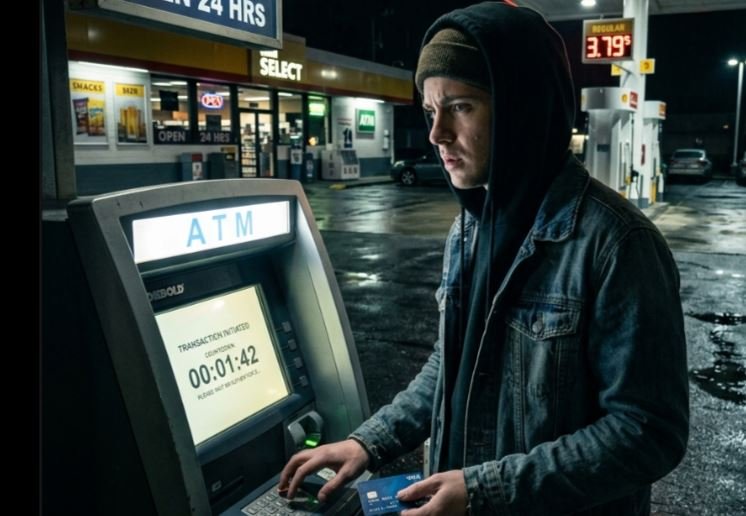
At 11:42 p.m., Daniel Harper stopped at a gas station outside Columbus to withdraw cash before driving home.
The station was quiet.
Only one cashier worked inside.
Security footage showed Daniel inserting his debit card into the outdoor ATM.
The transaction completed normally.
The machine counted the cash.
Then it ejected a card.
Daniel grabbed it without looking.
As he started walking away, he noticed the name.
It wasn’t his.
The card belonged to Michael Reeves, a name Daniel had never heard before.
Assuming the ATM had mixed up two customers, he looked around.
The parking lot was empty.
There wasn’t another person within sight.
Before he could press any buttons, the ATM screen changed.
Instead of the usual welcome message, a countdown appeared.
19
18
17
No instructions.
No warning.
No explanation.
Daniel later told investigators he felt embarrassed more than frightened.
He waited, expecting the machine to reset.
When the countdown reached five, headlights appeared at the entrance to the gas station.
A black sedan slowly drove toward the ATM.
At exactly zero…
the ATM made another sound.
It ejected Daniel’s real bank card.
The sedan stopped a few meters away but never opened its doors.
Daniel grabbed his card and walked back toward the store.
When he turned around seconds later, the sedan was already leaving.
The driver was never identified.
Police initially treated the incident as a simple ATM error.
But the investigation took an unexpected turn.
The card issued to Daniel first had been reported destroyed six years earlier after its owner died.
Bank records confirmed it should never have existed.
The ATM’s electronic logs showed only one successful transaction.
Daniel’s.
No second card had ever been recorded.
Engineers dismantled the machine the next day.
No foreign card was found inside.
No jam.
No duplicate.
Nothing.
The surveillance footage clearly showed Daniel holding two different cards only seconds apart.
Yet every internal record insisted the ATM had dispensed only one.
Months later, a retired maintenance technician contacted detectives after hearing about the case.
He quietly asked a strange question.
“Did the countdown start at nineteen?”
When detectives said yes, the technician nodded.
He admitted that during the early testing of that ATM model, engineers had once discovered an undocumented diagnostic mode.
Under extremely rare conditions, the machine displayed a 19-second service countdown intended only for factory calibration.
It was never supposed to appear in public.
More importantly…
that software version had never been installed in the ATM Daniel used.
The case was officially closed as an unexplained equipment anomaly.
The gas station eventually replaced the machine.
Employees say nothing unusual has happened since.
But locals still remember one detail that was never included in the official report.
For nearly a year after the incident…
every few weeks…
someone left a single bank card on top of the old concrete ATM base.
Every card belonged to someone who had already canceled the account.
No fingerprints were ever recovered.