Hurricane Marco formed in the Caribbean on a Tuesday.
By Thursday, it was a Category 2 and tracking toward the Lower Keys. The governor called for mandatory evacuation. Elena watched the news from her deck, Tide beside her, both of them tracking the storm’s approach with the particular fatalism of people who have seen too many hurricanes to panic but not enough to leave.
She didn’t evacuate.
Not because she was brave. Because the house was David’s. Because her research — thirty years of journals, samples, the particular archive of a life spent in water — was here. Because leaving felt like abandoning him, and she had already abandoned him once by living when he died.
She boarded the windows.
She moved the journals to the storm bunker — a concrete room beneath the stilt house, built after Hurricane Wilma, designed to survive surge and wind and the particular apocalypse that Florida weather delivers. She stocked water. Batteries. She prepared.
Tide watched.
He was restless. Pacing. The particular anxiety of animals who sense barometric pressure drops, who know — in ways that humans have forgotten — when the world is about to break.
By 8 PM, the wind was screaming.
By 9, the water had risen to the deck. Not surge yet. Just tide and wind pushing the Gulf inward, the particular preview of what was coming. Elena was upstairs, in the bedroom, gathering the last things. Photo albums. David’s watch. The particular objects that matter only to the person losing them.
Tide stood at the top of the stairs.
Blocking her path. Not aggressive. Urgent. His body vibrating with a frequency she had never seen — not fear, but demand.
“Move,” she said.
He didn’t.
She tried to step around him. He shifted. Cut her off. She reached for the photo on the nightstand — her wedding picture, David smiling, her veil blowing in a Key West wind. Tide grabbed her sleeve.
Not hard. Not biting. Gripping. Pulling.
“Let go,” she said.
He pulled harder.
She resisted. The particular stubbornness of a woman who has decided what she is willing to lose and what she is not. Tide dug his paws into the wood floor. He braced. He pulled with 70 pounds of muscle and 8 weeks of love and the particular strength of a creature who has decided that this human will not die today.
Elena fell.
Not violently. She stumbled, dropped the photo, caught herself on the doorframe. Tide didn’t release her sleeve. He backed down the stairs, pulling her with him, step by step, his eyes on hers, his message clear: down. now. not tomorrow. now.
The house groaned.
Not the wind. The pilings. The particular sound of wood under stress, of a structure meeting a force it was not built to survive. Elena heard it. She understood. She stopped resisting.
She followed him.
Down the stairs. Through the flooding living room — water at her ankles, then her knees. To the bunker door. She pushed it open. Tide shoved past her, turned, grabbed her shirt again, pulled her inside. She fell through the doorway. He leaped in after her.
She slammed the door.
Not a moment too soon.
The surge hit at 9:47 PM.
It wasn’t water. It was a wall. The particular physics of storm surge — the ocean rising 8 feet in minutes, hitting the stilt house broadside, lifting it off its pilings like a toy. Elena heard the sound through the concrete — the scream of nails pulling from wood, the crash of her kitchen disappearing, the particular death cry of a house that had stood for 28 years and was now, in 90 seconds, gone.
The bunker held.
Concrete. Anchored. Designed for this. But the water still came — through the vents, through the gaps, rising to their ankles, their shins. Elena sat on the bench. Tide pressed against her, his body warm, his heart hammering against her ribs, his particular presence the only thing that made the darkness bearable.
They stayed for six hours.
In the black. In the wet. In the particular silence that follows destruction, when the wind has moved on and the water is still high and the world has been rewritten.
When Elena opened the bunker door at dawn, her house was gone.
Not damaged. Gone. The pilings stood like broken teeth. The deck was a splintered raft 200 yards away in the mangroves. David’s chair. The photo albums. The particular accumulation of thirty years of marriage and two years of mourning — all of it was water now. Was memory. Was gone.
She stood in the doorway.
Tide beside her. Both of them looking at the absence where a life had been. She should have cried. She didn’t. She felt — for the first time since David died — the particular lightness of a person who has lost everything and discovered that she is still alive.
She knelt.
In the water. In the wreckage. She put her arms around Tide. He leaned into her. His tail moved — once, twice, the particular wag of a creature who has done what he was meant to do and is now, finally, at peace.
“I didn’t save you,” Elena whispered.
Tide licked her chin. Salt and dog and the particular taste of survival.
“You saved me.”
Part 3: The After
The video went viral.
Not from Elena. From her security camera — the one she had forgotten was running, powered by the bunker’s backup battery. It showed the stairs. Tide grabbing her sleeve. The fall. The pull. The particular struggle between a woman who wanted to die with her memories and a dog who refused to let her.
47 million views.
The internet — that mysterious, merciless god — found its offering. A hurricane. A widow. A dog. The particular triangle of virality that demands shares, comments, the particular collective grief of strangers who need to believe that love survives destruction.
But the story didn’t end with the storm.
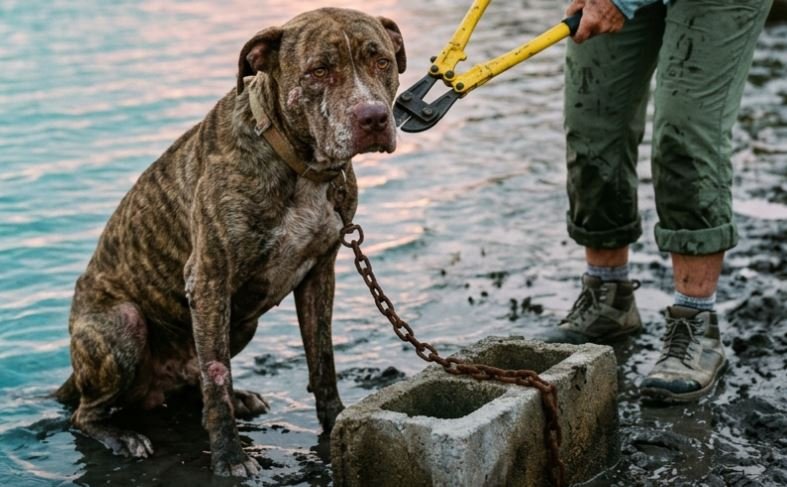
The Monroe County Sheriff investigated the chain. The cinder block. The particular evidence of animal cruelty that Elena had filed and forgotten. They found the owner — a commercial fisherman out of Marathon, with a history of violence, a record of discarded animals, the particular cruelty of a man who saw dogs as tools and the ocean as a grave.
He was arrested.
Not for the hurricane. For Tide. For the chain. For the particular crime of leaving a creature to drown because it was easier than setting it free.
Tide sat in the courtroom.
Not officially. But the judge allowed it — the particular leniency of a Florida judiciary that understands symbolism. Tide lay at Elena’s feet while she testified. He didn’t bark. He didn’t growl. He just watched the man who had chained him, with eyes that held no revenge. Only the particular certainty of a creature who has survived the worst and found something better.
The man was convicted.
Six months. The particular justice that doesn’t fit the crime but is all the law allows. Elena didn’t celebrate. She just took Tide home — to her new home, a smaller house on higher ground, built with insurance money and donations from strangers who had watched the video and wept.
She started The Tide Project.
A nonprofit. Small. Underfunded. The particular passion project of a woman who has learned that rescue goes both ways. They rescued dogs from abusive coastal situations — chained boats, flooded kennels, the particular neglect that island life can hide. Tide was the mascot. Not because he was friendly. Because he was present. Because he would sit with the new rescues, nose to nose, and communicate — in the particular language of dogs — that survival was possible. That trust could be rebuilt. That the water that had tried to kill him had become, finally, just water.
Elena took him swimming.
Not immediately. Not easily. The particular trauma of a dog who had nearly drowned, who had been chained to the tide, who had every reason to fear the ocean. She started in the shallows. She held him. She let the water move around them, warm and clear and safe.
By the second year, Tide would wade to his chest.
By the third, he would swim — not far, not fast, but with the particular joy of a creature reclaiming a world that had tried to take him. He would swim beside her skiff, his brindle coat dark with water, his amber eyes bright with the particular triumph of a dog who had learned that chains break, that storms pass, that love — the particular love between a broken woman and a broken dog — is stronger than the tide.
Elena still has the photo.
Not the wedding picture. That was lost. But a new one — taken by a volunteer, printed on cheap paper, taped to her new refrigerator. It shows her and Tide on the deck, after the swim, both of them wet, both of them smiling. The particular smile of survivors.
On the back, she wrote:
“He was chained to the tide. I was chained to the past. We cut each other free.”