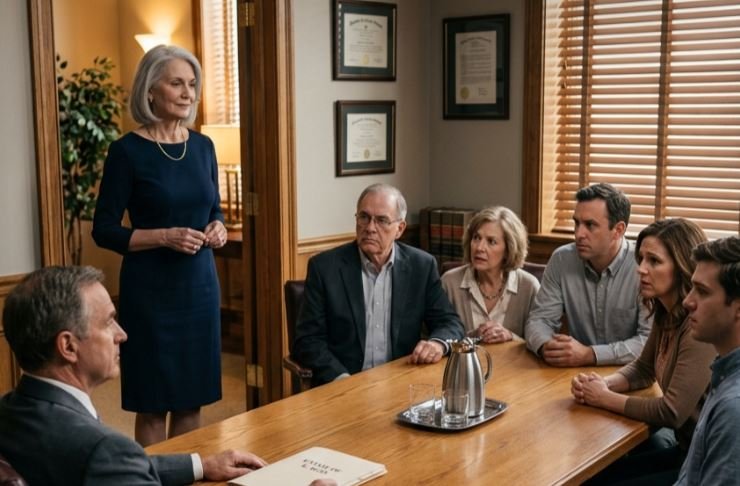
My father-in-law left his entire fortune to a woman none of us had ever met. That sentence alone was enough to unravel our family’s composure in that lawyer’s conference room. Then I noticed the ring on her hand, and everything got considerably more complicated.
Walter Ashford had been a quiet, private man for as long as I’d known him — nineteen years, since I married his son David. He’d built a modest but genuinely successful chain of hardware stores across three counties, widowed for the past six years since his wife Eleanor passed from a long illness, and had grown steadily more withdrawn in the years since her death, spending most of his time alone at the old family house, declining most invitations to holiday gatherings with an increasingly thin excuse of tiredness that none of us pushed back on as hard as, in hindsight, we probably should have.
His death, from a sudden cardiac event three weeks earlier, had been a shock the whole family was still processing when we gathered at his attorney’s office for the reading of the will — David, his two sisters, their spouses, and Walter’s longtime accountant, all of us expecting a fairly straightforward division of the estate among the three siblings, the way Walter had always casually implied it would go over the years.
The woman was already seated in the small waiting area when we arrived, and I noticed the family’s collective confusion the moment we walked in — nobody recognized her, a composed woman who appeared to be in her early sixties, dressed modestly but with an unmistakable quiet dignity, sitting with the kind of stillness of someone who’d clearly been preparing for an uncomfortable conversation for some time.
The attorney, a longtime family friend named Harold Pierce, explained gently before opening the will itself that Walter had left specific instructions requiring this woman — introduced only as Marguerite — to be present for the full reading, a detail that immediately set the room on edge in a way none of us fully understood yet.
The will’s opening sections were unremarkable — modest bequests to a few longtime employees, a donation to Eleanor’s favorite local charity, standard provisions any of us might have expected. Then Harold reached the section addressing the bulk of the estate — the hardware store chain itself, the family home, and a substantial investment portfolio Walter had quietly built over four decades — and read, in careful, measured tones, that the entirety of it had been left to Marguerite Colson, effective immediately upon his death.
The room went completely silent. David’s jaw tightened visibly beside me. His older sister, Renee, was the first to speak, her voice sharp with barely controlled shock. “Who exactly is she supposed to be? Dad never once mentioned this woman in his entire life.”
It was in that charged silence that I noticed it — a ring on Marguerite’s right hand, catching the afternoon light through the office blinds, a distinctive antique setting I recognized instantly because I’d admired it at nearly every family gathering for the better part of two decades. It was Eleanor’s wedding ring, the one that had gone missing sometime in the chaotic days immediately following her funeral six years earlier, a loss the family had quietly mourned alongside everything else, assuming it had simply been misplaced during the overwhelming logistics of those first grief-stricken weeks.
I nudged David and whispered what I’d noticed. His sister Renee, sharp-eyed even through her shock, followed our gaze and went pale.
“That’s Mom’s ring,” she said, her voice barely above a whisper, then louder, directed at the stranger across the room. “That’s my mother’s wedding ring. The one that disappeared after the funeral.”
Marguerite looked down at her own hand as if seeing the ring for the first time, then back up at the room full of stunned, hostile faces, her earlier composure shifting into something more careful, more resigned.
“I think it’s time I explained who I actually am,” she said quietly.
What followed was a story none of us had been prepared for, delivered with a steadiness that suggested she’d rehearsed it many times in her own mind before ever having to say it aloud to Walter’s family directly. Marguerite had been Eleanor’s hospice nurse during the final eight months of her illness — not a stranger to the family at all, in the sense that mattered most, but someone who had spent nearly every day of that difficult final stretch in the Ashford home, caring for Eleanor with a level of dedication that had, over those eight months, grown into something considerably deeper than a typical patient-caregiver relationship.
Eleanor, in her final weeks, lucid and clear-eyed about what was coming, had apparently asked Marguerite to keep something after she passed — the wedding ring, given not as some romantic gesture but, in Marguerite’s careful telling, as a genuine token of gratitude for the specific, exhausting kindness Marguerite had shown during months when Eleanor’s own family, however loving, simply couldn’t be present around the clock the way a hired nurse could be. Eleanor had asked her, specifically, to keep it quiet, worried that the family might misread the gift as something inappropriate rather than the simple thank-you she’d genuinely intended it as.
What none of us had known — what apparently only Walter had learned, gradually, in the years following Eleanor’s death — was that Marguerite had continued visiting the Ashford house periodically after Eleanor passed, initially just to check on Walter’s well-being out of genuine concern for a man she’d watched grieve up close, and that those visits had, over six years, evolved into a quiet, careful companionship neither of them had ever formally announced to the wider family, largely because Walter, private as ever, hadn’t known how to explain a relationship that had started under such complicated circumstances.
“He wanted to tell all of you,” Marguerite said, her voice steady but clearly difficult for her to maintain. “He kept saying he would, once he found the right moment. I think, in the end, he decided the will was going to have to be that moment, because he never quite managed to find the courage while he was alive.”
The room took a long time to process what she’d said. Renee, still visibly shaken, asked the question that mattered most to all of us. “Were you and my father actually together? All this time?”
“Not romantically, not for most of it,” Marguerite said carefully. “For years, it really was just companionship, two people who understood a specific kind of grief neither of us wanted to explain to anyone else. It became something more only in this last year. I know that probably doesn’t make any of this easier to hear.”
It didn’t, not immediately. The weeks following that meeting were difficult, full of the particular tangled grief of losing a parent while simultaneously discovering an entire dimension of his life none of us had understood. But Marguerite, to her considerable credit, didn’t disappear behind lawyers or insist on the full inheritance as written. She proposed, gently, a revised arrangement — a portion of the estate for herself, honoring what Walter had clearly wanted, but the majority restructured back toward the family, an offer none of us had expected and one that did more to soften the initial shock than any legal argument could have.
We didn’t become close overnight. Some wounds from that conference room took considerably longer than a single generous gesture to heal. But eighteen months later, Marguerite still occasionally joins Renee’s family for Sunday dinners, still wears Eleanor’s ring, and has become, slowly and cautiously, something the family never expected to need — a living link to both parents we’d lost, carrying pieces of each of them forward in a way none of us, in that first stunned meeting, could have imagined we’d eventually be grateful for.
THE END