The fire department declared the line dead at 3:45 PM.
Jose sat in Arthur’s kitchen until then. Shaking. Drinking coffee he couldn’t taste. Watching Spark — the particular watchfulness of a man who has been saved and doesn’t know how to say thank you to a creature who cannot hear it.
“He doesn’t even know his name,” Jose said.
Arthur smiled. The particular smile of a man who has heard this before.
“He knows other things,” Arthur said. “He knows I’m about to step into danger before I know it myself. He knows when the mailman is coming. He knows that some rules — like staying close, like coming when called — are less important than the particular knowledge of what will kill you and what won’t.”
Jose reached out.
Spark flinched — the particular flinch of a shelter dog who has been hit for flinching. But he didn’t run. He let Jose touch his head. Once. Twice. The particular permission of a creature who decides, in the moment, that this human is acceptable.
“I was listening to music,” Jose said. “I didn’t hear the line snap. I didn’t see the spark. I was just… walking.”
“That’s what we do,” Arthur said. “We walk. We assume the world is safe because it usually is. And then we meet the particular creature who knows it isn’t.”
The story went viral.
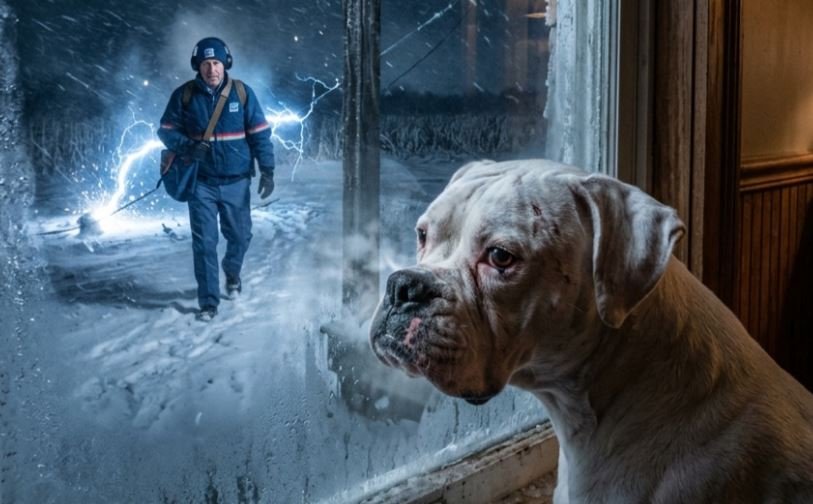
Not from Arthur. From Jose — who posted the security camera footage from his USPS truck, which showed Spark running across the ice, hitting him, the wire sparking. The particular footage that needed no sound because the visual was enough.
89 million views.
The internet — that mysterious, merciless god — found its offering. A deaf dog. A blind man. A mailman. A blue arc of electricity in the snow. The particular equation of virality: disability + danger + unexpected hero + survival.
The shelter called.
The same shelter that had scheduled Spark for euthanasia. The same director who had warned Arthur. They wanted Spark back — for a fundraiser, a calendar, the particular publicity that saves shelters and forgets individual animals.
Arthur declined.
Not angrily. Just… certainly. The particular certainty of a man who has learned that institutions are not friends, that Spark’s value was not in his viral moment but in his daily presence.
But he visited the shelter.
Not to return Spark. To adopt another. A white pit bull mix, 3 years old, also deaf, also scheduled, also labeled “unmanageable.” Her name was Fuse. Arthur didn’t rename her. He just brought her home.
Spark taught her.
Not with sound. With vibration. With the particular body language that deaf dogs use — the set of the shoulders, the angle of the head, the particular posture that says watch, wait, the world is full of things that will hurt you and things that will save you.
Fuse learned.
She sat at the window with Spark. She watched the driveway. She learned the particular routine of a blind man’s house — the counting of steps, the stomping of feet, the particular vibration that meant come, that meant danger, that meant I need you.
Jose still delivers the mail.
Every day. But now he stops. He sits on the porch. He tells Arthur about the route — the gossip, the weather, the particular news of rural Iowa that doesn’t make the internet but matters to the people who live there. And Spark and Fuse sit with him, both deaf, both watching, both present in a way that hearing dogs rarely are.
Arthur still teaches.
Not physics. Not formally. He tutors online — voice-only, the particular platform that doesn’t require him to see his students. He tells them about electricity. About resistance. About the particular physics of survival.
And he tells them about Spark.
Not the viral story. The daily one. The dog who doesn’t come when called. The dog who watches. The dog who decided, on an icy Tuesday in Iowa, that obedience was less important than love, and that independence — the very trait that made him unadoptable — was the particular gift that saved two lives.
Spark is 9 now.
Gray-muzzled. Slower. But still at the window. Still watching. Still deaf to the world but seeing it with a clarity that Arthur envies, that Fuse is learning, that the particular students who hear his story carry with them into their own lives.
The power lines were replaced.
Underground now. The particular modernization that rural Iowa resists until tragedy forces its hand. Arthur doesn’t need to worry about downed lines anymore.
But Spark still watches.
Because the world is full of dangers that don’t announce themselves. Because some creatures are born to see what others miss. Because the particular love between a blind man and a deaf dog is not about what they lack but about what they share — the particular attention, the particular presence, the particular refusal to look away.
And sometimes — when the light is right, when the corn is high, when the particular silence of the Iowa afternoon settles over the farmhouse — Arthur sits beside Spark at the window.
He can’t see what Spark sees. But he can feel the particular vibration of the dog’s body, the particular tension that means something is worth watching, the particular relaxation that means, for now, the world is safe.
He puts his hand on Spark’s back.
Spark leans into it. He doesn’t wag — not always. He just… presses closer. The particular weight of a creature who has found his person and will not leave, who will not come when called because he is already where he needs to be.
“Good boy,” Arthur says.
Spark can’t hear him. But he feels the vibration of the words through Arthur’s hand, through his ribs, through the particular connection that exists between two creatures who have decided that their disabilities are not deficits but doors.
And outside — in the driveway, in the cornfields, in the particular vastness of a world that is beautiful and dangerous and worth watching — the wind moves through the leaves.
Spark watches.
Arthur feels.
And both of them, in their particular silence, are exactly where they need to be.