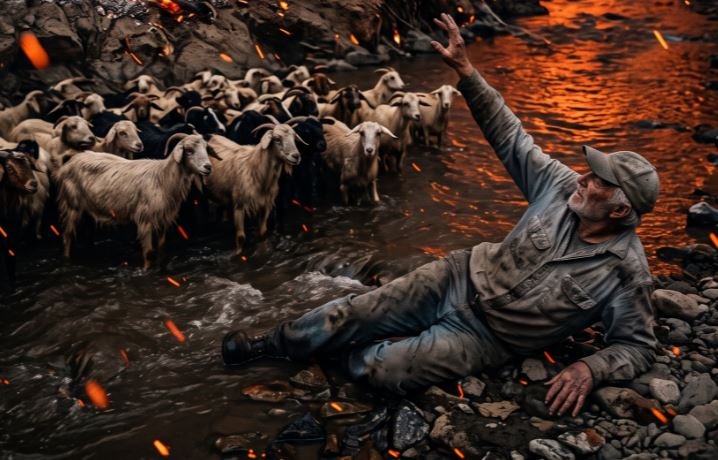
They stayed in the water for six hours.
Not because it was safe. Because it was safer. The fire moved around them — the creek creating a natural break, the water keeping the bank cool enough that the flames couldn’t hold. But the smoke was lethal. The heat was unbearable. Silas kept his head low, his face wet, his breathing shallow through a bandana that Juno had pulled from his pocket with her teeth.
She stayed on the bank.
Not in the water. She wouldn’t leave the edge. She moved along it, pacing, watching the fire, watching the goats, watching the particular world that had become orange and black and the smell of burning. When an ember landed near a goat, she stepped on it. When a kid tried to leave the water, she blocked it. She was everywhere. She was tireless. She was the particular creature that the breeder had thrown away because she wouldn’t fight coyotes.
She fought the fire instead.
Not with teeth. With presence. With the particular refusal to let anything she had herded die.
At 4 AM, the wind shifted.
The particular mercy of wildfire behavior — a cold front, a pressure change, the particular meteorology that firefighters pray for. The fire stopped its run. It settled into the blackened ridge and began to consume what was left, which wasn’t much.
Silas heard the engine at 5:30 AM.
Not a fire truck. A Cal Fire bulldozer, cutting line, checking for survivors. The operator — young, Filipino, face streaked with soot — saw the creek. Saw the goats. Saw the old man in the water and the dog on the bank and the particular impossibility of what he was looking at.
He called it in.
“Multiple survivors. Creek bed. One civilian. One dog. Forty-plus goats.” He paused. Looked at Juno. At the particular posture of a creature who had been standing guard for six hours and was still standing. “Make that one hell of a dog.”
They airlifted Silas.
Not because he was injured — though his hip was ruined, though his lungs were full of smoke, though his body was the particular wreckage of an 81-year-old man who had spent a night in a wildfire. But because the creek was surrounded by active fire, because the only way out was up, because the particular machinery of rescue sometimes requires helicopters.
Juno wouldn’t let them approach.
Not aggressively. She just stood. Between the medics and Silas. Between the goats and the strangers. The particular guardian behavior that she had never shown before and would never fully leave. She had to see Silas loaded, had to smell the medics, had to confirm — in the particular way of dogs — that these humans were safe before she would allow them near what was hers.
Silas reached for her from the stretcher.
“Juno,” he said. His voice was gone — smoke, exhaustion, the particular ruin of a night spent screaming at goats. But she heard him. Or felt the vibration. Or knew the particular shape of his mouth.
She went to him.
She pressed her head against his hand. He touched the burn on her ear. The ash on her coat. The particular evidence of a night that had transformed them both.
“Good girl,” he whispered.
She wagged her tail. Once. The particular wag of a dog who had finally, after two years of failing, succeeded at the only job that mattered.
Part 3: The Ash
The video went viral.
Not from Silas. From the bulldozer operator — who had filmed the creek, the goats, the dog on the bank, the particular image of survival that needed no explanation. It was posted at 6:47 AM, before the fire was contained, while the ridge was still smoking.
112 million views in 48 hours.
The algorithm — that mysterious, merciless god — had found its offering. A wildfire. An old man. A failed dog. Forty goats in a creek. The particular apocalypse imagery that the internet cannot resist — destruction, loyalty, the unexpected hero who comes from the discard pile.
People wanted to donate.
To Silas. To Juno. To the particular goat herd that had become famous. The GoFundMe — started by the bulldozer operator without Silas’s knowledge — raised $400,000 in a week. Enough to rebuild. Enough to fence. Enough to hire help so an 81-year-old man wouldn’t have to choose between his herd and his life.
Silas didn’t rebuild the house.
Not the same house. He built smaller. Closer to the creek. With a concrete roof and a fire-resistant shell and the particular architecture of a man who has learned that nature doesn’t negotiate. He built a barn with a sprinkler system that actually worked. He built a corral with a gate that opened directly to the creek bed.
He kept Juno inside.
Not because she wanted to be inside. Because she had earned it. Because the particular rug by the fire was no longer a failure — it was a throne. Because the dog who had dragged him from a burning barn would sleep where she wanted, would eat first, would be carried if her legs gave out before his.
The goats respected her now.
Not because she barked. She still didn’t bark. But because she moved among them differently — the particular confidence of a creature who had proven herself, who had stood on a burning bank and decided who would live and who would not. They made way for her. They nuzzled her. Delilah’s great-grandkid — a spotted doe with one horn, the particular genetics of memory — slept beside her in the barn.
Juno died at 11.
Not from the fire. From age. From the particular decline of a large dog who had lived hard and loved harder. She was buried beneath the new oak that Silas planted by the creek — not Ruth’s oak, which was gone, but a new one, a valley oak, the particular tree that would outlive them both.
The marker was simple. Silas carved it with his shaking hands, the particular craftsmanship of a man who had built fences for sixty years.
JUNO — Failed Guardian. Perfect Friend. She Dragged Me From Fire.
He visits every morning.
Not to mourn. To talk. To tell her about the goats, the weather, the particular news of a world that continues to burn and rebuild and burn again. He brings coffee. He sits on the concrete bench he built — fireproof, permanent, the particular architecture of grief that has learned to endure.
And sometimes — when the wind is right, when the creek is running, when the particular silence of the Mendocino hills settles over the ash and the new growth — he feels her.
Not as a ghost. As presence. As the particular weight of a dog who decided, on a night when everything was burning, that love was not a feeling but an action. That protection was not a breed standard but a choice. That the gentle creature who slept on a rug was also, always, the guardian who would drag him from death if he was too stubborn to walk.
The goats graze the ridge now.
Where the fire burned, where the oak fell, where Ruth’s grave was lost and remembered. The new grass is green. The wildflowers came back first — lupine, poppy, the particular succession that follows destruction. Silas walks among them, slower now, leaning on a cane carved from the dead oak that started the fire.
Juno’s ashes are scattered there.
Mixed with the soil. Feeding the grass. The particular return that means she is still watching, still present, still the particular guardian of a herd that didn’t deserve her and a man who didn’t know he needed her until the embers fell.
Silas still talks to Ruth.
By the new oak. By the creek. He tells her about Juno. About the night the dog dragged him from the barn. About the particular miracle of a failed guardian who became, in the only moment that mattered, exactly what she was meant to be.
“She was too gentle,” he says.
And he smiles. The particular smile of a man who has learned that gentleness is not weakness. That the dogs we discard for being soft are often the ones who will stand between us and the fire. That love — the particular love between a broken man and a gentle dog — is the only thing that survives when everything else has burned.
He pours coffee on Juno’s grave.
Not to waste it. To share it. The particular ritual of a man who has learned that the dead are not gone, just waiting, just listening, just needing to know that they are remembered.
The goats graze.
The creek runs.
The ridge — scarred, blackened, healing — holds the particular memory of a night when the world burned and a dog decided that some things were worth saving.
And in the ash, in the grass, in the particular silence of a California morning, Juno remains.
Not as a ghost.
As the particular truth that Silas carries with him, that he whispers to Ruth, that he will carry until he joins them both beneath the oak:
She dragged me.
When I wouldn’t walk.
When I was too stubborn to live.
She dragged me.
And I am here because she was too gentle to let me die.