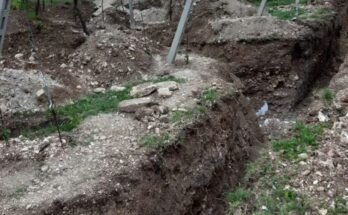
The engine failed at 6:17 AM.
Not a sputter. Not a warning. A catastrophic failure of the number three cylinder at 200 feet AGL, the particular altitude where a pilot has no time to think, only react. Hank pushed the nose down to maintain airspeed. He looked for a road, a clearing, any of the particular options that exist in flat country.
He found the Decker corn.
Twelve feet high. Tasseled. Ready for harvest. The stalks were dry, brittle, the particular fuel that turns a forced landing into a fire. He hit them at 80 mph. The Air Tractor’s wings sheared off. The fuselage rolled. The cockpit cage — the particular steel structure that keeps crop duster pilots alive — held, but only partially.
Hank woke upside down.
Suspended by his harness. Fuel dripping, not pouring — the tanks had ruptured but not ignited. His left leg was pinned. The rudder pedal had folded back on impact, trapping his femur against the seat rail. He could feel blood filling his boot, warm, urgent, the particular sensation of an arterial bleed that gives a man twenty minutes, maybe thirty.
He reached for his radio.
Dead. The antenna had sheared. His phone was in his shirt pocket, screen shattered, no signal. The particular isolation of a cornfield in August — walls of green on all sides, no visibility, no sound carrying through the dense foliage.
He screamed.
Not for help. Just… release. The particular scream of a man who has felt his body break and knows that the next phase is shock, unconsciousness, death.
Bess heard him.
Not clearly. The corn muffled sound. But she was on her chain, in her spot, and the particular frequency of a human in extremis — higher than normal, sharper, carrying a chemical signature of adrenaline and fear that traveled on the morning air — reached her.
She stood.
Not quickly. The particular stiffness of a dog who has spent six years on a chain. She oriented toward the sound. Toward the field. Toward the particular place where the yellow plane had disappeared into the corn.
She didn’t bark.
She had never barked. The particular silence that Dale Decker had resented, that had made her useless, was now the only tool she had. She couldn’t call the Deckers — they were gone, at the livestock auction in Cedar Rapids, wouldn’t return until evening. She couldn’t call anyone.
She pulled.
Against the chain. Not hard enough to break it — she had tried that as a puppy and learned that the collar won. But she pulled to the end of her radius, to the point where the chain stopped her, and she assessed.
The oak tree.
The one that shaded her water trough. It was old, its bark ridged, its trunk three feet from the end of her chain. Bess had spent six years watching squirrels climb it. She had never climbed it herself — Pyrenees aren’t climbers, and she was heavy, and the particular physics seemed impossible.
But she jumped.
Not gracefully. Her paws scrabbled on bark. Her body — 90 pounds of muscle and neglect — found a branch, lost it, found another. She pulled herself up, inch by inch, the particular desperation of a creature who has decided that impossible is just a word for things that haven’t been tried yet.
She reached the porch roof.
Low slope. Metal. She walked across it, nails clicking, and leaped from the far edge. The chain snapped taut behind her, pulled the staple from the rotted porch beam, and she fell — ten feet onto grass, chain trailing, collar loose, free.
She ran.
Into the corn. Not fast — the stalks were dense, taller than her head, the particular maze that disorients even coyotes. But she followed the scent of avgas, of blood, of the particular man who had waved at her every summer.
She found him in four minutes.
The yellow fuselage. The smell of fuel. Hank hanging upside down, conscious, his face gray, his hands fumbling with the harness release that wouldn’t release.
Bess approached.
She didn’t lick him. She didn’t whine. She just pressed her nose against his hand — the particular touch that said I am here. I am real. You are not alone.
Hank looked at her.
He didn’t know her name. He knew the white dog from the porch. The useless one. The broken one.
“Go,” he whispered. “Get help.”
Bess didn’t move.
She assessed. She smelled the blood — too much, too fast. She understood, in the particular way that dogs understand, that Hank didn’t have time for her to run to the farmhouse, find it empty, run to the highway, hope for a car. The particular math of survival that her instincts calculated without instruction.
She turned.
She ran. Not toward the farmhouse. Toward the highway. The particular direction she had watched for six years, where the semis rolled past at dawn, where the world moved even when the farm stood still.
Part 3: The Highway
Highway 9 ran east-west, two lanes, the particular artery of rural Iowa that carried grain to elevators and mail to towns and drivers who were half-asleep at 6:24 AM.
Maria Santos drove a Peterbilt.
Not her own — she was a company driver, 34, hauling frozen pork from Sioux City to Chicago. She had been on the road since 4 AM. She was tired. She was listening to a podcast about true crime, the particular distraction that long-haul drivers use to stay awake.
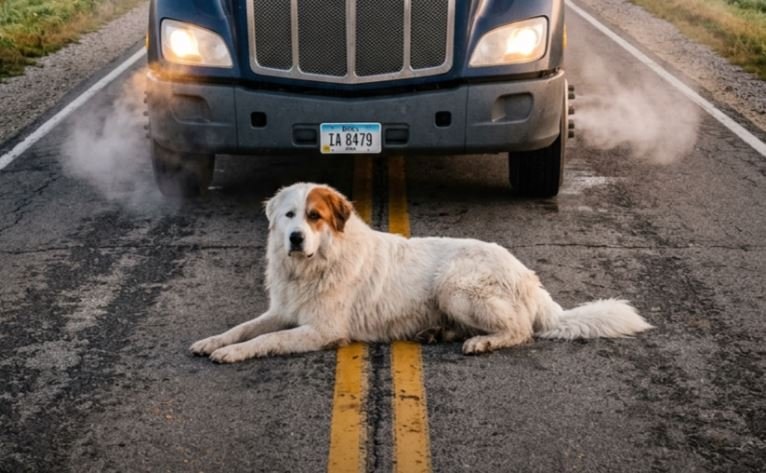
She saw the dog at 600 yards.
White. In the middle of the road. Not moving. Not running. Just… lying down. In the center line. The particular posture of an animal that had decided that motion was less important than presence.
Maria hit the brakes.
The Peterbilt’s air brakes hissed. The trailer shifted. She stopped forty feet from the dog, heart hammering, the particular adrenaline of a near-miss that truckers know too well.
She laid on the horn.
Bess didn’t move.
Maria opened the door. She jumped down, boots hitting asphalt. She approached the dog — cautiously, angrily, the particular confusion of a driver who has nearly killed an animal and can’t understand why it won’t get out of the road.
“Move!” she shouted.
Bess stood.
She didn’t run. She didn’t cower. She walked to Maria, pressed her nose against Maria’s hand — wet, urgent, smelling of blood and avgas and the particular chemistry of a creature who has found something that needs saving.
Then she turned.
She walked three steps toward the cornfield. She looked back. She made a sound — not a bark, but a huff, a particular exhalation that said follow. Now. This is the only reason I am here.
Maria followed.
Not because she believed in dogs. Because she was a mother — two kids in Des Moines, the particular instinct that recognizes urgency even when the mind doesn’t understand. Because Bess’s eyes held the particular knowledge that Maria had seen in her own dog’s eyes once, when the basement had flooded and the dog had woken her before the water reached the stairs.
They found Hank at 6:31 AM.
Eleven minutes since the crash. He was unconscious. His boot was full of blood. The fuel was still dripping, still unignited, the particular miracle of a crash that should have burned and hadn’t.
Maria called 911.
She didn’t have signal at first — the particular dead zone that exists between towers in farm country. She climbed onto the fuselage, held her phone high, and found one bar. She gave the coordinates. She described the plane. She stayed with Hank, holding his hand, talking to him in Spanish, the particular language of comfort that transcends consciousness.
Bess lay beside him.
Not on the blood. Beside it. Her body pressed against his side, her particular warmth against his cooling skin, the particular mammalian knowledge that heat is life and presence is medicine.
The helicopter came at 6:59 AM.
Life Flight, out of Iowa City. They winched Hank out of the cornfield, into the sky, into the particular machinery of trauma medicine that would save his leg and his life. Maria stood in the field, watching the helicopter disappear, her Peterbilt idling on the highway, her delivery schedule ruined.
Bess watched too.
Not the helicopter. The empty space where Hank had been. The particular absence that dogs understand before humans do. She sat in the corn, in the blood, in the wreckage of a plane and a morning, and she waited.
The sheriff came.
He found her there. He recognized her — the Decker dog, the useless one, the particular fixture of the farm that everyone drove past without seeing. He called Dale Decker. Got voicemail. Left a message.
He tried to catch Bess.
She wouldn’t let him. Not aggressively. She just… moved away. Back to the highway. Back to the spot where she had stopped a semi. She lay down again. In the center line. Waiting.
Maria moved her truck.
She parked it across both lanes, hazards flashing, the particular roadblock that rural emergencies require. She sat on the asphalt beside Bess. She didn’t touch her. She just… stayed. The particular companionship of two creatures who had done what they could and were now waiting for the world to catch up.
Dale Decker returned at 2 PM.
He found the sheriff, the truck, the plane in his cornfield, and his dog lying in the middle of Highway 9 like a statue. He approached with a leash. Bess didn’t stand. She just looked at him. The particular look of a creature who has spent six years being invisible and has now, finally, been seen.
“She saved Hank Voss,” the sheriff said.
Dale looked at the dog he had chained. The dog he had called useless. The dog who had never barked, never guarded, never earned her keep.
“She’s not my dog,” Dale said.
Not angrily. Just… the particular realization of a man who understands that some creatures are on loan, that ownership is not the same as belonging, that the particular dog lying in his road had become someone else’s the moment she decided to save a life.
Hank survived.
Not easily. Surgery. Pins. Six months of physical therapy. He lost partial use of his left foot — the nerve damage from the crushed femur — but he kept the leg. He kept his license. He kept flying, though lower, though slower, though the particular caution of a man who has met his mortality in a cornfield.
He adopted Bess.
Not from the Deckers. From the shelter where Dale had taken her — the particular surrender of a man who felt guilty, or generous, or simply didn’t know what to do with a dog who had outgrown his understanding of her.
Hank didn’t chain her.
He built her a platform on the Air Tractor’s wing — a custom cage, padded, with a view of the cockpit. She flew with him. Not as cargo. As co-pilot. The particular weight of a dog who had learned to trust the air, who no longer watched planes from the ground but rode in them, nose to the wind, the patch over her left eye squinting against the slipstream.
She didn’t bark at coyotes.
She didn’t bark at anything. The particular silence that had made her useless on the ground made her perfect in the air — no distractions, no panic, just the particular presence of a creature who had decided that her place was wherever Hank was.
They still fly the Decker fields.
Every summer. Bess in her wing cage, Hank at the stick, the yellow Air Tractor painting chemicals over corn that grows tall and green and indifferent. And when they pass the farmhouse, when they buzz the porch where she spent six years on a chain, Hank dips the wing.
Bess wags her tail.
Once. The particular economy of movement that she learned as a chained dog, conserved now into a ritual. A wave. A recognition. A particular thank you to the place that held her until she was ready to become what she was meant to be.
The Deckers got a new dog.
A German Shepherd. Properly aggressive. Properly loud. It barks at planes, at trucks, at the particular emptiness of rural Iowa that needs filling with sound.
Bess doesn’t bark.
She just flies. And watches. And waits for the particular moment when the world will need her again — not to guard, not to threaten, but to lie down in the road and refuse to move until someone follows her home.