Caleb Torres was a Cal Fire engineer.
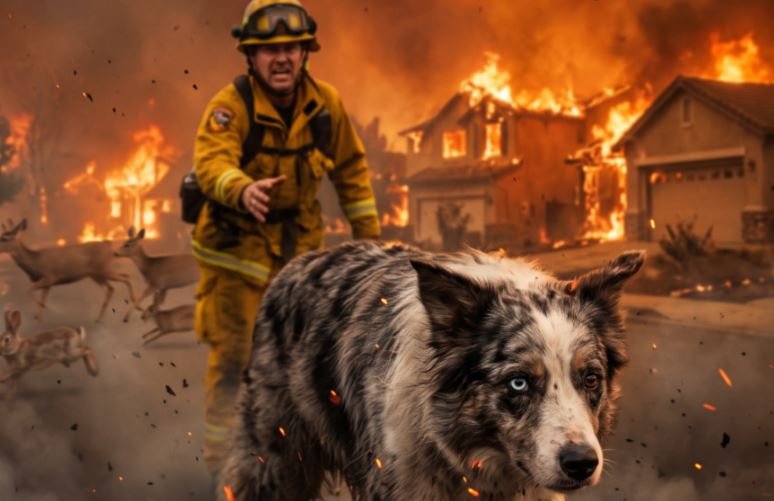
Not a firefighter who runs into burning buildings — usually. His job was structure protection, engine operations, the particular machinery of wildland firefighting that keeps flames from consuming neighborhoods. He was on Oak Valley Road at 12:15 PM, hosing down a roof, when he saw the deer.
Hundreds of them.
Not just deer. Rabbits. Squirrels. A coyote, loping past without its usual caution. The particular exodus that happens in fire — every creature moving in the same direction, away from the heat, away from the smoke, away from the particular death that was consuming the ridge.
Every creature except one.
Caleb saw him at 12:22 PM.
A dog. Blue merle, scruffy, running against the current. Not wandering — purposeful. Nose to the ground, body low, moving through smoke and embers with the particular determination of a creature who has a destination and will not be deterred.
Caleb shouted.
“Hey! Dog! This way!”
The dog didn’t look. Didn’t slow. The particular focus of a being who has filtered out everything except the one thing that matters.
Caleb watched him.
Not for long. Five seconds. Ten. The particular moment when a firefighter decides whether to follow a dog into a burning neighborhood or stay at his post, do his job, trust the system.
He followed.
Not because he was a hero. Because he was human. Because the particular image of a dog running toward fire while everything else ran away was the kind of sign that firefighters learn to read — the anomaly, the exception, the particular data point that doesn’t fit the pattern and therefore demands attention.
He followed Rusty up Oak Valley Road.
The houses were burning now. Not all — some were just smoking, threatened, the particular lottery of wildfire where one house stands and its neighbor collapses. The air was orange. Embers fell like snow. Caleb’s radio crackled with orders to retreat, to pull back, to abandon the road.
He didn’t.
Because Rusty had stopped. At a house — 1847 Oak Valley. The Martinez house. The particular home that looked untouched from the outside but was filling with smoke through every vent, every gap, every particular weakness that fire finds.
Rusty scratched at the front door.
Not barked — scratched. His paws on wood, the particular desperation of a creature who knows that what he wants is behind this barrier and time is running out. Caleb tried the door. Locked. He kicked it — once, twice, the particular violence that rescue sometimes requires.
It gave.
The interior was smoke. Not flame — not yet. But thick, white, the particular smoke that kills before fire does. Caleb dropped to his knees, the particular training that every firefighter knows — stay below the smoke, breathe what’s left, move fast.
Rusty didn’t drop.
He ran. Through the smoke, down the hallway, past the kitchen where a window had cracked and embers were landing on tile. Caleb followed, crawling, chasing the particular shape of a dog who moved like he knew the house, like he had done this before, like he was following a scent that was clear and bright and close.
The bathroom door was closed.
Rusty hit it. Body-slammed it. Once. Twice. The particular force of a 50-pound dog who has decided that this door is the only thing between him and what he loves. Caleb reached it, turned the handle, pushed.
Sophie was in the tub.
Curled. Silent. Not crying — the particular stillness of a child who has found her safe place and will not leave it, even when the safe place becomes dangerous. She had her stuffed rabbit. She had Rusty’s collar — she had been holding it when the family left, the particular comfort object that smelled like her dog.
She was breathing.
Shallow. Smoke. But breathing. Caleb grabbed her, wrapped her in his fire coat, the particular cocoon that protects what is fragile. He turned to run — and found Rusty in the doorway, blocking it, not letting him pass.
Not aggressively. Urgently.
The dog turned. Ran down the hall. Looked back. The particular gesture that said not that way. This way. Follow me.
Caleb followed.
Not toward the front — the front was smoke now, flame licking through the broken door frame. Toward the back. The kitchen. The window that Rusty had seen, that he had calculated, that represented the particular escape route that a dog who chewed door frames and dug under fences understood better than the firefighter who had kicked down the front door.
Rusty jumped.
Through the broken kitchen window, onto the back patio, into the particular air that was still breathable, still survivable. Caleb passed Sophie through — to hands that were waiting, he didn’t know whose, later he would learn they were a neighbor’s, a man who had refused to evacuate his own house until the Martinez house was checked.
Then Caleb climbed out.
The roof collapsed behind him. Not gradually — suddenly. The particular surrender of a structure that had held on as long as it could. 1847 Oak Valley Road ceased to exist in the particular way that houses cease to exist in wildfire — not as rubble, but as absence.
Rusty was on the lawn.
Coughing. His merle coat gray with ash. His paws burned — Caleb would see this later, would treat it, would wrap them in gauze. But in the moment, Rusty was standing beside Sophie, who had been laid on the grass, who was breathing, who was blinking, who was reaching out with a hand that found his fur and held on.
She didn’t speak.
She never spoke. But she pressed her face into his neck. And Rusty — the anxious dog, the destructive dog, the dog who had been returned twice and scheduled for a third — lay down beside her. He placed his burned paws on either side of her body. He made himself a shield. A bed. A particular fortress of fur and love that said I found you. I will not leave you. I was abandoned twice, but I will not let you be abandoned once.
Part 3: The After
Sophie was hospitalized for three days.
Smoke inhalation. Minor burns on her hands — she had been holding the faucet, the particular cool metal that was her anchor. She recovered. She went home. To a new home — an apartment in Chico, while the Martinez family rebuilt, while Paradise became again the particular place that rises from fire because Californians refuse to leave.
Rusty became a hero.
Not immediately. The video — filmed by the neighbor who had caught Sophie, shaky, vertical, the particular footage that authenticity demands — showed Caleb climbing out of the window, the roof collapsing, and Rusty lying over Sophie in the ash-covered grass. It was posted at 8 PM that night. By morning, it had 80 million views.
The comments were a flood.
“The dog they were going to return saved their daughter.”
“He ran INTO the fire. Every instinct said run away. Love said run in.”
“I’m crying in my car. Dogs are too good for this world.”
“Sophie holding his collar in the tub. She knew he would come.”
The Martinez family didn’t return Rusty.
Obviously. But more than that — they changed. Elena quit her job as a paralegal and became an autism advocate, the particular transformation that trauma creates. David started a nonprofit — The Run-In — that trained shelter dogs as comfort animals for non-verbal children. Rosa knitted sweaters for Rusty, one for every season, the particular hobby of a grandmother who had almost lost everything.
Rusty became Sophie’s service dog.
Not officially at first. Just… practically. He went everywhere with her. To therapy. To school. To the particular places that had been overwhelming before and were manageable now because a blue merle dog with one blue eye and one brown eye sat beside her and let her hold his collar.
He still had anxiety.
Still chewed when left alone. Still dug under fences. Still barked when Elena went to get the mail. But the Martinez family didn’t try to fix him anymore. They understood — the particular understanding that comes from almost losing everything — that his anxiety was not a flaw. It was love, expressed as fear. It was attachment, expressed as destruction. It was the particular trauma of a dog who had been abandoned and had decided, finally, that he would not be abandoned again.
And Sophie — non-verbal Sophie, who communicated through touch and pattern — learned one word.
Not spoken. Signed. The particular sign for dog — fingers snapping against thigh, the ASL sign that her therapist taught her. She signed it every morning. Every night. Every time Rusty lay beside her in the particular way that made her feel safe.
She signed it at his funeral.
Rusty died at 13.
Not from fire damage — his lungs were scarred, his paws never fully healed, but he lived long and well. He died in his sleep, on Sophie’s bed, with her hand on his collar and her fingers signing dog in her sleep.
The Martinez family buried him in their new backyard.
Not deep. Not hidden. In the particular place where the morning sun reached, where Sophie could sit with her stuffed rabbit and her signs and her particular grief that was not less because she didn’t speak it.
The marker was simple. Sophie chose the words — not spoken, but typed on her tablet, the particular technology that gave her voice:
RUSTY — He Ran In.
Elena added the rest:
“Returned twice. Abandoned twice. He ran into fire so that no one he loved would be abandoned again.”
Caleb visits every year.
Not because he has to. Because he was there. Because the particular moment when a dog ran toward fire and a firefighter followed changed him — made him trust instinct over protocol, made him look for the anomalies, made him understand that the best warning system is sometimes the one that the system rejects.
He brings his daughter now.
7 years old. The particular age where she understands that dogs can be heroes, that running toward danger is sometimes the only choice, that love doesn’t always look like obedience.
She places a flower on Rusty’s grave.
And Sophie — 13 now, still non-verbal, still signing dog every morning — sits beside her. She doesn’t cry. She just holds the stuffed rabbit that she had in the tub, the one that still smells like smoke if you press your nose into it, and she signs.
Dog.
Not past tense. Present. The particular grammar of love that doesn’t recognize death, that continues in the particular space between memory and presence where Rusty still lives.
He ran in.
And because he ran in, a child lived. A family healed. A firefighter learned. And a world that watched 80 million times learned that the dogs we call “unmanageable” are sometimes the only ones brave enough to run toward the fire.