December 3rd. 9:47 AM.
Maya was teaching fractions. The particular challenge of explaining one-third to children who still counted on their fingers. Poppy was beneath the reading rug, snoring softly, the particular peace of a dog who has found her place.
At 9:48, Poppy woke.
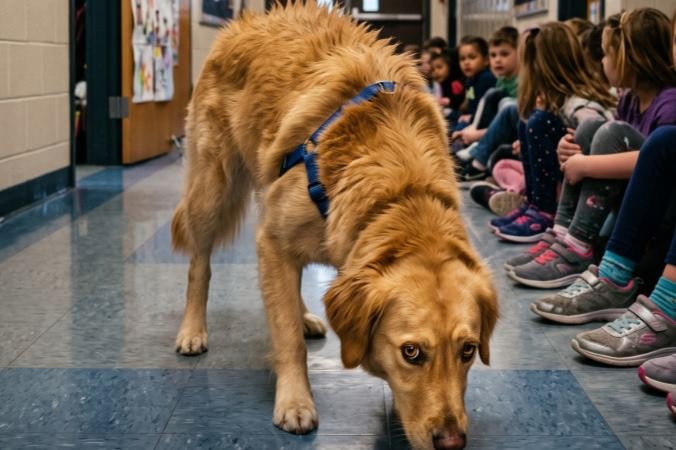
Not gradually. Instantly. Her body snapped upright. Her ears flattened. Her nose pressed to the floor tiles — the particular posture she always took before a “false alarm.”
Maya felt her stomach sink.
This is it, she thought. The last one. Doyle will take her.
Poppy didn’t whine.
She barked. Once. Deep. Resonant. The particular bark of a dog who has decided that this time is different, that this time is real, that this time the humans must move now.
Then she ran.
Not to the door — to the children. She moved between desks, nudging with her nose, herding with her body, the particular instinct of a creature who understands that small things must be gathered and moved. She nudged Marcus. She bumped Sofia. She stood in front of Elijah and would not let him stay seated.
“Poppy, stop,” Maya said.
Poppy looked at her. The particular look — amber eyes, ancient, certain — that said not a drill. Not false. Move.
Maya moved.
Not because she believed. Because she loved the dog. Because if this was the last time Poppy would be in her classroom, she would at least honor the particular urgency that Poppy felt. She would let her have this one final false alarm with dignity.
“Everybody up,” Maya said. “Line up. We’re going outside.”
The children groaned. “Again, Miss Chen?”
“Again. Quick feet.”
They lined up. 22 children in a snake line, the particular ritual of elementary school. Poppy ran the length of the line, counting them with her nose, confirming that none were missing, none were left behind.
She led them out.
Not walked — ran. Down the hallway, past the office where Mrs. Doyle looked up from her paperwork, past the library, through the double doors, onto the blacktop. Poppy didn’t stop at the usual spot — the designated assembly area 50 feet from the building. She kept going. Across the blacktop. Onto the field. Past the baseball diamond. To the far fence, 200 yards from Room 14.
“Miss Chen,” said Marcus. “This is too far.”
Maya didn’t answer.
She was watching Poppy. The dog had stopped at the fence. She turned. She sat. She looked back at the school with the particular stillness of a creature who has completed her work and is now waiting for the world to catch up.
At 9:52 AM, the ground spoke.
Not the jolt that Californians knew — the sharp, sudden snap of a fault releasing. This was different. A rumble. A wave. The particular sound of the earth flexing its muscles. The P-wave — the primary wave, the fast-moving compression that arrives seconds before the destructive S-wave, the particular physics that early warning systems detect but that animals have sensed for millennia.
The children felt it.
A ripple through their sneakers. A sway in the blacktop. The particular nausea that comes when the solid world becomes liquid. Marcus grabbed Maya’s hand. Sofia started to cry. 22 children pressed together, looking at their teacher for the explanation that she didn’t have.
Then the S-wave arrived.
The real earthquake. Not a ripple — a roar. The ground moved, the particular violence of a magnitude 6.8 that had been building for 200 years along a secondary fault that the geologists had missed. The school building — retrofitted, tested, certified — shuddered. The roof of Room 14 collapsed inward. The east wall buckled. The particular dust rose in a column that was visible from the field, 200 yards away, a mushroom cloud of concrete and chalk dust and the particular destruction of a place where children had been sitting 8 minutes before.
Mrs. Doyle made it out.
She was in the office, near the front door. She ran. Not gracefully — falling, scrambling, the particular panic of an administrator who has never been in real danger. She reached the blacktop as the building settled into its new shape, a structure that was no longer rectangular but parallelogram, no longer safe but memory.
She found Maya and the children at the fence.
All 22. Counted. Present. Crying, shaking, holding each other — but alive. And Poppy, sitting in front of them, her body between them and the school, her tail thumping once against the chain-link as if to say I told you. I told you. I told you.
Mrs. Doyle looked at Maya.
Maya looked at Poppy.
And they understood — not completely, not with the particular language of science, but with the particular knowledge that survivors carry — that the dog had not been broken. That the “false alarms” had not been false. That Poppy had been reading the earth’s diary, the small tremors and pressure releases and micro-faults that preceded the big one, the particular language of geology that human instruments were too crude to translate.
Poppy had been sensing P-waves.
The fast whisper that arrives before the shout. The particular vibration that travels through bedrock and tile and paw pad, that says something is coming, something is wrong, move, move, move. The trainers had called it anxiety. The janitor had called it broken. The school had called it disruption.
Poppy called it Tuesday.
Part 3: The Retrofit
The school was rebuilt.
Not on the same fault — the particular wisdom of a district that had learned that some ground is not meant for buildings. The new Lincoln Elementary was 8 miles away, on bedrock, with the particular engineering that comes from near-death experience.
Poppy was not allowed in the new school.
Not because they didn’t want her. Because the state had rules. Because a dog who had saved 22 children was still, legally, an unlicensed animal. Because bureaucracy moves slower than geology, and the particular machinery of permission takes longer than gratitude.
The parents rioted.
Not literally. But 44 parents — the mothers and fathers of 22 children who would have been in Room 14 at 9:52 AM — showed up at a school board meeting with signs, with tears, with the particular ferocity of people who have almost lost everything.
They didn’t chant. They didn’t shout.
They just stood — 44 adults, 22 children, and one butterscotch dog on a leash that no one held — and they waited. The board voted unanimously. Poppy became the first animal in California history to receive a “School Safety Companion” certification — a new category, created for her, the particular paperwork that turns a broken dog into a legal protector.
She got a vest.
Not a service dog vest — different. Blue, with the Lincoln Elementary lion embroidered in gold. The particular uniform of a creature who had earned her place not through training but through truth.
She slept in Room 14.
The new Room 14. Beneath the new reading rug. Where children read to her, petted her, learned from her the particular lesson that Maya wove into every curriculum: that the world speaks in languages we don’t always understand, and that the creatures we call broken are sometimes the only ones listening.
Maya married a seismologist.
Not because of Poppy — though Poppy introduced them, at a conference where Dr. James Okonkwo presented a paper on “Anomalous Animal Behavior as Precursor Detection,” and Poppy, invited on stage, had alerted to a micro-tremor during his presentation that his own instruments missed.
They had a daughter.
Named Poppy.
Not officially — her birth certificate said Penelope. But everyone called her Poppy, the particular nickname of a child who was born into a story that she would inherit, that she would one day tell her own children.
Poppy the dog died at 14.
Not from earthquake damage. From age. From the particular decline of a creature who had spent her life reading the earth and had finally earned the right to rest.
She was buried on the school grounds.
Not beneath a tree. Beneath a seismometer. The particular instrument that scientists had installed — not to study the fault, but to study her, to understand what she had known, to translate her particular language into data that future generations could read.
The marker was simple. Maya carved it:
POPPY — She Heard the Earth Whisper. She Made Us Run.
Every year on December 3rd, at 9:52 AM, Lincoln Elementary stops.
Whatever they are doing — fractions, reading, recess — they stop. They walk to the field. To the fence. To the particular spot where 22 children and one teacher stood while the world shook and a dog sat between them and destruction.
They place their hands on the ground.
They feel for the whisper. The P-wave. The particular vibration that Poppy taught them to hear. And if they are very quiet, if they listen with more than their ears, they can feel it.
The earth is always speaking.
Poppy just taught them how to listen.