Clara woke at 6:15 AM.
Not naturally — because the house was cold, because the door was open, because the particular draft of a Cape Cod winter had found its way upstairs. She found the empty bed. The open door. The particular tracks in the frost — human slippers, dog paws, leading toward the bog.
She ran.
Not dressed for it. In socks, in a sweater, in the particular panic of a granddaughter who understands exactly what dementia and ice mean when they meet.
She found them at the center.
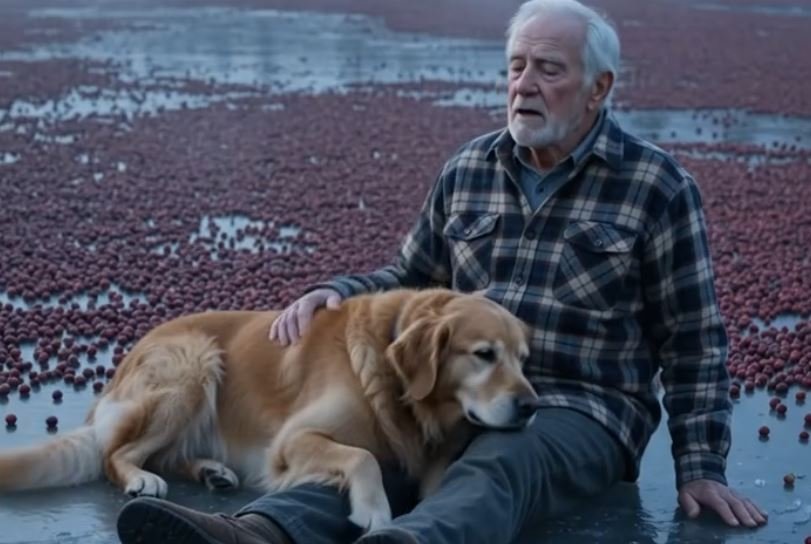
Elias, sitting. Maple, lying across his feet. Both covered in frost — not snow, but the particular crystallization of breath that freezes on fur and flannel when the air is cold enough. Both still. Both breathing — shallow, slow, but breathing.
Maple lifted her head.
Not quickly. The particular effort of a body that has spent hours shivering, that has burned through its reserves, that is running on the last dregs of will. She looked at Clara. Her tail — frozen, stiff — moved once.
I stayed, it said. I did not leave.
Clara called 911.
Then she sat on the ice. Not caring if it held her — it had held them, it would hold her. She wrapped her arms around both of them — her grandfather, who was cold but alive, and the dog, who was colder but conscious.
The paramedics came.
They wrapped Elias in thermal blankets. They carried him off the ice, across the bog, to the ambulance that couldn’t drive on the berm but could wait at the road. They treated him for hypothermia — stage 2, serious, survivable.
They almost missed Maple.
Not because they were careless. Because she was still. Because she had done her work and was now in the particular shutdown that follows extreme exertion. Because the story was the old man, the dementia patient, the miracle of survival.
Clara didn’t miss her.
She picked her up. 60 pounds — heavier than she looked, or maybe Clara was weaker than she thought, shaking with adrenaline and relief and the particular grief that follows almost-loss. She carried Maple to the house. Wrapped her in blankets. Fed her warm broth from a turkey baster, the particular medicine of a farm girl who knows how to treat animals.
Maple drank.
Not eagerly. Slowly. The particular recovery of a body that has pushed past its limits and is now learning that it can rest. She licked Clara’s hand. Once. Her tongue was cold.
The Border Collie arrived on Monday.
Clara sent it back.
Not rudely. Just… firmly. She called the breeder, explained, paid the cancellation fee. The particular expense of a decision that didn’t make financial sense but made every other kind of sense.
Maple was not a goose dog.
She would never chase birds. She would never protect the harvest. She would wag her tail at geese and sit in the water while they ate and cost Clara 30% of her crop for the rest of her working life.
But she was the bog dog.
The particular guardian of an old man who wandered. Who walked onto ice. Who forgot where he was but was never forgotten by the creature who chose to freeze with him rather than leave him alone.
Elias lived another two winters.
Not because of Maple — because of medicine, because of luck, because of the particular biology of a man who was tougher than his mind. But he never wandered onto the bog again.
Because Maple wouldn’t let him.
She learned. The particular intelligence of a dog who has survived one night on ice and will not risk another. When Elias walked toward the door at night, Maple blocked it. Not aggressively. She just lay across the threshold, 60 pounds of butterscotch fur, the particular immovability of a creature who has decided that this door is her responsibility.
When Elias tried to step over her, she stood. She herded him back to bed. She pressed against him until he lay down, confused but compliant, the particular gentleness of a dog who guides without force.
She became his nighttime nurse.
Not trained. Not certified. Just present. The particular presence that dementia responds to — not words, not logic, just the reliable, warm, breathing fact of a creature who is there, who will always be there, who has proven that she will not leave even when the ice groans and the temperature drops and the world becomes a place where memory fails and only loyalty remains.
Elias died in his sleep.
Not on the bog. In his bed. With Maple beside him, her head on his chest, listening to his heartbeat slow, then stop, then become the particular silence that follows a long life.
Maple didn’t leave the bed for two days.
Not because she didn’t understand. Because she did. Because the particular grief of dogs is not confusion but certainty — the knowledge that a person is gone and the particular refusal to accept the emptiness they leave behind.
Clara buried Elias in the family plot.
Near the bog. Near the pump house. Near the particular place where he had walked onto ice and a dog had followed him and proven that love is not about understanding but about staying.
Maple was there.
Not at the funeral — dogs weren’t invited. But at the grave, afterward, when the people left and the flowers were placed and the particular silence of a cemetery settled over the Whitaker family. Maple sat by the fresh earth. She lay down. She pressed her nose to the soil and smelled — what? Memory? Chemistry? The particular scent of a person she had kept alive through a winter night?
She stayed until Clara led her away.
Maple died at 12.
Not suddenly. The particular decline of a dog who had given too much on one frozen night and had spent the rest of her life paying the interest on that loan — arthritis, stiffness, the particular cold sensitivity that made her shiver in November, that made her seek heat, that made her remember even when no one asked her to.
Clara buried her beside Elias.
Not in the family plot — in the bog. Near the edge, where the ice formed first, where the geese landed, where the particular moment had happened that defined everything.
The marker was simple. Clara carved it herself, the particular craftsmanship of a farmer who knows how to work with her hands:
MAPLE — She Was Too Gentle for Geese. She Was Exactly Gentle Enough for Him.
Every winter, when the bog freezes and the geese fly south and the particular silence of a Cape Cod November settles over the Whitaker farm, Clara walks to the edge.
She places a blanket there.
Not for Maple — Maple is gone. For the particular memory of a night when a dog proved that gentleness is not weakness. That the dogs who fail at the jobs we give them sometimes succeed at the jobs we didn’t know needed doing. That the particular warmth of a creature who refuses to leave is sometimes the only medicine that matters.
And sometimes — when the ice groans and the stars are bright and the temperature drops to 7 degrees — Clara thinks she sees a shape on the bog.
Butterscotch fur. A tail that thumps once against frozen cranberries. The particular ghost of a dog who taught a family that love is not about being useful.
It is about being there.
Especially when the ice is thin. Especially when the night is long. Especially when the person you love doesn’t even know your name, but needs you anyway.