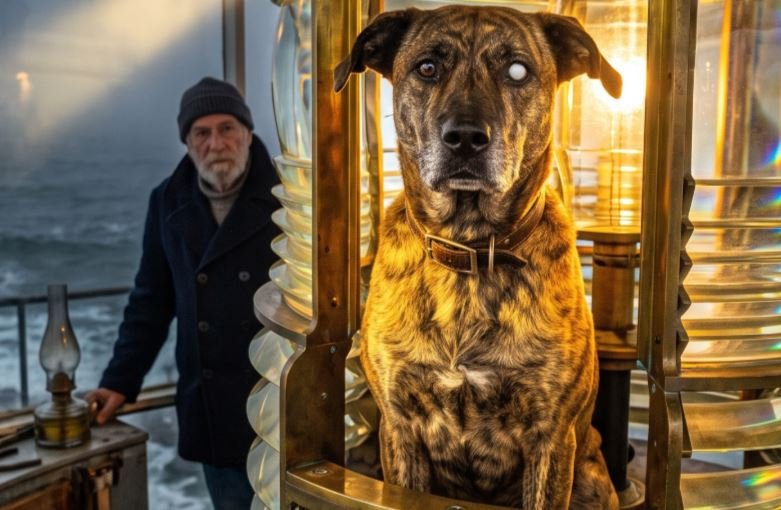
Wick didn’t behave like a normal dog.
He didn’t chase seagulls. He didn’t bark at seals. He didn’t do any of the things that dogs are supposed to do when they find themselves on a rocky Maine promontory with an old man and a failing light.
He climbed.
The spiral stairs — 147 of them, iron, painted white, rising from the keeper’s cottage to the lantern room. Thomas climbed them twice a day: dusk to light the lamp, dawn to extinguish it. It took him 8 minutes now, where it had once taken 3. His knees. His eyes. His particular fear of the step that wasn’t there.
Wick climbed with him.
Not beside him. Ahead of him. The particular posture of a dog who has decided that his job is navigation. He would stop at step 47 — where the iron was worn smooth and slippery — and wait. He would stop at step 89 — where a bolt protruded just enough to catch a boot — and block Thomas’s path with his body until Thomas felt the hazard with his hand.
Thomas didn’t train him for this.
He didn’t know how. He just… accepted it. The particular partnership of two broken creatures — one going blind, one already half-blind — learning to trust each other on a staircase that led to the only thing that mattered.
The lantern room was Wick’s favorite place.
Not because of the view. Because of the beam. The Fresnel lens — 1,008 hand-ground glass prisms — caught the light from a 1,000-watt bulb and threw it 20 miles across the black water. Every 15 seconds, the beam swept past. Every 15 seconds, the room filled with light so pure it felt like drowning.
Wick sat in the beam’s path.
Not randomly. In the exact spot where the light passed through the glass and projected a perfect circle on the floor. He sat in that circle, nose to the glass, and watched the water. When the beam swept past, his brindle coat turned gold. When it passed, he returned to shadow.
Thomas thought it was warmth.
The particular comfort of a cold dog finding the only heat in a stone tower. He didn’t realize — not yet — that Wick was reading the light. That the dog’s one good eye was tracking the reflection on the fog, the particular dance of brightness that told a story about visibility, about distance, about whether the light was reaching the ships that needed it.
On November 3rd, Wick saved the light.
Thomas had lit the lamp at 4:45 PM — early, because the days were shortening and the fog was thick. He descended to make tea. He was in the cottage kitchen when he heard it.
Not a bark. A howl.
Wick never howled. He was a silent dog, the particular quiet of a creature who had learned that noise attracts danger. But now — from the lantern room, 147 feet up — he howled. Long. Insistent. Musical in a way that made Thomas drop his kettle and climb.
It took him 12 minutes.
He found Wick at the top, standing in the beam’s path, staring at the Fresnel lens. Thomas looked — with his periphery, with his failing center, with the particular squint that was all he had left.
The light was out.
Not the bulb — the filament still glowed. But the clockwork that rotated the lens had jammed. The beam was frozen, pointing inland, illuminating a patch of spruce forest while the sea sat in darkness.
Thomas couldn’t see the mechanism.
Not clearly. Not with his eyes. But Wick was looking at it — nose to the glass, body rigid, the particular focus of a creature who had watched this light move 15,000 times and knew, instantly, when the pattern broke.
Thomas fixed it by touch.
The particular knowledge of 38 years — the feel of the gears, the catch of the escapement, the particular click that meant the clockwork was free. The lens began to turn. The beam swept back to sea. Wick stopped howling. He sat in the light’s path. His tail thumped once.
Thomas understood.
Not completely. But enough. The particular realization that the dog wasn’t warming himself. He was standing watch. He was the verification that Thomas could no longer provide — the living, breathing confirmation that the light was doing its job.
He called the Coast Guard.
Not to report the jam. To tell them about Wick. To explain — haltingly, aware of how crazy it sounded — that he had a dog who monitored the beam, who detected mechanical failures, who was more reliable than the photoelectric sensors they planned to install.
The commander was polite.
And dismissive. The particular condescension of bureaucracy toward sentiment — “Dogs don’t keep lights, Mr. Hale. Sensors do.”
The inspection was scheduled for November 28th.
Part 3: The Inspection
Commander Sarah Yates arrived with two technicians and a clipboard.
She was 40, efficient, the particular face of an organization that was trying to modernize on a budget. She had nothing against Thomas. She just had orders. The Fresnel lens was historic. It was also expensive to maintain. The LED retrofit would run on solar. The keeper’s cottage would become a museum. The stairs would be climbed by tourists, not men.
Thomas met her at the door.
With Wick. The dog sat beside him, brindle coat brushed, clouded eye visible, the particular dignity of a creature who knows he is being judged.
Yates was professional.
She inspected the lamp. The lens. The clockwork. She noted the repair Thomas had made on November 3rd. She checked the logbook — 38 years of entries, the particular handwriting of a man who still used fountain pens.
Then she climbed the stairs.
Thomas followed. Slowly. With Wick ahead of him, stopping at step 47, blocking the bolt at 89. Yates watched this. She didn’t comment. But she watched.
In the lantern room, she opened her case.
The LED array. Compact. Efficient. The particular technology that would replace 1,008 glass prisms and the 1,000-watt bulb that had burned for a century. She placed it on the floor beside the Fresnel lens.
Wick stood.
He walked to the LED. He sniffed it. He looked at Yates. Then he walked to the Fresnel lens, climbed onto the platform, and sat inside it — in the glass, among the prisms, in the particular heart of the light.
“Mr. Hale,” Yates said. “Your dog—”
“I know,” Thomas said. “He won’t move.”
They tried to coax him. Treats. Gentle pulling. The particular persuasion that humans use on animals who have decided to resist. Wick didn’t growl. He didn’t snap. He just… sat. In the lens. In the light. In the particular space that he had claimed as his own.
Yates called for backup.
Not police. A veterinarian. Animal control. The particular machinery of a system that removes obstacles. Thomas sat on the stairs, 147 steps up, and he waited. Wick waited with him, in the lens, watching the sea.
The vet arrived at dusk.
Dr. Elena Morales, 50, from Boothbay Harbor. She had read about the decommissioning in the paper. She had driven an hour because she wanted to see the lens before it was removed — her grandfather had been a keeper at Seguin Island.
She found Wick in the glass.
Not trapped. Seated. Calm. She didn’t reach for him. She sat on the platform beside the lens. She looked at the sea. She looked at the beam as it swept past — gold through glass, perfect, alive.
“Has he eaten?” she asked.
“Not since this morning,” Thomas said.
“Water?”
“There’s a bowl. He won’t touch it.”
Morales watched Wick. The particular watchfulness of a dog who is not afraid, not aggressive, just… committed. She looked at the LED array on the floor. She looked at the Fresnel lens, 150 years old, 12 feet tall, a masterpiece of glass and brass.
She looked at Thomas.
“Tell me what he does,” she said.
Thomas told her. About the stairs. About the beam. About November 3rd. About the howl that had saved the light. He told her with the particular desperation of a man who knows he sounds crazy but is trying anyway.
Morales listened.
Then she stood. She walked to the lantern room’s eastern window. She looked at the sea — fog rolling in, gray on gray, the particular invisibility that made lighthouses necessary.
She pulled out her phone.
She called her cousin. A lobsterman. Out on the water, three miles east. She asked him: Can you see the light?
He said: Barely. Fog’s thick. But I see it. Every 15 seconds. Wouldn’t want to be out here without it.
Morales looked at Wick.
The dog was looking at her. One amber eye, one clouded. The particular gaze of a creature who had been waiting for someone to understand.
“He’s not obstructing,” Morales said to Yates. “He’s working.”
“Working?” Yates said. “He’s a dog.”
“He’s a sentinel,” Morales said. “He’s verifying the beam’s reach. Mr. Hale can’t see it. The sensors won’t be installed until next month. Right now, that dog is the only reason that light is confirmed operational.”
Yates checked her clipboard.
She checked her orders. She checked the particular conflict between what she was told to do and what she was seeing — a brindle mutt in a Fresnel lens, a foggy sea, a lobsterman who could see the light because the glass still worked and the dog still watched.
She closed her clipboard.
“The LED stays in the case,” she said. “Until the sensors are online. The lens stays. The dog…” She looked at Wick. “The dog stays where he is.”
Thomas cried.
Not dramatically. Just tears on a 71-year-old face that had weathered 38 years of Atlantic storms. He didn’t thank Yates. He just nodded, the particular gratitude of a man who has been granted something he didn’t expect.
Wick wagged his tail.
Once. In the beam. In the glass. In the particular light that he had saved.
Part 4: The Light
The lighthouse was never automated.
Not because of Wick alone. Because of the video — filmed by Dr. Morales, posted to a local news site, shared to the particular corners of the internet where people still believe that old things matter. 90 million views. The algorithm — that mysterious, merciless god — found its offering. A dog in a Fresnel lens. A keeper going blind. A Coast Guard commander with a clipboard who had chosen mercy over orders.
The comments were a flood.
“The dog is the keeper now.”
“That Fresnel lens is 150 years old. You don’t replace art with LEDs.”
“I’m a lobsterman. That light saved my grandfather. Save it.”
“Wick for President.”
The Coast Guard reversed the decision.
Not publicly — they called it a “deferral of modernization pending heritage review.” But everyone knew. The Pemaquid Point Light would remain a staffed station. The Fresnel lens would remain glass. The stairs would be climbed by a keeper.
Thomas retired.
Not because he was forced. Because he was 72, and his knees were gone, and the particular truth of a lighthouse is that it outlives everyone who tends it. He moved to the keeper’s cottage — the Coast Guard allowed it, a lifetime lease, the particular compromise of bureaucracy bowing to public sentiment.
Wick remained.
Not as a pet. As the Assistant Keeper — a title that Yates invented, that appeared on no official document, but that was engraved on a brass plate and screwed to the lantern room door:
WICK — Assistant Keeper. He Verifies the Light.
He climbed the stairs every night.
Not with Thomas — Thomas couldn’t climb anymore. With the new keeper, a young woman from Portland who had watched the video and applied for the job because she wanted to work with a dog who understood light.
Wick taught her.
Not with commands. With presence. With the particular stops at step 47 and step 89. With the howl that meant the beam is wrong. With the tail thump that meant all is well.
He died at 15.
In the lantern room. In the beam’s path. On a March night when the fog was thick and the sea was calm and the particular light that had guided ships for 150 years swept past him one final time.
Thomas was there.
He had climbed the stairs — slowly, painfully, the particular effort of a 76-year-old man who would not let his dog die alone. He sat beside Wick. He placed his hand on the brindle coat. He felt the breathing slow. He felt the particular stillness that follows a long life.
Wick’s tail thumped once.
In the light. In the glass. In the particular circle of gold that he had claimed as his own.
Thomas buried him on the point.
Not in the keeper’s cemetery — that was for humans. In a spot where the beam passed overhead, where the grass was gold every 15 seconds, where the particular rhythm of the light was the only eulogy that mattered.
The marker was simple. Thomas carved it himself, with hands that shook, with eyes that could barely see the letters:
WICK — He Washed Up on the Rocks. He Climbed 147 Stairs. He Became the Light.
The Pemaquid Point Light still burns.
Every night. Every 15 seconds. The Fresnel lens still turns. The glass still throws gold across the Atlantic. And if you climb the stairs — all 147 of them — you will find, at the top, a worn spot on the platform where a brindle dog sat for 12 years, watching the beam.
The new keeper places a blanket there.
Not for warmth. For memory. The particular ritual of a place that understands that some keepers are not human, that some lights are verified by eyes that see differently, that some rescues go both ways.
Thomas visits every evening.
He sits on the rocks where he found Wick. He watches the light sweep past. And he knows — with the particular certainty of a man who has been saved by a dog — that somewhere in the beam, in the glass, in the particular magic of a lighthouse that refused to die, Wick is still climbing.
Still stopping at step 47.
Still blocking the bolt at 89.
Still watching the light.