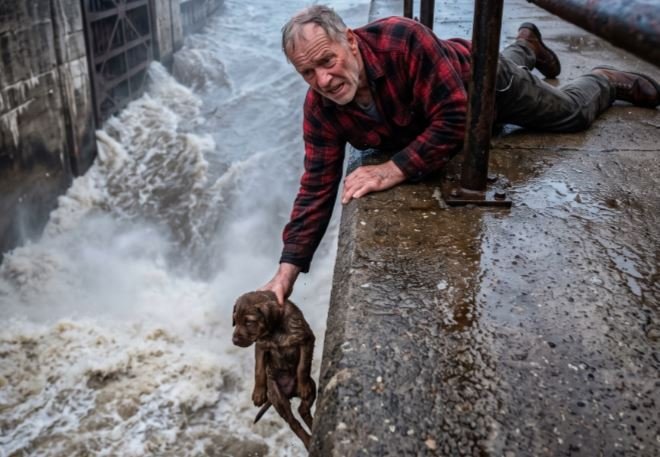
Spillway grew into 85 pounds of muscle and water-loving joy.
Not a house dog. A lockhouse dog. He learned the particular rhythms of the canal — the 6 AM gate checks, the afternoon water-level readings, the way Hank walked the walls with a clipboard even though the locks hadn’t opened for a ship in 20 years.
He swam.
Every day. In the basin, in the river, in the particular eddies where the current slowed and fish gathered. He would leap from the lock wall — the 20-foot drop that had almost killed him as a puppy — and hit the water like a seal, surfacing with his tail helicoptering, shaking spray across Hank’s boots.
Hank taught him the water.
Not commands. Respect. The particular knowledge of a lockmaster who understands that water is not an enemy or a friend — it is a force, indifferent, that must be read and honored. Spillway learned to read it. To feel the current through his paws before he jumped. To know, in the particular way that water dogs know, when the river was running too fast for play.
They were together for 15 years.
Not always happy. Hank’s knees failed. His eyes dimmed. The lockhouse roof leaked. The state threatened to demolish the decommissioned canal and sell the land to developers. The particular struggles of an old man and his dog, holding on to a place that the world had decided was finished.
But they held on.
Because the lockhouse was theirs. Because the water was theirs. Because the particular bond between a man who had pulled a puppy from death and a dog who had grown to love the thing that had almost killed him was not something that could be moved or sold or explained.
Part 3: The Return
Hank was 77 when he fell.
Not dramatically. Just… missed his footing. The north wall was slick with morning mist, the particular algae that grew on concrete in July, the film of water that made every step a negotiation. He was checking the upstream gate — a habit, a ritual, the particular purpose that kept him moving — when his left foot slid.
He went down hard.
His hip hit the concrete. His head missed the iron railing by an inch. He lay there, dazed, the particular confusion of an old man whose body has betrayed him, staring at the sky where gulls circled and the morning sun was too bright.
He didn’t see the danger.
But Spillway did.
The old dog — 15 now, gray-muzzled, stiff in the mornings — had been sleeping on the lockhouse porch. He felt the particular vibration of Hank’s fall through the concrete. Or he smelled the change — the particular chemistry of fear, of pain, of a body that is suddenly wrong.
He ran.
Not fast. Not the leap of a young dog. But the particular determination of a creature who has spent 15 years watching one human and knows, instantly, when that human is in the water’s domain.
Hank had rolled.
Not intentionally. Gravity. The particular slope of the lock wall, designed to carry water, not to hold men. He was sliding toward the edge. Toward the spillway. Toward the same brown water that had almost taken a puppy 15 years before.
Spillway reached him first.
Not by pulling him back — the dog was too old, too stiff, and Hank was too heavy. Spillway did something else. He lay down. Across Hank’s legs. His 85 pounds — once muscle, now bone and loyalty — pressing against the old man’s thighs, creating friction, creating drag, creating the particular anchor that stopped the slide.
Hank grabbed the railing.
His fingers — arthritic, numb, still strong from 40 years of turning lock gears — found the iron. He held. Spillway held. The water roared below, indifferent, waiting.
They stayed like that for 10 minutes.
Not moving. Just breathing. The old man and the old dog, locked together on the edge of the spillway, each holding the other in place. When Hank finally pulled himself up, inch by inch, Spillway didn’t move until the last possible moment, until Hank was safe on the flat concrete, away from the edge.
Then Spillway stood.
He walked to Hank. He pressed his nose to Hank’s cheek. He licked the salt there — tears, sweat, the particular taste of a man who has almost died and knows exactly who saved him.
Hugged him.
Not gracefully. Two old creatures on wet concrete, one crying, one wagging his tail — slow, stiff, but wagging. The particular reunion of beings who had saved each other, twice, in the same place, from the same water.
Part 4: The Circle
Hank sold the story.
Not for money. For the lockhouse. He contacted a local news station — the particular desperation of an old man who needs the world to know that a place matters. He told them about Spillway. About the spillway. About the circle of rescue that had started with a puppy in brown water and ended with an old man on the edge of the same drop.
The video — filmed by a lock inspector who happened to arrive that morning — showed only the aftermath.
Hank sitting on the concrete, Spillway in his lap, both wet, both alive. The particular image that the internet loves: not the danger, but the survival. Not the fall, but the hold.
It went viral.
Not because of the algorithm. Because of the caption Hank gave the reporter: “He was drowning when I found him. I was drowning when he found me. The water tried twice. We won twice.”
The state reversed the demolition order.
The lockhouse became a museum. Not of ships or canals or the particular history of the Great Lakes. Of rescue. Of the circle. Of the old man and the dog who had held each other on the edge of the water and refused to let go.
Spillway died at 16.
In his sleep. On the lockhouse porch. In the morning sun that he had sat in every day for 15 years. Hank buried him beside the spillway — not in the water, but above it, where the sound of the fall was constant and the mist rose every morning like breath.
Hank is 82 now.
He still walks the walls. Still checks the gates. Still sits on the porch in the afternoon with a cup of coffee and a hand that reaches, instinctively, for a dog who is no longer there.
But sometimes — when the morning mist is thick and the water is high and the particular roar of the spillway fills the air — he feels a weight against his leg.
Not real. Memory. The particular presence of a dog who taught him that rescue is not a single act. It is a circle. It is a promise. It is the particular commitment of two creatures who have looked into the same water and decided, together, that the current would not win.
He saved the puppy.
The puppy saved him.
And the water — indifferent, eternal, always waiting — keeps falling, keeps roaring, keeps reminding anyone who listens that some bonds are stronger than gravity.