Jake Morales rode a BMW R 1250 GS. Not for fun. He was a recovery specialist for an insurance company in Michigan’s Upper Peninsula, the particular man they sent when vehicles went off the road in winter and needed to be pulled from ditches, ravines, frozen lakes. He knew ice. He knew when to trust it and when to run.
He didn’t trust the ice on Fire Road 47.
Not at 2 AM in February. Not when the temperature had swung from 10 below to 15 above that week, creating the particular honeycombed ice that looks solid and isn’t. He was riding slow, studded tires crunching, when his headlight caught the movement.
A dog. Black German Shepherd. Not fullbred — some mix in the shoulders, some Lab maybe. Emaciated. Every rib visible beneath a coat that had once been thick and was now matted with ice and blood. He was running in circles. Not random — spirals. Around a specific spot in the center of a bay that locals called Blackwater because it was 40 feet deep and never froze evenly.
Jake stopped. He didn’t approach immediately. He assessed. The dog had been running long enough to wear his paws raw, to leave pink stains on the snow. Long enough to exhaust himself but not stop. The particular behavior of an animal caught in a loop — grief, panic, or something worse.
He cut the engine. The silence of the U.P. at night was absolute. No wind. No trees creaking. Just the dog’s ragged breathing and the particular crackle of lake ice settling.
The dog saw him.
He didn’t bark. He didn’t growl. He ran to Jake’s bike, grabbed the sleeve of his Carhartt jacket in his teeth, and pulled. Hard. The particular strength of a 70-pound animal who has decided that this human is not a threat but a tool.
“Easy,” Jake said.
The dog released. He ran back to the spot. He looked at Jake. He ran back. The particular herding behavior that Shepherds carry in their blood, modified by desperation into something frantic.
Jake followed.
Forty yards from shore. The dog stopped at a dark patch on the ice. Not snow-covered like the rest. Clear. Black. Six inches thick instead of the twelve that the rest of the bay had built up. The dog started digging. His claws — already bloody — scraped uselessly against the surface. He wasn’t trying to get to water. He was trying to get through.
Jake knelt.
He put his gloved hand on the ice. He felt the vibration. Not natural. Not current. Something mechanical. Something that hummed against the ice from below.
He pulled out his phone. No signal. The particular dead zone that followed Fire Road 47 for ten miles.
He grabbed his tire iron from the bike’s pannier. He looked at the dog. The dog looked back. Eyes yellow in the headlight, reflecting not fear but demand.
Jake struck the ice.
It cracked. Not all the way through, but spiderwebbed. He struck again. The particular sound of winter giving way — sharp, wrong, final. On the third strike, the black ice collapsed.
The water smelled of fuel.
Jake shone his flashlight into the hole. The beam cut through black water, through suspended ice crystals, through the particular darkness of a lake that had never given up its dead easily.
He saw the roof of a car. A Subaru Outback. Dark green. Covered in silt but intact. Upside down. Ten feet down.
The dog didn’t hesitate.
He dove. Straight into the hole. Into the black water. Into the particular suicide of a creature who had spent days trying to reach something and was not going to stop because a human had finally opened the door.
Jake followed.
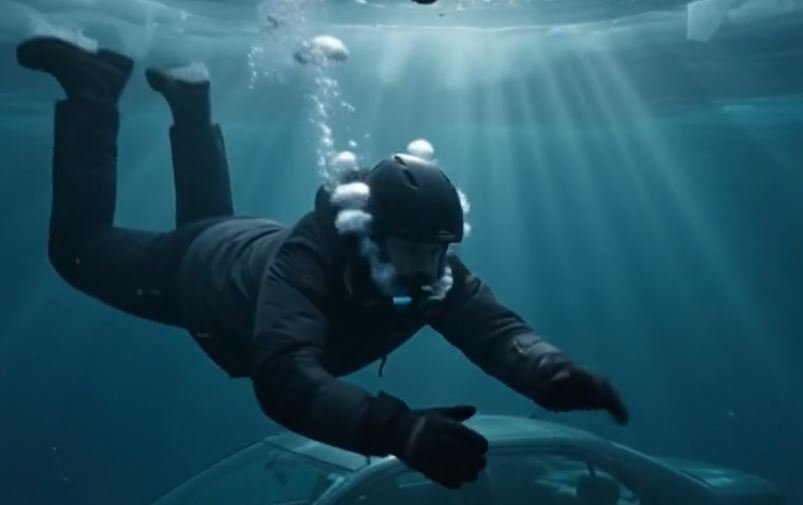
He didn’t think. The particular instinct of a man who has spent his life pulling people from wrecks. He had a respirator in his pannier — never used, carried for emergencies, the particular hope that you carry and never expect to need. He grabbed it. It wasn’t scuba gear. It was a rescue breather, ten minutes of air. He dove.
The cold was a fist.
Lake Superior in February doesn’t just chill. It kills. Jake’s face went numb instantly. His hands — gloved, waterproof — lost feeling in seconds. He kicked downward, following the dog’s shadow, following the particular trail of bubbles that rose from the animal’s lungs.
The Subaru was suspended on a shelf. The ice had formed around it, trapping it, preserving it like a fly in amber. The driver’s side window was intact. Jake shone his light through.
He saw her.
A woman. Thirty, maybe. Blonde hair floating in the current like seaweed. She was strapped in, upside down, her arms hanging toward the roof. Her eyes were closed. Her skin was blue-white, the particular color of deep hypothermia. But her chest moved. Barely. A flutter. A reflex. The particular persistence of a body that has cooled so fast it hasn’t had time to die.
And then her eyes opened.
Not fully. A slit. Yellow in the beam of Jake’s light. She looked at him. She didn’t move — couldn’t move, strapped, frozen, suspended. But she saw him. The particular horror and miracle of a woman who had been underwater for three days, breathing the last air in a trapped pocket, her body temperature dropped to 78 degrees, her heart beating six times a minute.
She was alive.
Jake’s regulator slipped. He grabbed it, forced it back into his mouth. He had maybe four minutes of air left. He kicked to the surface, burst through the hole, gasped in the frozen air. The dog was already there, treading water, waiting. Not for rescue. For Jake to do what he had come to do.
Jake grabbed his tow strap from the bike. He looped it around his waist. He tied the other end to the bike’s frame — 800 pounds of German engineering that might hold against the weight of a submerged car. He dove again.
He went to the passenger window. He used the tire iron — useless against ice, but against glass, tempered and stressed by cold, it worked. He struck the corner. The window shattered inward. Water rushed in, equalizing pressure, filling the last air pocket. The woman’s body shifted, limp, freed from the suspension of buoyancy.
Jake cut her seatbelt with his rescue knife. He grabbed her coat — down, saturated, heavy. He pulled. She came free, drifting, a dead weight that wasn’t quite dead. He kicked upward, towing her, his lungs burning, his vision tunneling.
The dog met him halfway.
The Shepherd grabbed the woman’s collar in his teeth. He pulled. The particular strength of an animal who had been running on adrenaline for three days, who had lost 20 pounds, who should have been dead but was instead swimming downward to help carry his person to the surface.
They broke through together.
Jake dragged her onto the ice. He checked for pulse — there, thready, slow. He started CPR. Compression after compression, his frozen hands on her chest, pushing blood that had thickened like syrup through a heart that barely remembered how to beat.
The dog stood over them.
Not interfering. Present. His body blocking the wind, his warmth — what little he had — radiating downward. He watched Jake work with the particular patience of a creature who had done everything he could and was now waiting for the human to finish.
At compression thirty, she coughed.
Water. Not much. She had been breathing air, not water, her larynx had spasmed shut in the cold, the particular mammalian dive reflex that saves hypothermic victims. She coughed, and her chest hitched, and her heart — stimulated by Jake’s hands, by the sudden influx of cold oxygen — found a rhythm.
Jake wrapped her in his emergency blanket. He carried her to the bike. He laid her across the tank, her head on the handlebars, her legs dangling. He kick-started the BMW — the particular reliability of a boxer twin in cold — and rode.
Five miles to the fire road. Two more to where signal began. He called 911 at 2:47 AM. The dispatcher didn’t believe him. Not until he described the car, the location, the particular impossibility of a woman pulled from a lake in February with a pulse.
The ambulance met him at the County Road intersection. They loaded her. They worked on her. They warmed her — slowly, carefully, the particular protocol for severe hypothermia that requires patience, not haste. Her core temperature was 79 degrees. She had been underwater for 72 hours.
She lived.
Not without cost. Frostbite in her fingers. Toes lost. The particular tax that the body extracts for miracles. But she lived. Her name was Sarah Chen. She was a nurse at Marquette General. She had been driving home from a night shift on Tuesday when she hit black ice, rolled, and went through the ice at the thinnest point of Blackwater Bay.
Her dog was Shadow.
He had been in the back seat. The rear window had broken on impact. He had swum out. He had climbed onto the ice. He had run for help. But the road was empty. The houses were distant. The particular isolation of the U.P. in winter. So he had stayed. He had run in circles for three days, trying to dig through ice that was too thick, waiting for someone to come, refusing to leave his person even when his body was failing.
The vet said Shadow should have died.
Hypothermia. Exhaustion. Paws worn to bone. Starvation. The particular combination of traumas that kills dogs in hours, not days. But he hadn’t died. Because he had decided that Sarah was coming back, and he was going to be there when she did.
Jake visited Sarah in the hospital.
Not immediately. A month later, when she was conscious, when her fingers were bandaged, when the particular reality of survival had settled into the particular work of healing. He brought flowers. He brought a photo of Shadow — recovered, bandaged, alive.
She didn’t cry.
She looked at the photo. She looked at Jake. She said, “He wouldn’t leave me. When the car went under, I saw him swim out the back. I thought he was abandoning me. I was so angry.” She paused. Her voice was rough, damaged by intubation, by cold. “But he was just going to get help. He just… couldn’t find it. So he kept trying.”
Jake nodded.
“He found me,” he said.
“You’re not help,” Sarah said. “You’re just a guy on a bike.”
Jake smiled. The particular smile of a man who has been called worse. “I’m the guy he decided was good enough.”
Shadow lived.
Not easily. His paws never fully healed. He walked with a limp. He lost two toes to frostbite. But he lived. And when Sarah was discharged, when she moved into her sister’s house because her own was too full of stairs and memories, Shadow went with her.
Jake didn’t adopt him.
He didn’t need to. Shadow had a person. But Jake visited. Every month. He brought beef jerky. He sat on the porch while Sarah’s sister made coffee. He watched Shadow sleep in a patch of sun, paws twitching, dreaming of ice and darkness and the particular moment when he had decided not to leave.
The Subaru was pulled from Blackwater Bay in April.
When the ice melted. When the divers could work. It came up on a flatbed, green paint peeled by pressure, interior filled with silt and the particular smell of a lake that had held it for three months. Jake was there. He watched them winch it onto the road.
He found something in the back seat.
A leash. Black nylon. Chewed through. The particular evidence of a dog who had tried to free his person before he had freed himself. Jake kept it. He hung it from his rearview mirror. The particular talisman of a rescue that had changed everything.
He still rides Fire Road 47.
Not for work. Just to pass Blackwater Bay. To look at the ice. To remember that the particular darkness of a frozen lake can hold life as well as death. That the particular silence of the U.P. is not empty. That somewhere, in the particular loop of a dog running in circles, there is a love that refuses to stop even when the body does.
And sometimes — when the ice is black and the night is clear and the particular stars of a Michigan winter are bright enough to hurt — Jake stops his bike. He turns off the engine. He listens.
Not for engines. Not for wind. For the particular sound of paws on ice. For the particular shadow that moves at the edge of his headlight. For the particular reminder that the world is full of creatures who will run until their paws bleed for the ones they love.
He hasn’t seen Shadow on the ice again.
But he keeps the leash. And he keeps riding. And he keeps stopping. Because that’s what you do when a dog teaches you that rescue is not a job but a debt. That the particular creatures we save sometimes save us back. That the black ice holds secrets, and some of them are alive.