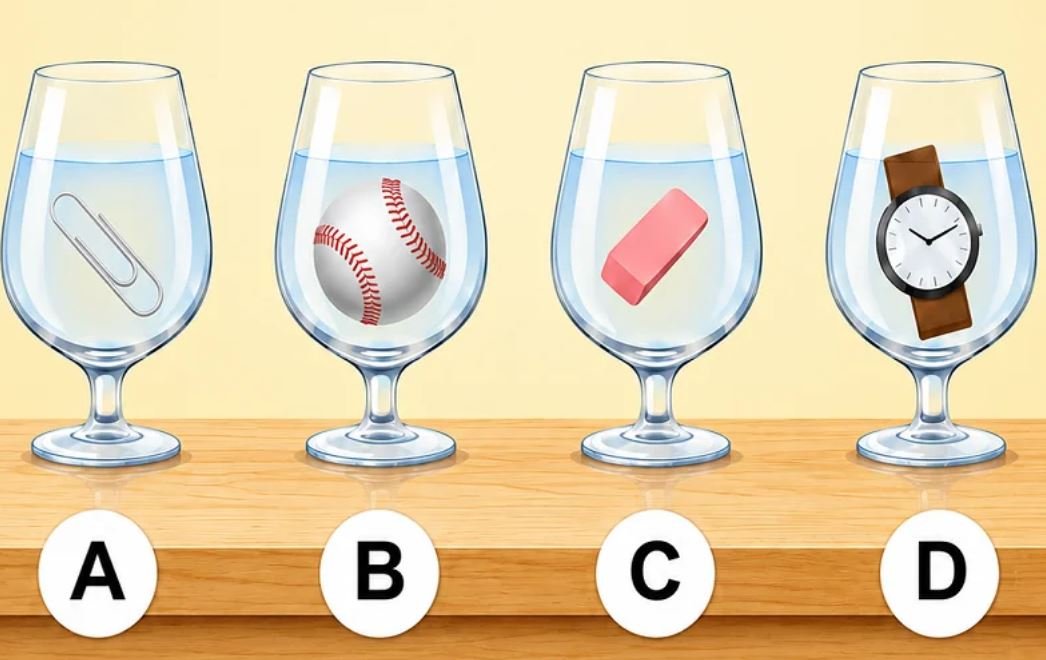
At first glance, this visual puzzle looks almost too easy. Four identical glasses — labeled A, B, C, and D — are each filled with water, and each contains a different object. Your mission? Figure out which glass actually holds the most water.
Sounds simple, right?
But here’s the twist: appearances can be deceiving. And the answer might just surprise you.
Understanding the Puzzle
Each glass appears to be filled to roughly the same level. However, the objects inside them are completely different:
Glass A contains a paperclip
Glass B contains a baseball
Glass C contains an eraser
Glass D contains a wristwatch
At first, most people choose based on looks alone. But the real key to solving this puzzle is understanding a basic scientific principle: displacement — the amount of space each object takes up inside the glass.
The Scientific Answer
The correct answer is Glass A.
Why? Because the paperclip is the smallest object and displaces the least amount of water. That leaves more room inside the glass for actual water compared to the others. Larger objects — especially the baseball in Glass B — take up far more space, meaning less water can actually fit inside, even if the water level looks the same.
So while all four glasses appear equally full, Glass A truly contains the most water. 💧
What Your Choice Might Say About You
Now comes the fun part. Although the puzzle has a logical solution, many people answer based on instinct, perception, or first impressions. So, what does your choice say about how you think?
If You Chose A (Paperclip)
You’re likely analytical and detail‑oriented. You look beyond appearances and focus on underlying facts and principles. Practical, observant, and logical — you prefer reasoning over assumptions. 🧠
If You Chose B (Baseball)
You probably rely more on intuition and visual judgment. You trust your first impressions and make decisions quickly and confidently. Decisive, energetic, and rarely one to overthink. ⚾
If You Chose C (Eraser)
You balance logic with creativity. You like considering different possibilities before reaching a conclusion and remain open to changing your perspective. Thoughtful, flexible, and balanced. 🧽
If You Chose D (Watch)
You may focus more on symbolism and deeper meaning than on pure logic. You tend to think emotionally or abstractly — valuing experiences, reflection, and the hidden significance behind things. ⌚
Why These Puzzles Fascinate Us
Visual riddles like this become popular because they’re quick, interactive, and surprisingly thought‑provoking. They encourage people to compare answers, challenge assumptions, and reflect on how they think.
More importantly, they remind us that perception isn’t always reality. What looks true at first glance may not actually be true at all. Sometimes, the smallest detail — like the size of a paperclip — completely changes the answer.
Final Thoughts
Whether you answered correctly or not, the real value of this puzzle lies in the way it makes you think. Did you rely on logic? Instinct? First impressions?
In everyday life, just like in this puzzle, the truth often lies beneath the surface. And often, the people who pause, observe carefully, and think a little deeper end up seeing what everyone else misses.
So… did you choose Glass A? 👇