Thomas Miller was a well-known hiker and outdoorsman in the small town of Blackwood, Oregon. On September 5, 2026, he set out for a solo three-day trek through the Devil’s Peak wilderness area. He was an experienced navigator, equipped with a GPS, a satellite phone, and a detailed map. But when he didn’t return by the scheduled date, a massive search and rescue operation was launched.
The search lasted for two weeks. Helicopters, drones, and hundreds of volunteers combed the dense forest, but not a single trace of Thomas was found. No gear, no footprints, no signal from his devices. It was as if he had simply vanished into thin air.
A month later, a local historian named Sarah was archiving a collection of old glass-plate negatives donated by the estate of a long-dead photographer. The photos were from the mid-1920s, showing the early logging camps and settlement of the Blackwood area.
As Sarah scanned a photo taken in July 1924, she saw something that made her heart stop.
The photo showed a group of rugged loggers standing in front of a massive cedar tree. But standing at the very edge of the group, looking directly at the camera, was a man who didn’t belong.
He was wearing a modern, high-tech hiking jacket with a distinctive logo on the chest. On his left wrist was a glowing digital smartwatch. But it was his face that was the most shocking. It was Thomas Miller.
Sarah zoomed in on the high-resolution scan. The man in the 1924 photo had the exact same facial features, the same beard, and the same small, anchor-shaped tattoo on his right forearm that Thomas was known for. He looked terrified, his eyes wide and hollow, as if he were screaming silently into the lens of a camera that hadn’t even been invented yet.
Sarah checked the physical negative. It was an authentic, century-old glass plate. There was no sign of tampering, no double exposure, no digital manipulation. The silver salts of the photograph had captured Thomas Miller’s image in 1924, a full hundred years before he was even born.
She contacted the search and rescue team, showing them the scan. They were speechless. One of the officers, who had been Thomas’s close friend, confirmed the tattoo and the watch. “That’s his watch,” he whispered. “I was with him when he bought it. It’s a 2025 model.”
The investigation took a darker turn when Sarah found a second photo in the same collection. This one was taken a week later, in a different part of the woods.
In this photo, Thomas was alone. He was sitting on a fallen log, his modern jacket torn and his skin pale. He was holding a piece of paper against his chest. Sarah enhanced the image until the text was legible.
It was a handwritten note, dated July 19, 1924.
“The Peak is a door. It doesn’t lead back. If you find this, tell them I’m still here. I’m always here.”
Behind him, standing in the shadows of the massive trees, was a tall, thin figure in a dark suit. The figure had no face—just a smooth, white surface where features should have been. It was the same figure that had appeared in other “Unsolved Files” across the country.
The search for Thomas Miller was officially called off, but the mystery only grew. Local residents began to report seeing a man in a bright orange hiking jacket wandering the woods at night, but whenever they got close, he would vanish into a cloud of sepia-toned mist.
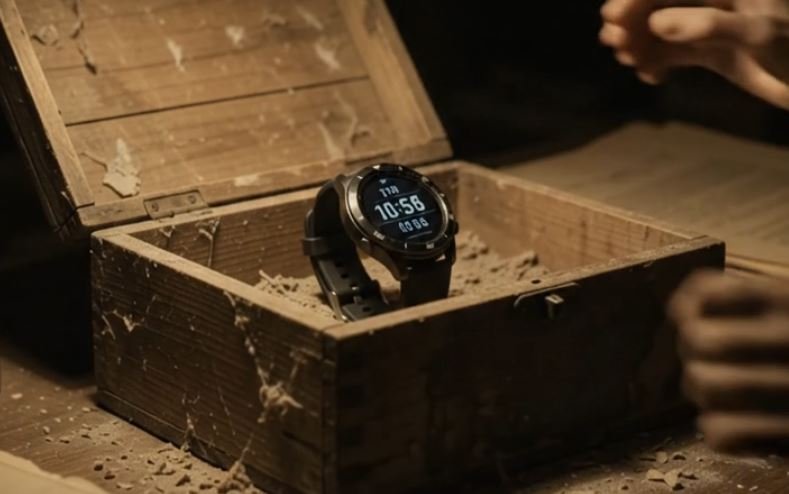
A year later, Sarah was visiting the local museum when she saw a new exhibit: a collection of artifacts found in a deep, hidden cave near Devil’s Peak. Among the rusted logging tools and old coins was a single, perfectly preserved digital smartwatch.
The battery was dead, but when the museum staff plugged it in, the screen flickered to life.
The date on the watch was July 19, 1924.
And the last recorded heart rate was a flatline.
If you ever go hiking near Devil’s Peak, keep an eye on the old trees. You might find a carving or a photo that hasn’t been taken yet.
Because in the woods, time isn’t a line. It’s a circle. And once you step inside, you might find yourself standing in a photograph from a century ago, waiting for someone to find the negative.