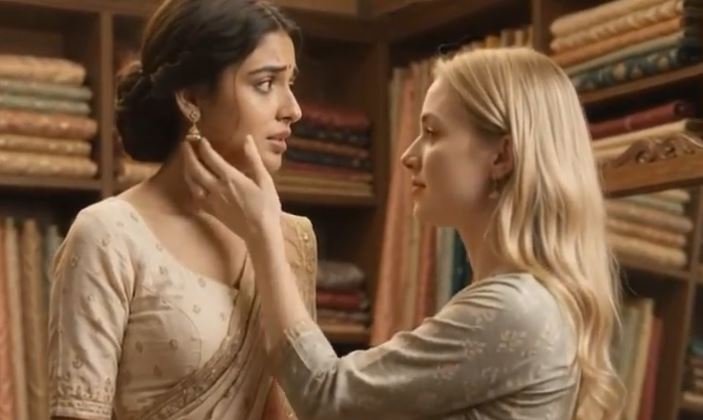
Ammi had found the shop. “Ustad Rukhsana’s granddaughter,” she’d announced, like a match she’d arranged herself. “Best fitting-wali in the city. Your engagement blouse deserves her.”
Ustad Rukhsana’s granddaughter turned out to be Ustad Rukhsana’s niece — Sloane — who took one look at me over the counter and said the only fully professional sentence she’d say all month: “Fitting room. Platform. Ten minutes.”
The shop was narrow and deep: front room of buttons and bangles, back room of mirrors and bolts, a curtain between them that swished like a heartbeat. Sloane’s aunt ran the counter; Sloane ran the needle.
“This blouse is for my engagement,” I told her on the platform, the third fitting, because the first two had produced blouses that fit perfectly and fittings that lasted ninety suspicious minutes. “To a man. Next month. His name is Danish, he’s an engineer, my ammi loves him, and your aunt is doing the fittings — or supposed to be.”
“She has arthritis,” Sloane said, which was new information, delivered while kneeling, tape in hand, not measuring anything.
“Then who did the first two blouses?”
Silence. The tape went around my waist and stayed there, slack, her fingers resting on the end of it like it was a skipping rope.
“If your aunt comes back,” I whispered — and the strange thing is I wasn’t scared, I was counting, counting how many visits were left before the wedding, how many more times the curtain would swish, how many more excuses I could invent for a blouse that had been finished weeks ago — “she’ll see her niece measuring me wrong on purpose. She’ll see the tape around nothing and your face too close to my waist and she’ll know why this fitting is taking an hour. She’ll know why I keep ‘forgetting’ things and coming back—”
She stood. Turned my face toward her with a hand on my jaw — the first time she’d touched me anywhere but the tape — and kissed me. Slow. Measured. A kiss that tasted like tailor’s chalk and raw silk and the trousseau in my mother’s closet that was never going to be worn.
The curtain swished.
Her aunt came through with a jar of buttons, looked at us — the tape on the floor, my dupatta on the platform, Sloane’s hand still on my jaw — and did not scream, did not gasp, did not do anything except cross the room, pick up the pencil, and write on the measurement card:
“Two inches at the heart. Let out.”
Then, to me, kindly: “Come back Thursday. Alone. This one” — a nod at Sloane — “takes after me. I opened my shop in 1974 with nothing but a machine and a secret. Sit. Both of you. I’ll make chai.”
I sat. We drank chai. Ustad Rukhsana told me about the woman she’d waited thirty years for, who’d died the spring before her shop opened, and how she’d stitched a hidden red thread into every wedding outfit she’d ever made, “because somebody should carry it forward.”
“Thursday,” she said when I left. “And beta — the engineer. Tell him gently. Men recover from kind women faster than from silent ones.”
I told Danish gently. He was sad for a week and then engaged to a colleague by spring, and sends me a card every Eid. My ammi took longest. Not about the broken engagement — about the shop. “You fell in love in a fitting room?” she kept saying, half scandalized, half delighted, the way mothers are when the scandal turns out to have good bones.
The wedding was two years later, in a garden, and my outfit was made in that shop. Ustad Rukhsana cut it herself. Sloane stitched it. Inside the hem, where no one would ever see it, they sewed a red thread.
At the ceremony, my mother-in-law — Sloane’s aunt — adjusted my dupatta one final time and whispered, “Two inches at the heart. I let it out myself.”
I still don’t know what that means, exactly. I’ve stopped asking. Some measurements aren’t taken in inches.