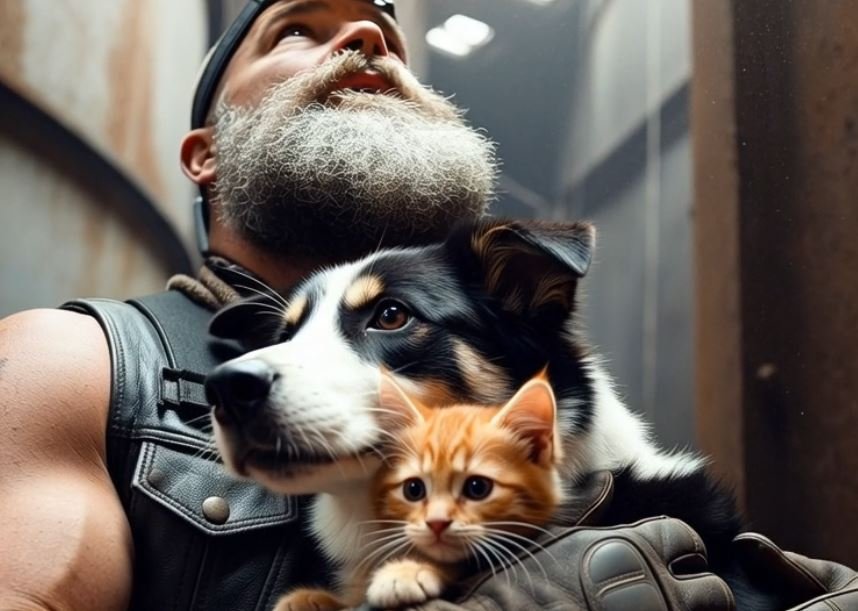
My name is Mason “Bear” Callahan, and I have been in dark places before. I have ridden through tunnels where the air was thin and the walls pressed close. But I have never lowered myself into a hole so deep that the daylight became a coin, then a star, then a memory, until the morning of November 3rd, when my own dog told me that something was living at the bottom of a grain silo in rural Kansas.
The Iron Mercy Riders were on a photography run. We had been riding through the farmland of central Kansas, looking for abandoned places, rusted machinery, the bones of America’s agricultural past. We found a grain elevator outside a town that had dried up and blown away. The silos were massive, cylindrical, sixty feet deep, their metal walls orange with rust, their tops open to the sky.
My dog, Diesel, was with me. She rides in my sidecar on every trip. She is a brindle pit mix, rescued from a railroad track, and she has a nose that finds things the rest of us miss. When we stopped near the elevator, she ran to a grate in the ground and she barked.
Not her usual bark. An urgent, insistent bark that made my skin prickle.
I walked over. The grate was rusted, covering a shaft that led straight down into one of the silos. I pulled out my phone and turned on the flashlight. I shone it down.
Sixty feet down, on a narrow ledge that ran around the wall, there was a shape.
A dog.
A black-and-white border collie mix, small, maybe thirty pounds. She was huddled on the ledge, her body pressed against the rusted metal. Her eyes caught the light and reflected it back, but not like a normal dog’s eyes. They reflected like silver moons, clouded and blind.
“She’s blind,” I said.
“How long?” Eddie asked.
I looked at the ledge. It was four inches wide. There was no water. No food. The bottom of the silo was twenty feet below the ledge, filled with old grain and dust.
“Days,” Darlene said. “Maybe longer.”
I had rope. A hundred feet. I had a harness. I had a headlamp. I did not have permission or time.
I tied the rope to a rusted auger, an iron machine that had been bolted to the concrete for a century. It weighed tons. It would hold. I clipped the harness to my chest and I sat on the edge of the grate.
“Bear,” Eddie said. “That ledge is four inches wide. If you slip—”
“I know,” I said.
I pushed off.
The descent was terrifying. The walls were sheer metal, rusted, flaking. The air grew colder and thicker as I went down. The light from above shrank to a coin, then a star, then a memory. My headlamp cut through the darkness, revealing the ledge, the rust, the dust of decades.
Then I saw her clearly.
She was blind. Her eyes were clouded, white with cataracts. She was thin, her ribs showing, her fur matted with dust. But she was alive. And she was not alone.
Under her chin, tucked against her chest, was a shape.
Small. Orange. Trembling.
A kitten.
She was protecting it. A blind dog, on a four-inch ledge, sixty feet down, in total darkness, was curled around a kitten no bigger than my hand. She had kept it warm. She had kept it safe. She had given it the only thing she had left.
“Hey, baby,” I whispered. “I’m here.”
She growled. Not a threat. A warning. She was a mother without children, protecting the only thing she had found in the dark. She didn’t know I was safe. All she knew was that the world had dropped her into a hole, and she had found something smaller than herself, and she had decided to survive for it.
I reached out my hand. She sniffed it. Her nose was dry, cracked. She licked my fingers. Once. Then she relaxed. She let me lift the kitten first. It was light, trembling, its eyes still closed. I tucked it into my vest. Then I slipped my arm under her chest and I lifted her.
She was lighter than she should have been. Maybe twenty pounds. She had been on that ledge for twelve days. Twelve days without food. Without water. Without light. Twelve days of keeping a kitten alive with nothing but body heat and will.
I held her against my chest and I shouted, “Pull!”
The rope went taut. I held her with one arm, the kitten safe in my vest, and I let them lift us. The ascent was harder than the descent. The walls pressed close. The metal scraped my back. But I held her, and she held onto me, her blind face pressed against my neck, her body trembling.
When we reached the top, Eddie grabbed my vest and dragged me onto the concrete. I fell onto my back, still holding her, the kitten mewing in my chest. The sunlight hit us like a physical blow. She flinched. She had not seen light in twelve days. She had never seen light at all.
I held her and I cried. I cried because she had been blind and abandoned and dropped into a hole in the earth, and she had still found the mercy to protect something smaller than herself.
I named her Mila. Because she was blind, but she had seen something worth saving.
The kitten I named Pip. Because he was small, but he was the sound that led us to them.
Mila and Pip came home with me. The veterinary clinic in Salina treated them both. Mila was dehydrated, malnourished, and had pressure sores from the ledge. Pip was underweight but otherwise healthy. They were inseparable. When the vet tried to separate them for examination, Mila cried, a high, desperate sound that made the whole clinic stop.
So we kept them together.
The first month was hard. Mila was afraid of the dark. Not because she could see it, but because she remembered the silo. She would not enter a room unless Pip was with her. She would not sleep unless she could feel him against her chest. She followed his sound, his movement, his breath.
Pip became her eyes. He would walk ahead of her, meowing softly, and she would follow his voice. He would lead her around furniture, around corners, to her food bowl, to her bed. He was a kitten, barely old enough to walk, and he had become the guide for a blind dog.
I watched them, and I learned something I had not known before. Family is not who you are born with. Family is who you decide to protect when the world drops you into a hole.
Some people see a blind dog and a kitten and they see a burden. They see animals that should be separated, that should be placed in different homes, that should learn to live without each other.
But Mila sees something else. She sees the warmth that kept her alive in the dark. She sees the voice that leads her around the furniture. She sees the kitten who sleeps on her chest every night, who purrs against her heart, who makes the world less dark.
And that’s enough.