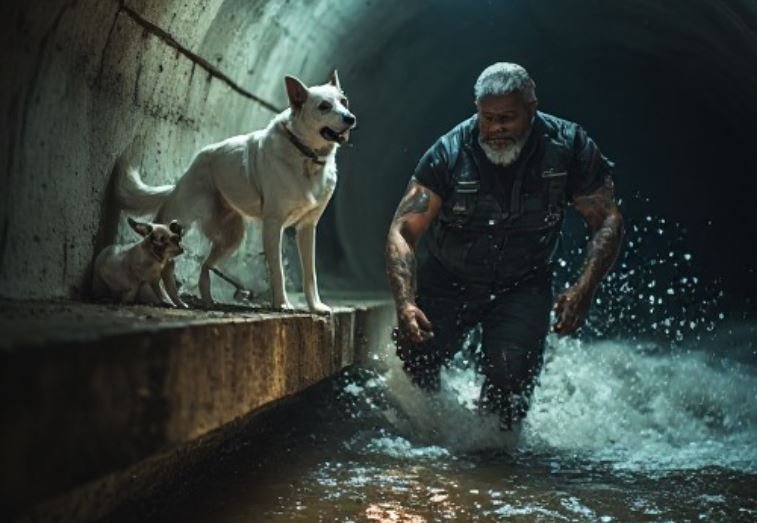
My name is Eddie “Preacher” Boone, and I have been wet before. I have ridden through storms that turned the road into a river and made the air taste like copper. But I have never crawled into a concrete pipe while water rose around my waist until the afternoon of August 12th, when a white shepherd mix who could not hear taught me that courage is not about knowing the danger. It is about standing anyway.
The Iron Mercy Riders were on a supply run through eastern Tennessee. A tropical storm had stalled over the Smoky Mountains, dropping rain in sheets that turned creeks into torrents and drainage ditches into death traps. We had delivered water, tarps, and medical supplies to a cutoff community near Gatlinburg, and we were navigating the back roads when the flash flood hit.
Luis saw it first. A drainage culvert, massive, maybe six feet in diameter, that ran under the road. The water was pouring into it in a brown, churning torrent. And inside, visible for a moment when the headlights caught the opening, was a white shape.
“Dog,” Luis said. His voice was sharp. “In the pipe.”
We stopped. The water was rising fast. The road was already covered. The culvert was a concrete tube, dark and smooth, designed to move water fast. Anything inside would be swept away.
I looked into the pipe. The water was waist-deep and rising. Three inches per minute, maybe more. The current was strong enough to knock a man off his feet. And thirty feet in, on a raised concrete shelf that ran along the bottom, was a dog.
A white shepherd mix. Maybe fifty pounds. She was standing on the shelf, her legs braced against the current, her body trembling. Her ears were pinned back. Her eyes were wide. But she was not looking at us. She was looking behind her.
“She’s guarding something,” I said.
“How do we get her?” Caleb asked.
“She can’t hear us,” Darlene said. “Look at her ears. She’s deaf.”
I looked. Darlene was right. The dog’s ears did not move when we shouted. She did not turn when the bikes approached. She was deaf, trapped in a concrete tube, with water rising around her, and she could not even hear the roar of the flood that was about to kill her.
I took off my vest. My leather would catch on the concrete. I took my phone and strapped it to my arm with the flashlight on. I handed my helmet to Bear.
“I’m going in,” I said.
“Preacher,” Eddie said. “That water is rising.”
“I know,” I said.
I dropped to my belly at the culvert entrance. The water hit my face, cold and brown and full of debris. I crawled into the pipe. The current slammed against my chest, my shoulders, my legs. The concrete was slick with algae. The darkness was absolute beyond my phone’s light.
I crawled. Ten feet. Twenty. The water rose from my waist to my chest. The current tried to push me backward. I dug my boots into the concrete, my hands finding cracks, my body fighting the water that wanted to take me.
Then I saw her. Thirty feet in. Standing on the shelf. Her body was soaked, trembling, her white fur darkened by the water. She turned her head. She saw my light. She saw me. But she did not move.
She looked behind her.
I crawled closer. The water was at my chest now. I was running out of time. I reached the shelf and I looked past her.
There was a dog.
A tiny dog. A Chihuahua mix, maybe four pounds, trembling against the wall, its body pressed into the concrete, its eyes closed. It was too small to stand against the current. It would have been swept away in seconds. So the shepherd had stood over it. She had blocked the water with her body. She had made herself a wall.
And she was deaf. She could not hear the water. She could not hear me. She could only feel the vibration, the pressure, the cold. But she had stayed.
“Hey, baby,” I whispered. “Hey, brave girl.”
I reached out my hand. She sniffed it. She looked at the Chihuahua. Then at me. She was deciding. In the middle of a flood, in the dark, with water rising, she was deciding if she could trust me.
She stepped aside.
I reached past her and I lifted the Chihuahua first. It was wet, cold, trembling. I tucked it into my shirt, against my skin. Then I reached for her. I slipped my arm under her chest and I lifted her. She was heavy, soaked, her muscles spent from bracing against the current.
I turned. The water was at my shoulders now. The current was stronger. I held both dogs against my chest and I crawled backward, out of the pipe, into the light, the water fighting me every inch.
When I reached the entrance, Bear and Luis grabbed my vest and dragged me onto the road. I fell onto the asphalt, both dogs on my chest, my body heaving, my clothes soaked. The water poured out of the pipe behind me, rising, filling, destroying.
The shepherd looked at me. Her eyes were brown. Exhausted. But alive. She licked my hand. Once.
I named her Hush. Because she could not hear the world. But she had listened to something deeper.
The Chihuahua I named Whisper. Because he was small, but he was the reason she had stayed.
Hush and Whisper came home with me. The veterinary clinic in Knoxville treated them both. Hush was exhausted, dehydrated, and had abrasions on her legs from the concrete. Whisper was hypothermic but unharmed. They were inseparable. When the vet tried to examine them separately, Hush became frantic, searching, her nose working the air until she found him.
She was deaf. She could not hear him. But she could smell him. She could feel his vibration. She could sense his presence in ways that did not need ears.
I learned to communicate with her. Hand signals. Touch. Vibrations on the floor. She learned to watch my hands, my face, my body. She learned that a thumbs-up meant good, and a flat palm meant stop, and a gentle touch on her shoulder meant I was here.
Whisper became her ears. He would bark at the door, and Hush would feel the vibration and run to join him. He would hear my motorcycle and run to the window, and Hush would follow, not because she heard the engine, but because she followed him.
Some people see a deaf dog and they see a disability. They see an animal that is broken, that is less, that needs to be fixed.
But Hush sees something else. She sees a world that is not defined by noise. She sees a Chihuahua who is her ears, her voice, her connection to a world she cannot hear. She sees a man who crawled into a flood to reach her, not because she could hear him calling, but because he could not leave her standing in the dark.
And that’s enough.