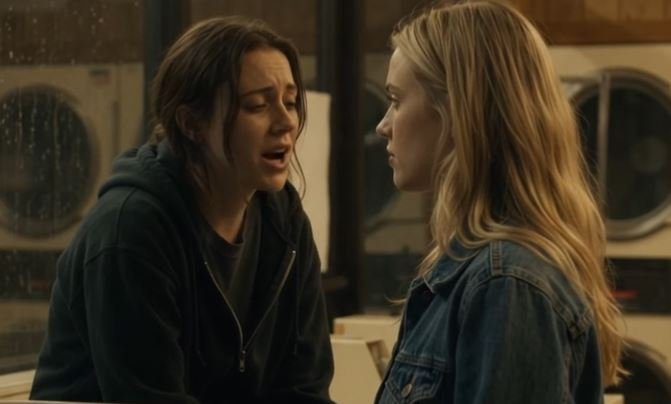
My thesis was on urban third places — laundromats, specifically, as the last honest public spaces. Which is why, when my building’s laundry flooded the week of my defense, I didn’t rage. I gathered my quarters like a pilgrim and crossed to the 24-hour place I’d been studying for a year for “research.”
I’d logged everything about that laundromat for my fieldwork: the attendant’s hours, the regulars, the machine that ate dollars. I had NOT logged the blonde who appeared in my field notes only as “denim jacket, irregular, 12-1 AM, reads labels.”
She was, in retrospect, logging me.
Sloane’s version, delivered over our third date at the same laundromat (she’d reserved the folding table; there was a candle; the attendant, a woman named Ruth who turned out to be Sloane’s aunt, had closed early for us and put up a sign: “PRIVATE FUNCTION”): she’d first seen me in September, studying my own laundry like it was data. She timed her visits to mine within a week. For three weeks she did nothing but read my basket’s contents from two machines away, building what she called “a personality profile from fabric.”
“You cannot build a personality profile from fabric.”
“I learned you wore the same five hoodies on rotation, you annotated your own grocery lists, and you talked to the machines when they broke. I was gone by week one. The sock was week three, and I needed an opener because you were DEFENDING YOUR THESIS that Friday and I was out of runway.”
The sock — child-sized, purchased in a six-pack at a pharmacy, selected for maximum confusion — worked exactly as engineered. The kiss happened because I laughed mid-accusation, and she said later that my laugh “voided the warranty on her restraint.”
The defense went well. I cited the laundromat in my acknowledgments — “and to the anonymous stranger who returned my sock,” which made my committee laugh, and made Sloane, sitting in the back row (she’d come; of course she’d come; she’d asked Ruth for the flyer date), cry once, discreetly, into her own sleeve.
We dated at midnight for months, both of us night-people by nature and schedule. Ruth pretended to be annoyed and closed early for us weekly. The regulars adopted us — the taxi driver who folded his uniforms like flags, the med student who studied in the corner — and when we finally got a place together, they threw us a party IN the laundromat, streamers on the dryers, Ruth’s nephew DJing from the attendant’s booth.
The sock is framed. Obviously. With a small brass plate: “THE OPENER.”
And the five remaining socks from the six-pack live in a labeled box in our closet that Sloane guards with her life. “For anniversaries,” she maintains. “Milestones. The birth of our first child, probably — tiny sock, enormous meaning.”
Our wedding favors were tiny socks, each pair embroidered with our initials. Ruth wore one as a corsage.
My thesis got published. The laundromat chapter is the one people cite. They always ask about the sock paragraph — yes, there’s a sock paragraph — and I always give them the same answer:
“Some infrastructure you study. Some infrastructure studies you back.”