Dr. Okafor was the kind of professor who wrote his lectures in fountain pen and graded in green ink because red “aggressed the page.” He’d taught the same Tuesday-Thursday seminar for nineteen years, and he missed nothing — a fact he proved definitively that Thursday.
The full story, which he told at our wedding reception (we invited him; he attended; he cried into the program and denied it): week two of the semester, he’d noticed the left-handed girl in the fourth row leaning subtly sideways during lectures. By October he’d identified the target: the brunette in the back row with the notebook full of margin scribbles. He found it “the most disciplined courtship I’d ever witnessed — no talking, no disruption, just incremental illustration.”
He’d planned to intervene at graduation if necessary. “I had a speech prepared. Something about margins. You two spared me by fourteen weeks.”
Sloane — this one was Sloane, yes, but she spelled it S-L-O-A-N-E and corrected people, which tells you everything — had been drawing in my margins since the first week because she’d “run out of nerve by the time the aisle existed.” She’d taken the fourth-row left-handed desk deliberately, chosen the seminar deliberately, everything deliberate except the first week, when she’d just been a left-handed girl who doodled and I’d just been the stranger whose notebook she could reach when I fell asleep. (I fell asleep in lectures. The margins of those weeks show tiny drawings of me sleeping, which I have mixed feelings about.)
By year two the drawings had a narrative: the cups meeting, the cups sharing a table, the cups in the rain ( she’d drawn rain; I still don’t know why rain). I never checked my margins. Two years. This remains a source of marital debate.
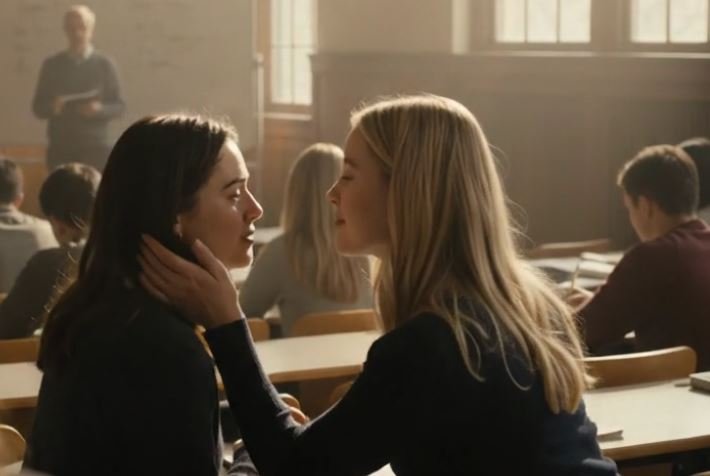
The kiss happened Thursday of week six, final semester. Dr. Okafor’s “congratulations, without turning around” was, he maintains, “the finest moment of my pedagogical career, and I once got a standing ovation from a review board.”
We dated through finals — actual dates, with talking, which revealed that Sloane-with-an-E was funnier in person than in pencil, though the pencil version had better timing. We compared notebooks: hers was a parallel archive. Every drawing from my margins existed in hers as a draft. She’d been A/B testing coffee cups for two years.
Dr. Okafor wrote us a letter the day we told him we were engaged — a real letter, fountain pen, green ink. It said: “You were my favorite thing I ever taught, and I taught you nothing. Margins, children. All the important things happen in the margins.”
We framed it. It hangs above the desk where we both work now, in the home office with two desks facing each other — a configuration Sloane describes as “the aisle, resolved.”
The original notebooks sit in a box under the desk. Occasionally we take them out and read the margins in order, both archives side by side, like scholars of our own two-year silence.
The last margin drawing — the one from the Thursday of the kiss — shows two coffee cups, one heart, and beneath it, in handwriting that took her three drafts to steady:
“FINALLY. NOW TALK TO ME.”