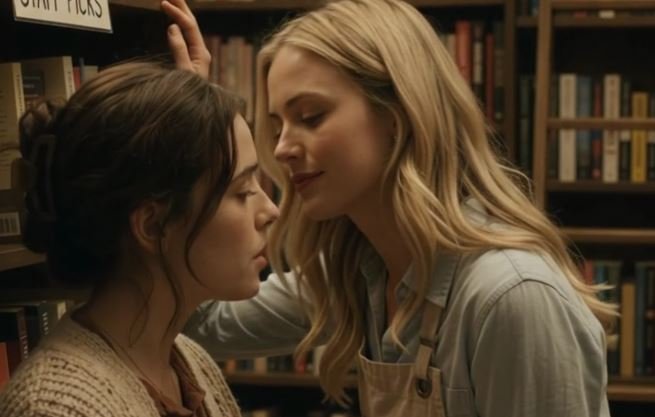
The bookseller was named Sloane — I’ve stopped being surprised — and her system was an act of literary patience I’d later describe, at our wedding, as “a phishing scheme designed by Jane Austen.”
Eight months earlier, frustrated by dating apps, she’d devised a filter disguised as an event: she bought a box of identical 1998 paperbacks at an estate sale, each containing the same planted artifact — a penciled phone number on page 112, “call me, the ending explains it” — and shelved them one at a time in her staff-picks slot with a handwritten tag she updated weekly. Her logic: anyone who noticed the marginalia, understood it, and bothered to mention it to the staff would pass three tests — observation, curiosity, and nerve — before a single word was exchanged.
Ten books. Ten months. Nine people never opened past the cover. The tenth opened it, laughed, put it back, and told her friend about “some weird old note” at a party — a story that reached Sloane through the grapevine and nearly ended the experiment.
“Number eleven,” she said, the night I finally called — from the bookstore’s own doorway, ten minutes after the kiss, because I am not a patient woman — “was supposed to be the last. The estate sale only had twelve copies. You’re statistically the end of an era.”
“There’s one more book?”
“One more. It’s not for sale.”
It wasn’t. It lived behind the counter, in her bag, everywhere she went. It was identical to the others except that its page 112 note, in her own handwriting, said: “Found you. — S.” She’d written it the week after copy number eleven hit the shelf, on a hunch she refused to explain, even to me, even now.
The 1998 phone number, for the record, belonged to a man named Walter in Duluth who answered on the second ring, listened to my confused explanation, and said: “That book was my wife’s. She wrote that number in every copy she ever gave away. She passed in 2003. I’ve gotten one of these calls every few years since. You’re the first one who sounded happy.”
We wrote to Walter. We still do, every anniversary. He sends a photo of his late wife’s garden each spring. The 1998 number still works. Sloane insists that if we ever have a daughter, her first phone number should contain the digits, “for continuity.”
We run the bookstore together now — Sloane bought it from the retiring owner with a loan and a business plan, and I handle events. The staff-picks shelf still operates on a system: one book, one tag, one handwritten provocation. The current one reads: “Used. Loved. Waiting. Ask about the ending.”
Customers ask constantly. Sloane says the same thing every time, and it never stops being true:
“The ending’s better in person.”
We married in the bookstore, twenty guests, aisles one through three, Walter’s photo of the garden taped inside every program. The eleventh book sat on a lectern during the ceremony, page 112 open, facing the guests.
And the twelfth book — the not-for-sale one — was the ring pillow. Neither ring had a box. They had a marginal note, written in 1998-style pencil:
“Call me. The ending explains everything.”
It did.