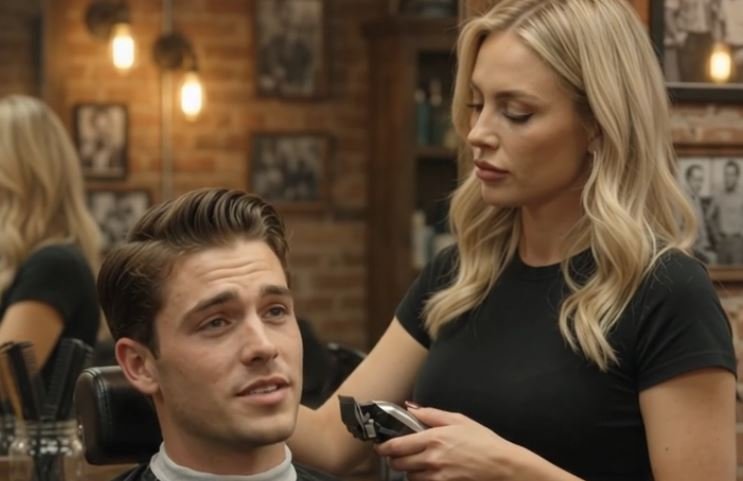
I found the shop by accident — my usual barber retired, my hair did not, and Sloane’s place sat between my apartment and my office like it had been zoned specifically for my schedule. SHEAR. One word on the window, brick interior, four chairs, one of them always empty when I needed it.
She ran the shop alone. I learned this across visits the way you learn anything from a barber: in fragments, delivered while facing forward, mediated by a mirror. Her grandmother owned the building. Her mother taught her to cut hair at the kitchen table. She’d trained in three cities and come home because “somebody had to be here, and I’d already seen the other places.”
Fifty-two minutes, every four weeks, for a year. She never asked about a girlfriend. I never offered. The mirror conducted the whole relationship — her eyes meeting mine in the glass while her hands worked, a conversation entirely in reflections, patient the way only people who work with their hands understand patience.
The haircut before the story happened, she’d said — to my reflection, mid-fade — “Same time in four weeks?” and I’d heard, clearly, the second sentence she didn’t say: I’ll be counting. I booked four weeks out like always. I counted too.
Then the day: the last appointment slot, the shop empty, the radio playing something slow, and the clippers going quiet at minute forty with my left side done and my right side an accusation.
“You’ve cut my hair for a year,” I said to her reflection. “And the clippers have been off for a full minute.”
She set them down. Leaned in behind me — closer than barbers lean, into the space where the mirror holds two faces and makes them one.
“If the next walk-in opens that door,” I breathed, “I’ll be half-cut, and you’ll be standing where no barber stands—”
She turned my face with a hand on my jaw and kissed me over the cape. Slow. Clipped. A year of mirror conversations ending in the only language they’d been building toward.
The door chimed. A guy my age, holding a takeout bag, mid-sentence: “You guys open? I just need a— oh. OH. I’ll come back.”
“Appointment only,” Sloane said, without breaking eye contact with me in the mirror, and he fled into the night like a man who’d walked into a chapel mid-vow.
She finished the cut in silence. Not awkward silence — consecrated silence. The right side took ten minutes. She spun the chair to face the mirror, held up the hand mirror behind me, waited.
“Well?” she said — the first word she’d said aloud to my actual face instead of my reflection, and it landed like a signature.
“It’s uneven,” I said. “My left side got more attention all year.”
She laughed — a real one, head back — and punched it into the register: double the usual price.
“First kiss tax,” she said. “Non-negotiable. Pay it every four weeks or find another barber.”
I paid it every four weeks. I’ve paid it for three years now. The price list on her wall still says HAIRCUT — $40, in chalk. Under it, in her handwriting, added that night in marker that she refuses to erase:
FIRST KISS TAX — DOUBLE.
New customers ask about it constantly. She tells them: “Long story.” They ask me — regulars learn I’m the story — and I tell them the truth: the man in the chair fell for the woman in the mirror, and the mirror, after a year of keeping us honest, finally looked away at the right moment.
We got married in the shop. Obviously. Four chairs pushed aside, twenty folding chairs in their place, Edison bulbs burning at close of business. My vows were about the mirror. Hers were about the clippers being off for a full minute.
Her grandmother — eighty-nine, sharp as the shears — walked me down the tiny aisle because, as she put it, “I knew before either of you. I watched the appointment book. He kept booking her last slot on purpose.”
I did. I absolutely did. Every four weeks for a year, I took the last appointment so the shop would be empty when the cape came off.
Some men plan grand gestures. I planned around a haircut schedule, and it was the smartest engineering of my life.
The cape hangs in our hallway. Clean. Retired. Under it, framed, is the receipt from that night — the doubled charge, itemized, dated, signed on the back in her handwriting:
“Worth it. — S.”