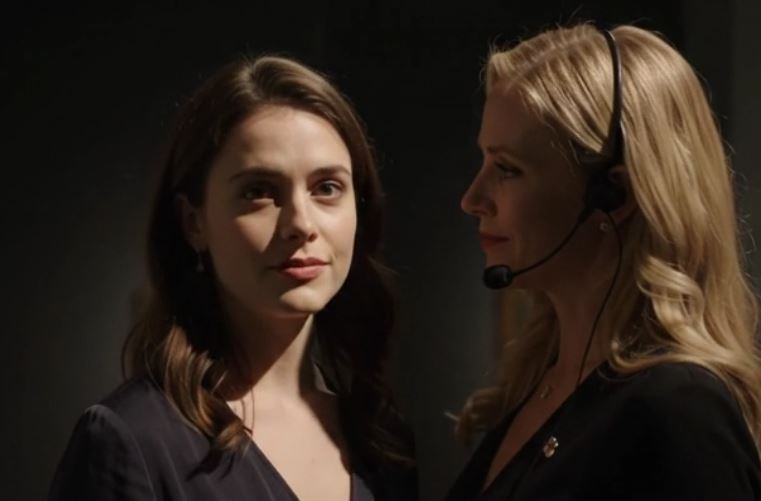
The supervisor was a woman named Odette, who had run museum security and, apparently, the museum’s unofficial romance infrastructure since 1989, when she’d met her own wife in the sculpture garden during a blackout. “Museums are full of people looking at things,” she told us, over the staff-only coffee she made us the morning after the gala, when Sloane and I arrived to confess before the incident report found us. “Occasionally two of them look at each other. My job is cameras. Cameras can be… conservation-minded.”
The painting — the one under the spotlight — turned out to have its own story, which Sloane had been saving for tour twelve. It was a portrait of two women, 1620s, officially catalogued as “sisters.” The museum’s own research, unpublished, suggested otherwise: the women’s joined hands, the ribbon shared between them, a lock of hair braided into the frame’s gilt. “The museum keeps it quiet,” Sloane said. “Four hundred years of pretending, professionally maintained. I give the official tour eleven times a night. I was saving the true version for someone worth the risk.”
Tour twelve happened that morning, in front of the painting, Odette holding her coffee and standing watch at the gallery door like a chaperone who’d switched sides. It was the best tour I’ve ever had. The women in the painting, per Sloane’s reconstruction, had commissioned the portrait themselves — an act of documentation, defiance, and devotion, paid for with their shared inheritance, painted by an artist they’d chosen together. “Nobody knows their names,” Sloane finished. “We lost the records. But they made sure we’d never lose the proof.”
We dated properly after that — museum events, naturally, then less museum things: her apartment with its art books stacked as furniture, my terrible cooking, the discovery that she narrated everything like a docent when nervous (“and here we see Elena attempting the freeway, a bold late work”).
Odette’s camera policy became a standing joke among the staff, who’d apparently maintained a pool. The docents had watched Sloane do eleven tours for one visitor and had, per the bartender at the staff holiday party, “taken positions.” Odette refused to disclose her own wager. Her wife, a retired archivist named Celia, disclosed it for her: “She had you kissing by tour eleven. She was off by one. She’s furious. It’s the first bet she’s lost since the sculpture garden.”
The engagement happened in front of the painting — Odette’s camera officially, publicly “conserved” for the occasion, the whole docent staff crammed into the adjacent gallery pretending to dust. Sloane proposed with a ring she’d had made to echo the painting’s ribbon detail, and her speech was one sentence:
“They made the proof. Four hundred years later, here’s mine.”
We married in the museum’s courtyard. The painting’s gallery was the reception room. Odette gave us the camera footage of the first kiss as a wedding gift — the “conservation” recording, timestamped, her handwriting on the drive: “Exhibit A.”
It plays at our anniversaries now. Eleven tours. One spotlight. Two women in a 1620s portrait watching four hundred years collapse into one gallery, one headset off since gallery three, one kiss that Odette — who never loses bets — still insists she called correctly.
“Tour eleven,” she maintains, every year, raising her glass.
“Tour twelve,” Sloane corrects, every year, kissing me again for the record.
The painting hangs in our home now — a high-quality print, the original being four hundred years old and museum property. It’s in the hallway. Guests always ask about the two women.
We tell them the truth. They commissioned it themselves. They chose the artist together. They knew exactly what they were doing.
So did we.