In this city, fire and EMS ride the same calls in pairs — engine first, ambulance second, two crews working the same ten square feet of chaos with a division of labor older than both our careers. For two years, Engine 12 and Medic 3 had been paired more often than randomness allowed, and I’d long suspected the dispatch supervisor of matchmaking, because no rotation is that coincidental.
He was Engine 12’s driver — the one who positions the rig like it’s a chess piece, who arrives at every scene and immediately finds me, not my partner, not the officer, me, to ask the only question he ever asked: “BP?”
“BP?” — two years of “BP?”
My partner, Glenna, fifteen years in, had a running commentary. “That man has asked you your patient’s blood pressure four hundred times,” she said, month eighteen, over post-shift eggs. “He has never once asked mine. You want to know what that means?”
“It means I report faster.”
“It means he’s a coward with excellent rig placement.”
She was right on both counts, which I discovered at 2 AM on a Tuesday, in the bay, under the red standby light that makes everyone look slightly haunted.
It started, as these things do, with equipment. He knew my glove size (small, powder-free). He knew my jump kit was left-pocket dominant. He knew I took my coffee black after night three of a shift cycle and abandoned it entirely by night five. None of this had ever been discussed. It had accumulated — the way sediment accumulates — two years of shared scenes: the highway rollover where he’d held my flashlight at the exact angle I needed without a word; the apartment fire where he’d walked out of a smoke-filled stairwell carrying a cat and handed it to me specifically, because, as I understood later, I’d mentioned once, months prior, to no one in particular, that I missed my childhood cat.
That night, the bay was asleep — station quiet, the truck polished to a mirror, his radio at regulation volume because radios live at full volume, that’s the rule, that’s the whole rule.
He turned it down one notch.
“We respond to the same calls,” I whispered, and my voice did something I’d have to blame on fatigue. “Two years. We’ve never once talked about anything but vitals. You hand me equipment without being asked. You know my glove size. And you just turned your radio down in a fire station.”
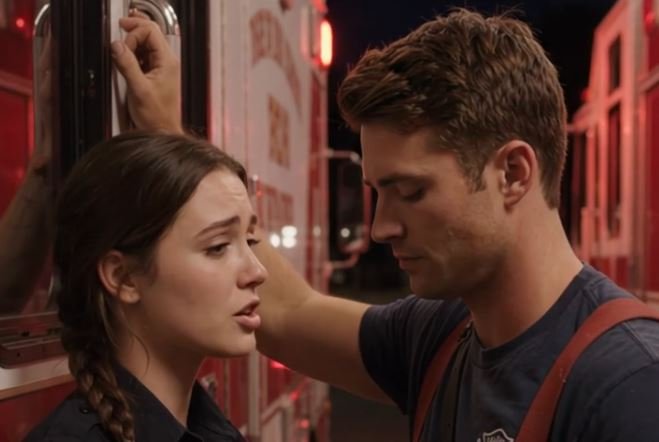
He leaned in. The standby light turned the bay red and gold, and somewhere in the station a bunk creaked, and the whole building seemed to lean toward us like a crew at a scene.
“If the tones drop,” I breathed, “we’re both out that door, and you’ll have to look professional while I’ve forgotten every protocol—”
He turned my face with a hand on his jaw-side hand, work-rough and steady, and kissed me. Slow. Staged. Two years of “BP?” resolving into something that required no vitals at all.
The tones dropped.
I have never moved faster in my life. Gear on, rig out, Engine 12 behind us, siren splitting the night — and five blocks in, at the first red light, Glenna looked over from the driver’s seat, looked at my pulse clip glowing on the dashboard, and delivered the verdict:
“One-sixty. Either the patient’s worse than I’m reading, or Engine 12 finally made a move.” She accelerated through the intersection. “Betting pool says I owe Diaz forty.”
“There was a BETTING POOL?”
“Honey. There’s a league. Hernandez runs it out of Station 8. Your man was the favorite at 3-to-1, but the odds on tonight specifically were long because you seemed, quote, ‘professionally oblivious.'”
The patient was fine — minor smoke inhalation, a cat involved, which seemed on-brand for our story. By dawn, every station on the channel had heard, because radios hear everything and firefighters gossip worse than the bridal industry. The captain called us in at shift change and delivered the speech: regulations, professionalism, the usual — and then, on our way out, added, off the record, “Took you two long enough. The dispatch rotation wasn’t random, by the way. File your paperwork and take the weekend.”
The rotation, it turned out, had been engineered by a dispatcher named Phyllis, who had watched two years of “BP?” from her console and decided, in her words at our wedding, “that some people need to be dispatched toward each other.”
Phyllis officiated. Obviously. She’d earned it.
We still ride the same calls. He still asks “BP?” — always me, never Glenna — and I still answer, and the crews still pretend this is normal. But there’s a notch in his radio’s volume dial, worn smooth from being turned down, and every anniversary at 2 AM, we stand in the empty bay under the standby light, and he turns it down one notch, and I say, “Do you understand what that means here?”
And he kisses me before the tones can drop.
They never do.
Phyllis sees to that.